
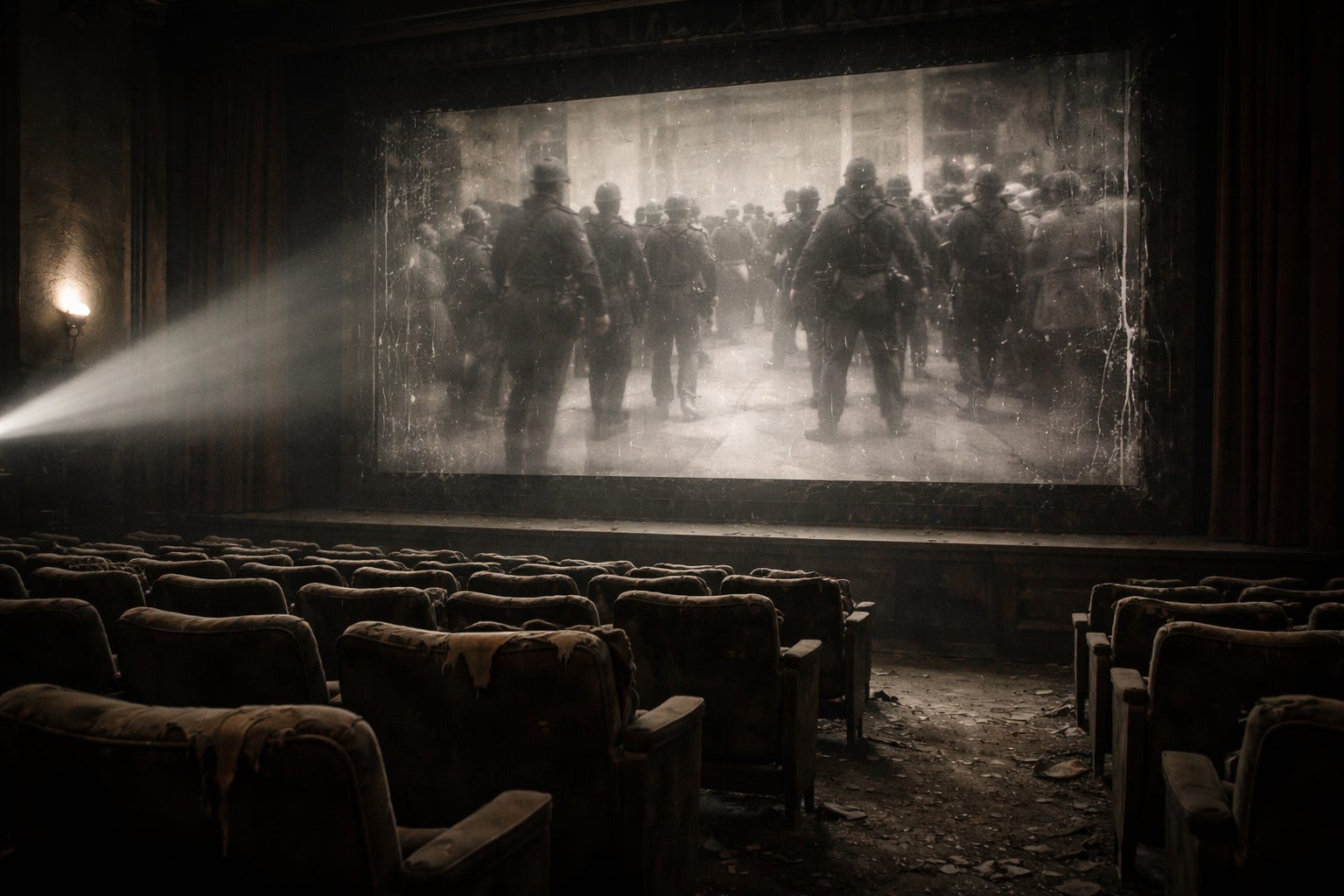
This Is an Old Movie — and We Know How It Ends
A reading of Van Jones, protest discipline, and the machinery of legitimacy

Author’s Note
This essay is a late response to a recent, Jan 17, 2026, Substack piece by Van Jones. I read his argument closely and found its framing consequential in ways that deserved scrutiny. While presented as a call for balance and empathy, the essay relies on forms of moral symmetry that obscure asymmetries of power, accountability, and risk—particularly in moments where state authority is being contested in real time. What follows is a critical and factual reading of that argument, informed by history and structure rather than reaction. I offer it in that spirit.
by Floyd Webb
There is a familiar comfort in stories that insist everyone is sincere. They reassure us that the crisis is not structural but emotional, not about power but misunderstanding. If we could just slow down, lower our voices, and see each other’s humanity, the country might find its way back to itself.
That is the movie Van Jones is offering.
It is carefully edited. Empathetic. Reasonable in tone. And deeply familiar to anyone who has lived through earlier moments when state power came under scrutiny and the public was urged to calm down for the sake of unity.
I’ve seen this movie before. Different actors. Same script.
What’s being framed as a clash of narratives is, in reality, a conflict between unchecked authority and public accountability.
The seduction of symmetry
Van Jones structures his argument around balance. Conservatives see law enforcement under attack. Progressives see authoritarian power expanding. Both fears are sincere. Both sides are trapped in algorithmic echo chambers. Both need to listen better.
Emotionally, this works. Analytically, it fails.
Fear exists on all sides. That has never been in dispute. The question has always been whose fear is backed by the power of the state.
One side fears disorder.
The other experiences detention, disappearance, injury, death.
These are not parallel conditions. They do not carry equal risk. They do not demand equal restraint.
This is the fallacy of false equivalence, dressed in the language of healing. Jones substitutes emotional symmetry for political analysis—and in doing so, advocates for the status quo.
By equalizing sincerity while flattening power, the essay relocates a crisis of legitimacy into a problem of tone. That move is not neutral. It quietly favors the side already holding authority.
Protest is not confusion — it is response
Van Jones urges conservatives to stop collapsing protest into terrorism. On this point, he is right. History is unambiguous: labeling dissent as criminal threat has always been the state’s most efficient shortcut.
But when the essay turns to progressives, the ask changes.
This is not a safety manual. It is a capitulation checklist.
Don’t block vehicles.
Don’t surround agents.
Keep your hands visible.
Comply with dispersal orders.
Move when told.
The premise is clear: safety is achieved through compliance. But compliance here requires accepting the legitimacy of the authority issuing the order. That legitimacy is precisely what is being contested.
Safety advice that requires accepting the legitimacy of the threat is not safety advice.
It is surrender dressed as wisdom.
Calls for “proper protest” have never been neutral. They have always functioned as a disciplining mechanism—narrowing the acceptable range of dissent while leaving the structure of power untouched. History does not merely suggest this. It documents it.
You cannot ask people to comply their way out of a legitimacy crisis.
Minneapolis is not an abstraction
On January 7, 2026, Renée Nicole Good was fatally shot by a federal immigration agent in South Minneapolis.
She was a U.S. citizen. A mother of three. She was in her vehicle in her own neighborhood during a large-scale federal enforcement operation. Multiple shots were fired. She died at the scene.
Federal authorities immediately described the shooting as self-defense. Local officials publicly disputed that account, citing video evidence they said contradicted the federal narrative. The investigation was taken over by federal authorities themselves.
Van Jones frames this as a case of disputed facts and social media confusion. But the primary source of the “uncertainty” is not the algorithm—it is the state.
Uncertainty here does not arise from competing TikToks or partisan feeds. It arises from institutional control of the narrative, from self-investigation, from delayed transparency, and from a long historical record in which accountability arrives late—if it arrives at all.
Waiting patiently for clarity while force continues to be exercised is not wisdom. It is acquiescence.
The missing variable: accountability
Van Jones is right about one thing: outrage spreads faster than nuance. Fear travels well. Certainty goes viral.
But this is not only a media problem. It is an institutional one.
When official statements are issued within hours of lethal force, when victims are labeled threats before evidence is independently reviewed, when federal agencies investigate themselves, the distortion is structural. No algorithm invented that.
The central question is not whether people feel fear on both sides. It is whether there are meaningful constraints on power when fear is invoked as justification.
And that question does not resolve itself through empathy.
The question then becomes: what institutions are we building, what laws are we demanding, that can actually perform this oversight?
We have heard this soundtrack before
The conservative fear Van Jones articulates—chaos, disorder, outside agitators—has been the standard rationale for repression since Reconstruction. It was invoked to crush labor organizing. It was used against civil rights workers. It justified surveillance, infiltration, and detention during the Cold War and after September 11.
The language barely changes. Only the uniforms do.
Bull Connor did not see himself as a villain. He believed he was maintaining order. That belief did not make his actions legitimate.
Order without accountability is not stability. It is coercion with better branding.
Birmingham was not about tone
Martin Luther King Jr.’s Letter from Birmingham Jail is often invoked as a generic appeal to patience or civility. That reading drains the text of its force.
King was responding to a coordinated call from white clergy urging restraint, patience, and trust in existing institutions. Their argument was not violent. It was polite. Moderate. Reasonable.
And King rejected it entirely.
“For years now I have heard the word ‘Wait!’… This ‘Wait’ has almost always meant ‘Never.’”
King was not celebrating disorder. He was naming a pattern: demands for calm in the face of injustice function as demands for compliance.
That is the sharper parallel to our moment. Calls for restraint are not neutral. They carry history. And that history is not kind.
Humanity is not justice
Van Jones closes with a plea to see each other’s humanity, to remember that people are better than their worst posts, that we are all we have.
That impulse is not wrong. But it is incomplete.
Humanity did not desegregate lunch counters.
Listening did not stop police dogs and fire hoses.
Civility did not dismantle COINTELPRO.
Those changes came from disruption, litigation, sustained pressure, and the refusal to accept calm as a moral achievement when the structure itself was unjust.
Empathy without accountability does not heal a democracy. It anesthetizes it.
This is an old movie — and the ending is known
We do not lose each other because we disagree. We lose each other when force replaces consent, when accountability lags behind power, and when calls for unity are used to postpone justice indefinitely.
If we are serious about changing the ending, rebuilding accountability cannot remain an abstraction.
That means stripping away qualified immunity.
It means independent prosecutors for police and federal agent killings.
It means rejecting the premise that the state can be the sole arbiter of its own excesses.
This is not a new crisis requiring a new story. It is an old one, running on a loop.
Anything less may feel calming.
History tells us it will not be enough.
The Ending
The old movie never ends with justice. It ends with quiet. The lights come up, the order remains, and we’re told the tension has passed because the noise has stopped. Power keeps its seat. Protest is taught better manners. Accountability is promised later. The reel is shelved, not destroyed—ready to be run again when memory fades and someone calls this time “different.”
Who am I?
I’m Floyd Webb, a Chicago-based filmmaker, curator, and writer working at the intersection of history, media, and political power. My work focuses on how narratives are constructed, disciplined, and remembered—especially where Black life, state authority, and cultural memory meet. I write as someone shaped by Chicago, by archival work, and by long cycles of watching the same arguments return with new costumes.
This Substack is a space for careful reading, historical grounding, and refusal of easy symmetry. I’m not interested in outrage for its own sake. I’m interested in clarity—about power, accountability, and the stories we keep being told to accept.
How to Support This Work
If these essays are useful to you, the best way to support them is simple:
Subscribe so the work can continue regularly
Share pieces that help sharpen public conversation
Comment thoughtfully—this is a reading community, not a comment section
And if you’re able, consider becoming a paid subscriber to support independent, research-driven writing that doesn’t answer to institutions or algorithms
This work takes time, care, and attention. Your support helps protect all three
Footnotes / Further Reading
Martin Luther King Jr., Letter from Birmingham Jail (1963).
U.S. Commission on Civil Rights, reports on federal law enforcement accountability.
Brennan Center for Justice, analyses on protest policing and qualified immunity.
ACLU, “Federal Law Enforcement and Accountability Gaps.”
DOJ Civil Rights Division reports on protest response and use of force.
Historical accounts of COINTELPRO and federal suppression of dissent.