
66%: Not From Warsaw
Polls, power, and the friendships that form between the categories

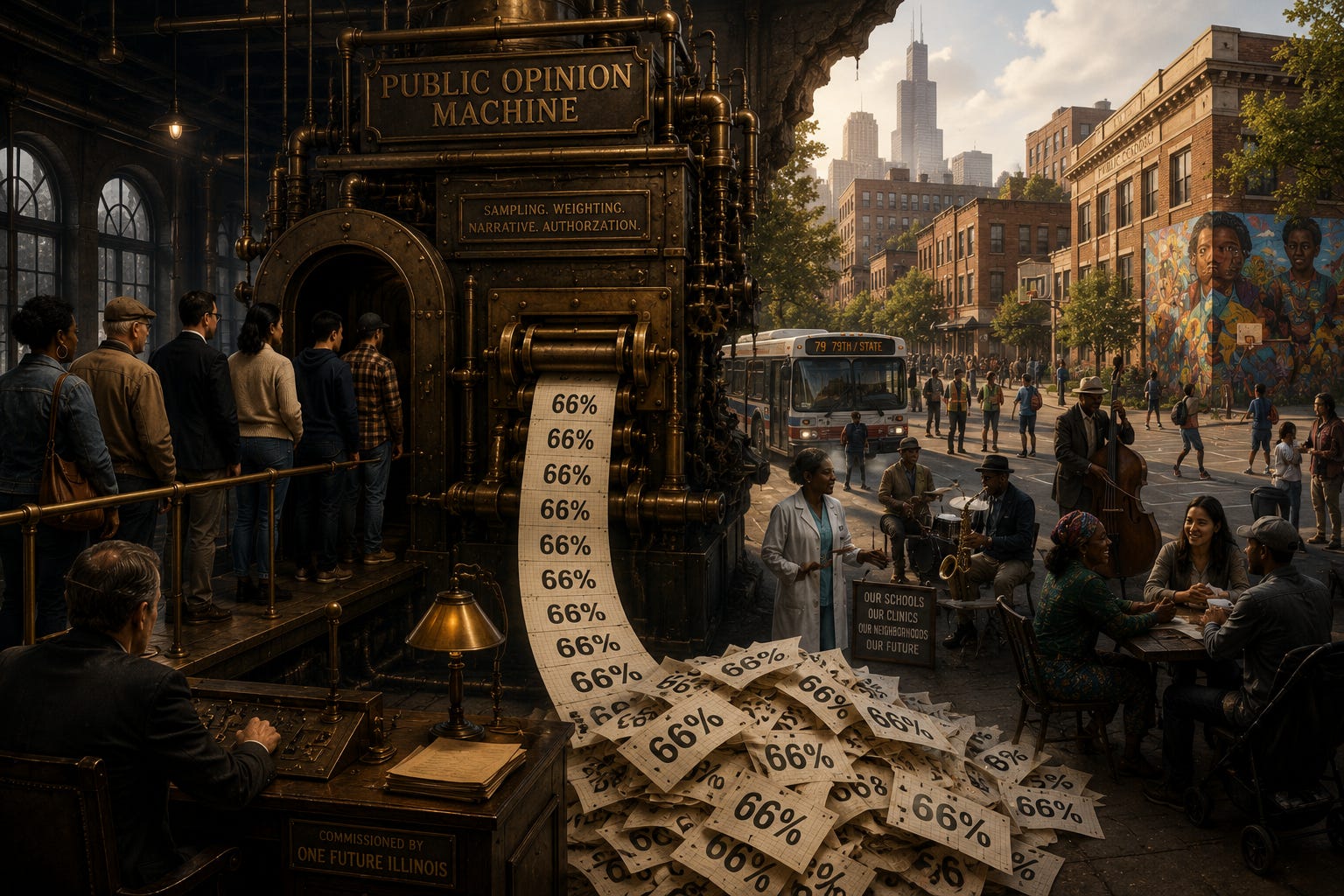
by Floyd Webb
“To be counted is not the same as to matter.”
I never believe a poll. Not from Chicago, not from anywhere. Let me tell you why.
On June 24, 2026, Crain’s Chicago Business — the publication of record for the city’s commercial elite, whose advertisers are its constituency and whose constituency is its advertisers — reported that 71% of Chicago voters are not inclined to re-elect Mayor Brandon Johnson. Buried in the same article was the number that traveled furthest: 66% disapproval. The poll had been commissioned by One Future Illinois, a political action committee and affiliated nonprofit built and staffed by veterans of the Rahm Emanuel administration, funded by anonymous donors whose identities are legally shielded by the organization’s 501(c)(4) structure. The byline belonged to Greg Hinz, Crain’s longtime political columnist, a journalist so embedded in Chicago’s civic and business networks that his coverage and his subject matter are sometimes difficult to distinguish. No demographic breakdown was published. No methodology was interrogated. The full crosstabs were promised later.
66%.
I recognized that number. A year earlier, the New York Times and Siena College had found that 66% of American voters described Donald Trump’s second term as chaotic. That poll came with full methodology, disclosed sponsorship, demographic crosstabs, and the institutional credibility of two organizations with no financial stake in the outcome. Same number. Completely different instrument. Completely different hand holding it.
I am not making an argument about numerical coincidence. I am making an argument about function. The number travels independently of the method because the number’s function is not description. It is authorization. 66% doesn’t tell you what Chicago thinks about Brandon Johnson. It tells the donor class that the institutional weight of the business community has made its decision, that the infrastructure is ready, that their money will not be wasted on a race the incumbent can survive. The poll doesn’t measure the political situation. It ratifies a conclusion that was reached before the first question was asked.
“The number travels independently of the method because the number’s function is not description. It is authorization.”
This is what I want to investigate. Not whether 66% is accurate or inaccurate. But what 66% does — and who it is speaking to — when the instrument producing it belongs to the people most invested in the outcome it describes.
There is a word at the center of this investigation.
Poll.
Not the measuring stake driven into the ground. That is a different word entirely — a false cousin that sounds like kinship but shares no blood. The poll I am investigating comes from the Germanic, surfaces in English in the 13th century, and means at its root one thing: a head. Before mass literacy, before secret ballots, before the elaborate apparatus of modern democratic performance, elections were decided by counting heads. The poll was the head. The polling was the counting. To go to the polls was, literally, to present your head to be tallied.
From there the word traveled, as words do, accumulating the sediment of history. By the 17th century poll meant votes. By the 19th century it meant the place where votes were cast. By 1902 it had arrived at its current meaning — a survey of public opinion, a sampling of heads, a numerical claim about what a population thinks or feels or wants.
And somewhere along that journey it gave us the poll tax.
Not a tax on measuring stakes. A tax on heads. Levied first as a flat fee on every person regardless of means, then weaponized during Jim Crow as the price of voting — a fee designed specifically to price Black Americans out of the act of being counted. The poll tax did not suppress Black votes by accident. It understood, with precise structural clarity, that counting is never neutral. That whoever controls the count controls the outcome. That the instrument of measurement is also an instrument of power.
“The modern political poll and the poll tax are the same instrument: a mechanism for deciding whose head will be counted and whose will be priced out of the count.”
The modern political poll and the poll tax are the same instrument: a mechanism for deciding whose head will be counted and whose will be priced out of the count. The centuries change. The mechanism doesn’t.
I grew up in Chicago in the early 1960s knowing this without knowing I knew it.
There were words in daily use. Polack. Mick. Wop. Spic. Dago. One for every ethnicity, attached to jokes that circulated in workplaces and casual conversation as social lubricant, as icebreakers before the real business of the day began. Some people didn’t register the words as cruel. They were very serious to me as a kid. I didn’t use them. I may have told a redneck joke or two — I won’t claim a purity I didn’t have — but I didn’t use those.
Because the kids those words were about were my friends. In the Chinatown elementary school where I came up, where we had a handful of white kids because the Italians had long since moved their children into Catholic school parochial infrastructure, where Polish whiteness was still being negotiated in ways that hadn’t yet built a wall between us, where the Irish had long since arrived into full political power through the Daley machine and the police department and left the rest of us to figure out the public school together.
What I understood even then, before I had language for it, was that the slur tracked the ladder. Each ethnic group’s word got retired from polite company roughly when that group had purchased enough economic and political acceptability to make its use costly. The Irish got there first in Chicago. The Italians got there through labor and the Church and other enforcement structures I will be careful about naming. The Polish were still mid-negotiation. The words aimed at Black people and Chinese people never retired the same way — because full arrival was structurally prevented, not merely delayed.
“This is not a story about race. It is a story about class expressing itself through race.”
This is not a story about race. It is a story about class expressing itself through race — about which communities get to accumulate economic and political capital, which get to convert that capital into institutional protection, and which get left in the public school when everyone with options has already chosen a different institution. The slur is the price tag. It marks what the market has decided you are worth until you can afford to buy your way out of the category.
But here is what that market cannot measure and what I knew from lived experience: our friendships existed outside those constructs. Not instead of them — the constructs were real, the words were weapons, the ladder was operating whether we acknowledged it or not. But human beings kept finding each other anyway, in the space between the official categories. The Polish kid and the Black kid riding the same bus. The Chinese kid in the Chinatown classroom who became a friend before either of us had been taught we weren’t supposed to. Friendships that the social map said shouldn’t happen, happening anyway — because we shared something more immediate than ethnicity. Similar appetites. The same bus. The same weather. The same public school that everyone with options had already left.
A poll cannot measure what happens in that space. It counts within the categories it has already decided matter. It cannot find what forms between them.
I say Polish people. Not Poles. The distinction matters to me the way African American matters — not as bureaucratic precision but as the refusal to flatten a nation, a history, a people into a shorthand that serves whoever is doing the labeling. Language is already a kind of measurement. How you name something determines what you can see in it and what you have decided in advance not to look for.
Which is why, when I eventually made it to Warsaw and Kraków — in the 1990s, living then out of London, moving through Europe on assignment with a camera and a notebook — I was not surprised by what I found. I was there for jazz.
Specifically the kind they were calling free jazz — music that treats imposed structure not as a given but as a choice, that insists the musician has the right to determine the terms of their own expression, that asks what freedom actually means once the obvious external constraint has been named and refused.
In Poland that question was not abstract. These were people who had lived under Soviet-imposed structure, who had named it and refused it through Solidarity and survived the consequences, and who were now doing the harder work of figuring out what freedom meant beyond the removal of that structure. Free jazz gave them a language for that inquiry that politics hadn’t yet supplied. And in those rooms — in Kraków, in Warsaw, more than once, in conversations that found me rather than ones I sought — the music kept opening into history.
They wanted to talk about Tadeusz Kościuszko. The Polish military commander who fought in the American Revolution and understood, from inside his own nation’s dismemberment by imperial powers, what subjugation meant structurally. Who left money for the education and liberation of enslaved people because he recognized that the logic imprisoning them and the logic partitioning his country were expressions of the same will to power. Who saw the connection between Polish sovereignty and Black freedom not as metaphor but as fact — the same class fact, operating through the same mechanism of imperial capital, requiring the same refusal.
I trust those rooms in a way I have never trusted a poll — not one from Chicago, not one from anywhere, not even one claiming to be from Warsaw. What those conversations gave me, what the friendships in the Chinatown classroom gave me long before that, was the understanding that the people the official count is designed to exclude tend to find each other anyway. Not through formal organization necessarily. Through recognition. Through the specific solidarity of people who share the same weather and ride the same buses and have learned, by necessity rather than theory, that the instrument measuring them was never designed in their interest.
In July 2024, a new organization announced itself to Chicago with the language of civic necessity. One Future Illinois, it called itself — a 501(c)(4) social welfare nonprofit with an affiliated political action committee, devoted to cutting across party lines to solve problems. The framing was generous and vague in the way that power prefers.
The people behind it were less vague.
Steve Koch, chairman — investment banker, former Deputy Mayor under Rahm Emanuel. Michael Ruemmler, president — Emanuel’s chief of staff for legislative affairs, manager of his 2011 and 2015 mayoral campaigns, and prior to One Future Illinois the operator of the business PAC that spent two million dollars intervening in City Council races to prevent the council from turning, in his own words, sharply to the left. Derek Douglas, lead director — president of both the Civic Committee and the Commercial Club of Chicago, the institutional home of the city’s corporate elite. Jesse Ruiz, board member — former deputy governor for education, former interim CEO of Chicago Public Schools.
This is not a civic organization. This is a machine in nonprofit clothing — the institutional residue of an administration that governed Chicago from 2011 to 2019 by closing fifty public schools predominantly in Black and Brown neighborhoods, engineering a fiscal architecture of TIF diversions and privatization deals, and suppressing the video of Laquan McDonald’s murder for thirteen months until a court order forced its release. Rahm Emanuel is not on One Future Illinois’s board. He doesn’t need to be. He left behind something more durable than a title — a network of operatives, donors, and relationships that reconstitutes itself under new organizational names whenever the moment requires it.
The moment it required it was Brandon Johnson’s election in 2023.
And here is where the convergence must be named, because the press will not name it.
One Future Illinois represents the neoliberal wing of the Democratic Party — corporate centrists, Emanuel operatives, Commercial Club board members, investment bankers who speak the language of civic concern while advancing the interests of capital. The Illinois Policy Institute, which commissioned its own polling assault on Johnson earlier in this cycle, represents the Koch-funded hard right of the Republican Party. Different parties. Different rhetorical registers. Different social positions on the issues the culture war keeps warm.
“The same class interest.”
The same class interest.
Both organizations exist to ensure that democratic majorities cannot subordinate capital to community. Both commission polls to manufacture the weather under which that project becomes inevitable. Both treat the question of who controls Chicago’s public schools, public budget, and public land not as a democratic question to be decided by the people who live there but as a resource allocation problem to be managed by the people who own things there. The partisan divide between them is real at the level of identity and culture. At the level of class — at the level of who the city’s fiscal architecture serves, who benefits from TIF diversions, who gets to determine what responsible governance means — they are functionally allied.
This is not a new alignment. It is a newly visible one. When a genuine progressive challenge materializes — when Harold Washington won in 1983, when Brandon Johnson won in 2023, when Zohran Mamdani won the Democratic primary in New York in 2025 — the alliance becomes visible because it has to act. The poll is one of its instruments. The nonprofit structure is another. The fragmented opposition field, encouraged by donor signals that the incumbent is vulnerable, is a third.
One Future Illinois commissioned Change Research in October 2025. Johnson’s approval came back at 31%. They commissioned Change Research again in June 2026. This time: 66% disapproval, 71% not inclined to re-elect. Crain’s Chicago Business ran it as news under Greg Hinz’s byline. The demographic breakdown was withheld. The methodology was promised later. The number traveled.
Even if you accept polling as a valid form of knowledge — which I don’t, but follow me — this particular poll fails by its own standards. The Suffolk University/Chicago Tribune survey conducted two months earlier used live telephone interviews across all fifty wards, published its full methodology, and released complete demographic crosstabs. It found Johnson at 34% favorable and 44% unfavorable. Still underwater. But with Black adults at 43% favorable and Latino residents at 39% favorable. In Chicago’s political arithmetic, in a multicandidate February election where the progressive vote consolidates rather than splits, those numbers do not describe a defeated mayor. They describe a mayor whose fate depends entirely on who shows up — and on whether the field gets shaped between now and February 2027 to fragment the coalition that could still deliver him a second term.
The 66% disapproval number is not a measurement of that reality. It is an attempt to foreclose it. To signal to potential donors and candidates that the business community’s decision has been made. To manufacture the weather under which challengers calculate that the race is already won and Johnson’s coalition calculates that the race is already lost.
“The machine never died. It filed for nonprofit status.”
The machine never died. It filed for nonprofit status.
Here is what that machine cannot count.
It cannot count the woman on the 79th Street bus who knows what the school closures did to her neighborhood and has not forgotten who ordered them. She is not a racial category. She is a class position — a person whose community’s assets were liquidated by a fiscal architecture designed to serve people who do not ride that bus and do not send their children to those schools. The poll that One Future Illinois commissioned did not find her, or if it found her it did not weight her the way an honest crosstab of Chicago’s actual electorate would require.
It cannot count the jazz musician on the South Side who understands that cultural infrastructure and political infrastructure are expressions of the same argument — that the question of who controls the music school and who controls the school board are not separate questions. That defunding one is the same act as defunding the other, performed by the same class interest wearing different institutional clothing.
It cannot count the network of people — Black, Latino, Polish, Chinese, whatever the demographic categories say this week — who find each other across every official boundary because they share the same appetite for a world more honest than the one currently on offer. Who didn’t need a commissioning organization to bring them together. Who formed in the space between the categories, the way friendships form in public schools when everyone with options has already left, the way conversations form in Kraków jazz rooms when the music opens into history and two people on opposite sides of the Atlantic discover they have been living inside versions of the same story.
In one of those rooms, a Polish free jazz musician told me that the point was not to play without structure. The point was to choose your structure rather than inherit it. To be conscious of what you were refusing and what you were building in its place. Freedom, he said, is not the absence of form. It is the insistence on determining your own.
These people are choosing their structure. They are determining their own form. And their form has content that no poll commissioned by the Commercial Club of Chicago will ever be designed to find: the reopened school, the funded clinic, the mental health center that didn’t get closed, the neighborhood that isn’t for sale, the public institution that still belongs to the public.
This is the class interest that One Future Illinois, the Illinois Policy Institute, and the entire apparatus of commissioned polling and anonymous donor infrastructure exist to prevent from being counted. Not because it is radical. Because it is a majority. Because in a city where the progressive vote consolidates rather than splits, in a February election with a multicandidate field, the people the official count excludes are also the people who decide.
That is what I trust. Not the instrument. The room.
Not the poll. The people in it who know why the music matters and what it costs when the school that taught it gets closed.
Not from Warsaw. Not from anywhere. From the space between the categories where the real count has always been kept.
Afterword: What the Count Missed
A poll measures sentiment. It does not measure governance. What follows is not an endorsement. It is what the instrument was designed to make invisible, made visible long enough to read.
While One Future Illinois commissioned Change Research to survey 801 likely voters about their feelings toward Brandon Johnson’s administration, the administration was governing. The distinction matters because the instrument was designed to erase it.
Johnson expanded One Summer Chicago to more than 31,000 hired youth — a 55% increase in summer employment opportunities designed to do what policing promises and never delivers: give young people something to lose. A poll that samples “likely voters” by definition undersamples young people, undersamples people without stable addresses, undersamples people whose relationship to electoral politics has been shaped by decades of disinvestment. The 31,000 aren’t invisible in the 66% number by accident. They’re invisible because the category “likely voter” was designed to exclude them before the first question was asked. The instrument doesn’t find them. It was not built to.
The administration pioneered a year-round city peacekeeping program and established a new Office of Gun Violence Reduction. This is not a press release. It is a theory of violence, enacted — the argument that violence is a public health problem with social determinants, and that those determinants require year-round institutional attention rather than seasonal suppression and permanent incarceration. The communities where this program operates are not well-represented in a sample of 801 likely voters recruited through geofenced digital advertisements. Their experience of what changed is not what the poll was commissioned to find.
Johnson advanced his “Treatment Not Trauma” commitment by reopening mental health clinics that previous administrations had closed and helping open comprehensive facilities like the Roseland Health Hub. The neighborhoods that received these resources were the same neighborhoods whose schools were shuttered under the administration whose institutional shadow now funds the polling apparatus calling Johnson’s governance a failure. That is not irony. That is the mechanism — close the clinic, manufacture the crisis, commission the poll, declare the successor incompetent.
And the administration pumped hundreds of millions of dollars directly back into Chicago Public Schools — into programs, mental health resources, and the buildings the last administration left to rot. The children in those buildings are not likely voters. Their parents, many of them, are not likely voters either — not because they don’t care but because the category was constructed around people who already have a reliable relationship to institutional power. The poll does not find them. It was not designed to.
None of this is in the 66% number. None of it was meant to be. The instrument asked likely voters how they feel. It did not ask the 31,000 young people who worked this summer whether employment changed their relationship to their city. It did not ask the residents of Roseland whether a health hub constitutes governance. It did not ask the teachers and students in Chicago Public Schools whether hundreds of millions of dollars in restored funding registers as leadership.
The instrument was not designed to find those answers. It was designed to produce a number. The number was designed to do a job.
To be counted is not the same as to matter.
Floyd Webb is a filmmaker, photographer, curator, and writer whose work explores the intersections of Black culture, cinema, music, technology, and social movements. Born in Mississippi and raised between the Mississippi Delta and Chicago, he has spent more than five decades documenting artists, activists, and communities across the African diaspora.
Further Reading
1. Taylor, Keeanga-Yamahtta. From #BlackLivesMatter to Black Liberation. Chicago: Haymarket Books, 2016.
The clearest contemporary argument that race in America is class expressed through a specific historical mechanism. Taylor provides the theoretical foundation for this essay’s central claim — that what looks like a racial story is always also a story about which communities get to accumulate capital, convert it into institutional protection, and buy their way off the ladder. Essential reading for anyone who wants to understand why “not a story about race” is not a retreat from the reality of racism but a deepening of it.
2. Ferguson, Thomas. Golden Rule: The Investment Theory of Party Politics. Chicago: University of Chicago Press, 1995.
The foundational text on donor-class control of electoral outcomes. Ferguson’s investment theory holds that political parties are best understood not as representatives of voter coalitions but as instruments of competing blocs of major investors. One Future Illinois — its 501(c)(4) donor shield, its PAC infrastructure, its commissioned polling as market signal to the business community — is a case study in Ferguson’s thesis published thirty years before the organization existed. Read this and the Crain’s headline becomes a financial instrument, not a news story.
3. Reed, Adolph, Jr. Stirrings in the Jug: Black Politics in the Post-Segregation Era. Minneapolis: University of Minnesota Press, 1999.
Reed has been making the class-over-race argument in Chicago’s specific political context for thirty years, often against considerable resistance from within Black intellectual and political circles. His analysis of the limits of Black electoral politics — what representation can and cannot deliver when the fiscal architecture of the city remains controlled by the same class interests regardless of who holds the mayor’s office — is essential counterpoint and context for any serious engagement with the Johnson administration’s situation.
4. Davis, Mike. City of Quartz: Excavating the Future in Los Angeles. London: Verso, 1990.
The model for what this essay attempts — using a specific American city as the laboratory for national arguments about class, power, and the manufactured consent of urban governance. Davis’s Los Angeles is Chicago’s mirror: a city whose progressive possibilities were systematically foreclosed by the same alliance of real estate capital, political operatives, and civic infrastructure that One Future Illinois represents in its Chicago iteration. The methodology is transferable. So is the conclusion.
5. Mayer, Jane. Dark Money: The Hidden History of the Billionaires Behind the Rise of the Radical Right. New York: Doubleday, 2016.
The definitive account of Koch network infrastructure — the funding architecture behind the Illinois Policy Institute and its national siblings. Mayer documents how a network of anonymously funded nonprofits, think tanks, and civic organizations was constructed over decades to shift the boundaries of permissible political debate rightward, independently of electoral outcomes. The Illinois Policy Institute’s 6.6% approval poll did not emerge from nowhere. It emerged from an apparatus that Mayer maps in granular detail.
6. Spence, Lester K. Knocking the Hustle: Against the Neoliberal Turn in Black Politics. Brooklyn: Punctum Books, 2015.
Spence directly addresses how neoliberal policy logic — the assumption that market mechanisms are the appropriate tool for allocating public resources — captured Black political institutions and Black political imagination in cities like Baltimore, Detroit, and Chicago. The school closure argument that runs through this essay finds its theoretical form in Spence’s analysis. When an administration closes fifty public schools in Black and Brown neighborhoods and calls it fiscal responsibility, it is operating inside a framework that Spence names and dismantles.
7. Kościuszko, Tadeusz. “Manumission of His Serfs and Last Will and Testament.” 1817. Reprinted in Kosciuszko in the American Revolution, edited by Miecislaus Haiman. New York: Polish Institute of Arts and Sciences in America, 1943.
The primary source. Not commentary on Kościuszko — the document itself. The reader who wants to understand what those Kraków conversations were actually about should read the man’s own words: a Polish military commander who fought for American independence leaving his American assets for the purchase and liberation of enslaved people, specifically naming Thomas Jefferson as executor. Jefferson never fulfilled the bequest. The document illuminates both the possibility of cross-imperial solidarity and the mechanism by which that solidarity gets betrayed by the class interests of the people entrusted to carry it forward. It is, in this sense, the oldest source on this list and the most current.