
“About Dem 40 acres”
If the Promises Had Been Kept: A Black History Month dispatch from Occupied Chicago.

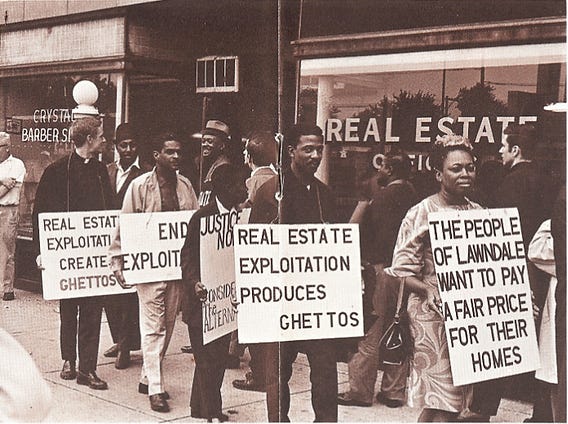
by Floyd Webb
Every February, we are invited to remember a dream.
A single speech. A single paragraph. A single moral appeal.
What we are never invited to remember is the invoice.
Black history is not only about aspiration. It is about asset transfer. It is about land granted and land denied. It is about checks written and checks returned.
If we are going to invoke Dr. King honestly this month, we have to remember not just the dream — but the demand.
Chicago Was the Workaround
I was born in Bronzeville, a child of the Great Migration.
My family later bought a home in Maywood — then a functioning factory town along the western industrial corridor of Cook County. Union wages were steady. The promise of stability was narrow but real.
Neither fact is incidental.
Chicago was not the dream.
Chicago was the workaround.
The Great Migration is too often framed as ambition. It was rerouting. When land was denied in the South — when emancipation’s economic promise was revoked — Black families moved north at the exact moment the federal government was distributing land and subsidized mortgages to white Americans at historic scale.
That contradiction is the beginning of the story.
The Asset America Refused to Transfer
In January 1865, General William Tecumseh Sherman issued Field Order No. 15, setting aside confiscated Confederate land in coastal Georgia and South Carolina for formerly enslaved families in 40-acre plots. Four months later, Andrew Johnson rescinded the order and returned the land to former slaveholders.
The failure was not bureaucratic. It was deliberate.
“Forty acres and a mule” was not metaphor. It was material.
Let’s treat it as what it was: a distribution of productive capital, identical in function to the Homestead Acts that gave 270 million acres to settlers between 1862 and 1914.
In 2026 dollars:
Forty acres of productive farmland: $240,000–$400,000
A mule — productive capital in 1865 terms: $30,000–$40,000
A reasonable midpoint: $300,000 per family at inception.
Allow that to compound modestly at 3–4% annually, pass intact across generations, and its value today would sit between $1–3 million per family, excluding mineral rights or development gains.
That is how American wealth was built. It was the 1865 equivalent of a Silicon Valley founder being handed their seed capital, their first patent, and a guaranteed seat at the table — all at once.
The racial wealth gap is not mysterious.
It is compound interest on land never transferred.
The Programs That Proved It
The federal government distributed roughly 270 million acres between 1862 and 1914.
In 1934, the FHA institutionalized redlining — federal policy that shaped housing access until 1968.
In the 1940s and 1950s, the GI Bill underwrote education and homeownership for millions.
The policy worked.
But it fractured geographically.
In the North, education was occasionally accessible. Mortgages were not.
In the South, neither was.
By 1950 in the Chicago metropolitan region, fewer than 2% of FHA- and VA-backed suburban mortgages went to Black families, despite thousands of federally financed homes being built annually.
Education without equity does not compound.
A degree without a down payment is a salary without a stake. It allows you to earn, but not to own. And in America, wealth is built through owning.
A Colder Accounting
My father was a wounded Vietnam veteran.
Purple Heart. Bronze Star. Recognition delivered by William Westmoreland.
The ceremony acknowledged sacrifice. I remember the uniform pressed, the medals gleaming.
But the policy stopped short of restitution.
The GI Bill required a bank to say yes. The banks said no.
So my father went to the factory.
That purchase in Maywood mattered. It gave us a lawn, a school, a sense of place.
But it was footing without redundancy.
When manufacturing collapsed across western Cook County in the late 1970s and 1980s — tens of thousands of industrial jobs disappearing — property values stagnated, municipal tax bases eroded, schools deteriorated, infrastructure declined, and stability proved conditional.
Recognition without asset transfer is containment.
Chicago: Violence First, Finance Second
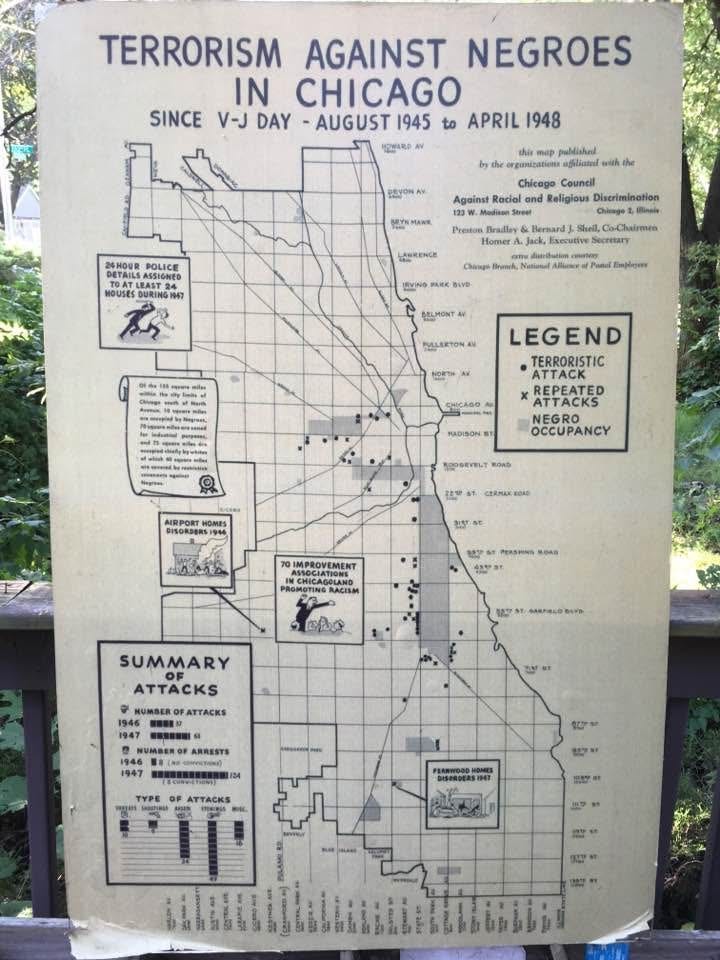
Organized white terrorism against Black residents in Chicago, 1945–1948, documented by the Chicago Council Against Racial and Religious Discrimination. Attacks concentrated at residential boundaries as Black veterans and families attempted to move beyond established segregation lines during the postwar housing boom.
Between 1945 and 1948, bombings, arson, and mob assaults enforced residential color lines in Chicago.
The timing matters. Black veterans were returning. The GI Bill was active. The housing boom was underway.
Violence aligned with federal redlining maps (1934–1968).
Before finance codified the boundary, terror enforced it.
And when overt violence became politically costly, finance refined the mechanism.
Contract buying replaced bombs.
The $4 Billion Extraction
Contract buying was a counter-reparations regime.
Between 1950 and 1970, Black Chicagoans lost an estimated $3.2 to $4 billion (2019 dollars) through predatory contract buying.
A 2019 study by researchers at Duke University, UIC, and Loyola University Chicago quantified the plunder.
Approximately 85% of properties purchased by Black Chicagoans in the 1950s were sold on contract.
Speculators marked up prices by an average of 84%.
A common pattern:
Purchase for $12,000
Resell days later for $22,000
No mortgage. No title until final payment.
Miss one installment — lose everything.
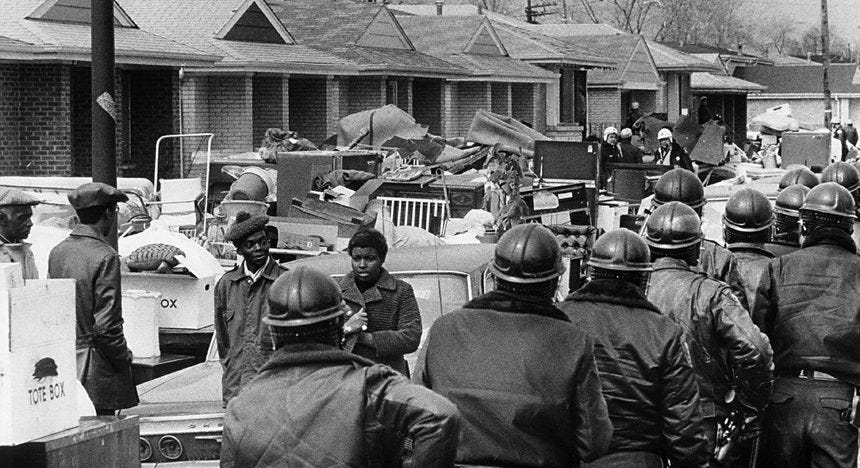
Black families paid an average “color tax” of $587 more per month (in current dollars) — due to inflated prices and usurious interest structures — than they would have under a conventional mortgage.
Approximately 60,100 homes were purchased between 1950 and 1970. Between 75% and 95% were contract sales.
Roughly $1 million per day was extracted from the Black community during that era — nearly $8 million per day in 2020 dollars.
This was not market distortion.
It was industrial-scale wealth transfer.
Mississippi: The Theft That Never Ended
In Mississippi, Black land ownership peaked in 1910 and declined catastrophically through fraud, coercion, violence, and partition actions.
Today, heirs-property law continues the erosion. A speculator can purchase fractional interest from one distant heir — say, a cousin who inherited 1/16th of a plot — and force a court-ordered sale of the entire property, often at auction, where the family loses everything.
The past is not haunting the present.
It is operating inside it.
The Check Marked “Insufficient Funds”
In 1963, Dr. King described the Constitution as a promissory note.
When Black Americans attempted to cash it, he said, the check came back marked “insufficient funds.”
By 1968, during the Poor People’s Campaign, he sharpened the language:
“We’re coming to Washington to get our check.”
Not recognition.
A check.
Economic redress.
They quote the dream.
They do not quote the invoice.
The issue was never recognition.
The issue was restitution.
If the Promises Had Been Kept
If land had transferred in 1865.
If titles had been protected.
If federal housing policy had been equitable.
If GI benefits had translated into equity.
If Chicago had not required terror to enforce containment.
If $4 billion had remained in Black households.
There would be no reparations debate.
The debate exists because repair was refused when it was cheaper.
A system that refuses repair must call its collapse natural.
But Chicago carries the record.
The ledger remains open.
Further Reading
Ira Katznelson, When Affirmative Action Was White
Beryl Satter, Family Properties
Duke/UIC/Loyola (2019) Contract Buying Study
W.E.B. Du Bois, Black Reconstruction in America
Richard Rothstein, The Color of Law
Thomas W. Mitchell, Heirs Property Scholarship
Chicago Council Against Racial and Religious Discrimination archives (1945–48)
Thanks for this history. I would also recommend to readers the book _The South Side: A Portrait of Chicago and American Segregation_ by Natalie Y. Moore for more detailed history on Contract Buyers.
The shameful truth about this country.