
Crackle Over Cloud: Prophet Crossfade, Digital Minimalism, and the Rise of Analog Futurism ✦
Bass is The Place: the Canonization of Maghostut Malachi Favors

by Floyd Webb
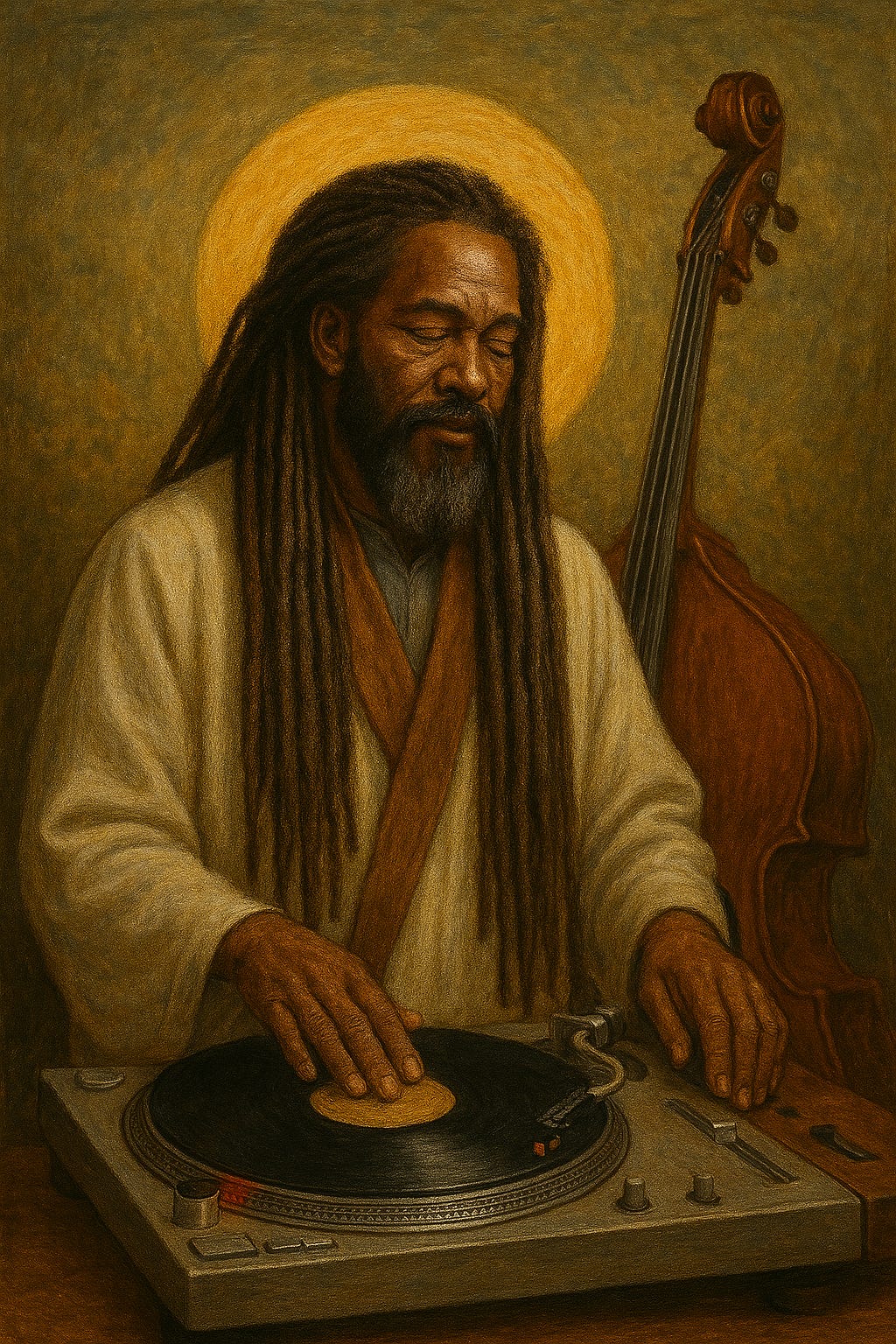
“The needle is my oracle, the bass is my altar, and the hiss is where the ancestors speak.” — Prophet Ezekiel Crossfade
In an age saturated with digital noise, surveillance, and the tyranny of the algorithm, a quiet revolution is tuning its instruments. Its message is not shouted from social media pulpits, but transmitted through hum, hiss, groove, and feedback. At its heart is a man with dreadlocks, a tape deck, and a sermon in the static: Prophet Ezekiel Crossfade, spiritual architect of the Church of the Static Circle, and the driving force behind a new analog awakening.
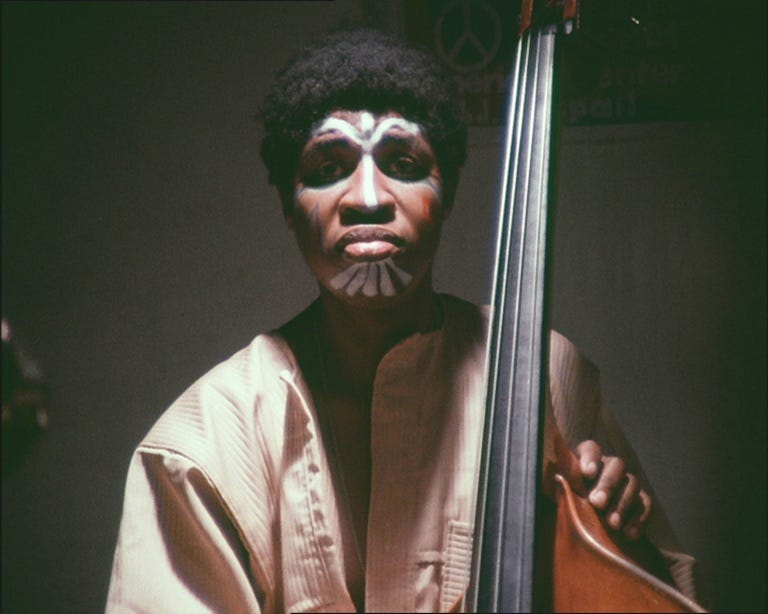
Crossfade is not content to merely preach against the cloud. He is canonizing the sonic saints—those visionary musicians who turned chaos into communion, dissonance into transcendence. And on August 22nd, in Chicago’s Hedgwich community, his movement enters a new phase of earnest ceremony. The Katalyst Music Gallery will transform into a sanctuary, where Crossfade will lead the first official canonization ritual for Maghostut Malachi Favors, the cosmic bassist of the Art Ensemble of Chicago, under the full rites of the Church.
I. A Movement Rooted in Resistance
Digital minimalism, made popular by authors like Cal Newport, argues that we must subtract the clutter from our digital lives to regain agency, focus, and meaning. Millions are tuning out—not to disappear, but to reappear in their own lives. But where digital minimalists curate quiet, Prophet Crossfade composes ritual. Where others disconnect, he remembers.
His church, rooted in the frequencies of Black sonic liberation, doesn’t reject technology wholesale—it reclaims its tactile, embodied, analog lineage. In Crossfade’s words:
“We’re not anti-tech. We’re pre-synthetic. We remember when sound came from wood, breath, wire, and skin. The vinyl hiss is not noise. It’s ancestral bleedthrough.”
The Church of the Static Circle gathers in quiet listening sessions, vinyl communions, and dub-infused mass. But now, it begins to build an infrastructure of reverence—a canon of analog saints, those whose vibrations carved open time and space.
II. The Canon Begins: Malachi Favors as Sonic Saint
The celebration of Malachi Favors is no random tribute. Crossfade calls him the “Bass Prophet of Interdimensional Groove,” a founding figure in the Church’s sacred text. His work with the Art Ensemble was not just avant-garde jazz—it was ritual soundcraft, a layered invocation of African futurity, street theater, and post-industrial blues.
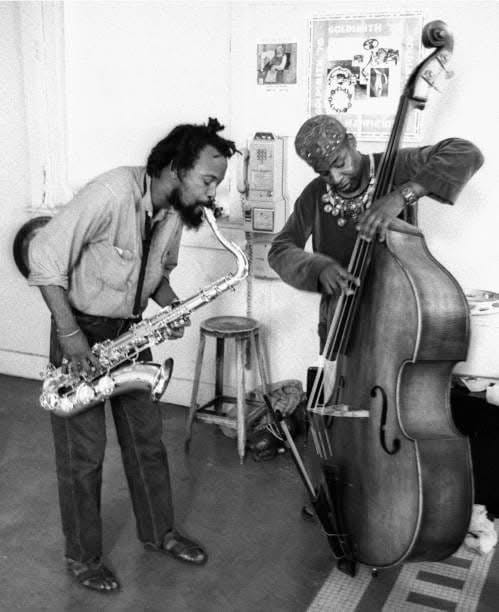
On August 22nd, under a vow of analog silence, all mobile devices will be switched off. The audience will gather in real time and space. A single upright bass will stand in the center, surrounded by candles and reel-to-reel decks. Crossfade will deliver a sermon—a mix of turntable improvisation, oral history, and dub delay. The ceremony will close with the Declaration of Sonic Sainthood, canonizing Favors as the first in the Static Circle Hall of Vibration.
“We don’t bury our saints in cemeteries,” Crossfade says. “We press them into wax, loop them on tape, and let their frequencies haunt the air.”
III. Analog as Memory Technology
This canonization is more than spiritual pageantry—it’s a method of memory repair. In a world where the cloud fails, where streaming libraries vanish, and where history is increasingly owned and edited by corporations, analog is a technology of liberated remembrance.
Digital minimalism focuses on detachment from algorithmic life. But analog futurism, as practiced by the Static Circle, is re-attachment to soul frequency—through vinyl, cassettes, Super 8, Polaroids, and shortwave transmissions. It teaches presence not through emptiness, but through vibration.
Crossfade sees this not as nostalgia, but resistance:
“If you don’t own the format, you don’t own the memory. If your archives are in the cloud, they can be deleted. But the tape? The tape remembers. The record forgives. The bass reverberates.”
IV. Toward a Sonic Spirituality
The Static Circle does not oppose the digital, but refuses to worship its false prophets. It honors the analog as a sacred redundancy—a way to communicate, to remember, to pray even when the network falls silent.
The future imagined by Prophet Crossfade is not accelerationist—it’s cyclical, rooted in Black temporalities, communal gatherings, and deep listening. The bass becomes a compass. The tape hiss becomes weather. And every moment offline is an act of re-enchantment.
Final Frequency
This August 22nd at Katalyst, Prophet Crossfade isn’t just celebrating Malachi Favors. He’s sounding a call to spiritual resistance, inviting us to remember with our hands, our ears, our full attention. The canonization marks the beginning of a broader analog liturgy—one that offers a path out of techno-feudal fatigue and into a grounded, soulful futurism.
So switch off. Step in. The revolution will not be livestreamed.
It will be dubbed.
It will be pressed.
It will be felt in your chest like the first bassline after silence.
Presented by The Analog Futurist Church of the Static Circle, Bass is the Place@The Katalyst Music Gallery—August 22, 7pm, located at:
13257 S. Baltimore Avenue, Chicago, IL 60633
“Low End Saints: An Avant-Garde Bass Communion”
Malachi Favors – “Theme de Yoyo”
*Art Ensemble of Chicago – Les Stances à Sophie (1970)
Favors’ funky, aggressive bass anchors this wild blend of soul, free jazz, and political groove—featuring Fontella Bass on vocals.
Malachi Favors – “Odwallah”
*Art Ensemble of Chicago – Urban Bushmen (1982)
A ritualistic performance piece; Favors channels ancestral rhythm in a live, meditative setting with bowed textures and deep pulse.
Malachi Favors – “Tutankhamun”
*Art Ensemble of Chicago – Tutankhamun (1969)
A minimalist, hypnotic solo bass statement—this is Favors as shaman, invoking time and space with sparse, deliberate plucks and silences.
4. William Parker – “Morning Mantra”
Raining on the Moon (2002)
Spiritual jazz meets poetry; Parker’s bass walks with reverence and confidence through cosmic terrain, grounding Leena Conquest’s vocals.
Alan Silva – “Skies of America” (excerpt)
*Cecil Taylor Unit – Live in Paris (1970s bootlegs)
Silva’s electric double bass playing is pure chaos theory—explosive, unpredictable, yet fluid within Taylor’s percussive storms.
6. Henry Grimes – “For Django”
*Henry Grimes Trio – The Call (1965)
Before his mysterious disappearance, Grimes left us this profound piece—an ecstatic fusion of freedom and form, with the bass at the center.
7.Sirone – “Resurrected”
*Revolutionary Ensemble – Vietnam (1972)
An underrated giant—Sirone’s bowed bass tears open emotional landscapes, part lament, part rebellion.