
Cultural Refugees
St. Clair Bourne, Antoine Fuqua, and What $1 Billion Won’t Fund

by Floyd Webb
Part One: The Billion-Dollar Paradox
The news reached me the way so much of the film business reaches us now: as a pair of headlines separated by only a few days but somehow speaking to one another. The first announced that Antoine Fuqua’s Michael, the long-awaited film about Michael Jackson, had become the first biographical motion picture in history to surpass one billion dollars at the worldwide box office. It was a milestone that every studio dreams of, not simply because of the money but because a billion-dollar film reverberates throughout the entire industry. It enriches investors, distributors, exhibitors, streaming platforms, theater owners, technicians, marketers, and everyone whose livelihood depends upon the machinery of cinema continuing to move. Then came the second headline. Netflix had halted development of Fuqua’s long-planned film starring Denzel Washington about Hannibal, one of history’s most brilliant military strategists and, by all accounts, a project the director had wanted to make for years. I found myself reading both stories twice, less interested in the business news than in the contradiction they revealed. How could a filmmaker deliver one of the most profitable films of his career—one that generated extraordinary wealth for an entire industry—and still find the story he most wanted to tell suspended beyond his reach? The question stayed with me long after I had put my phone down.
A filmmaker can spend a lifetime creating extraordinary value for an industry and still discover that the story he most wants to tell remains beyond his reach.”
Most readers saw only the celebrated director. I saw someone else entirely.
The headlines carried me back more than four decades to a music-video set in New York City, long before Antoine Fuqua’s name appeared above movie titles or beside Academy Award winners. Peter Allen was directing. Eric Meza was producing through Hush Productions. Music videos were still an uncertain frontier, regarded by much of the recording industry as little more than promotional novelties. MTV had not yet transformed them into the dominant visual language of popular music, and very few people imagined that these brief experiments in editing, choreography, photography, and storytelling would become one of the great training grounds for a generation of filmmakers. I had been brought in to shoot black-and-white Super 8 footage, and Antoine was there as a performer. I remember him as ambitious without being theatrical about it. He watched everything. He paid attention to the rhythm of the set, the way decisions were made, the movement of lights and cameras, the quiet conversations between producers and directors. Within a remarkably short time he was coordinating productions himself, and even then it seemed obvious that he had arrived not merely to participate but to learn the machinery from the inside.
It is one of the peculiar gifts of growing older that success rarely surprises you. When you have watched someone at the beginning of their journey, the destination often feels less improbable than it does to everyone who encounters them only after they have arrived. Seeing Antoine’s name attached to a billion-dollar film did not astonish me. What unsettled me was something else entirely. After everything he had accomplished, after proving not only his artistic ability but his commercial value to one of the largest entertainment industries on earth, why did it still seem that the stories he most deeply wanted to tell required another round of negotiation? Somewhere inside that question I began thinking not only about Antoine but about an entire generation of Black filmmakers whose careers had unfolded before my eyes.
I would never have met Antoine had it not been for another filmmaker whose influence is almost impossible to measure. His name was St. Clair Bourne, though almost everyone who knew him simply called him Saint. I first met him at FACETS Multimedia in Chicago after a screening of one of his documentaries on Amiri Baraka. The audience slowly filtered out into the night while we remained behind talking about films, politics, history, and the peculiar lives of independent filmmakers. There was nothing dramatic about the conversation. It simply continued until I realized we had become friends. Years later I would understand that this was one of Saint’s great gifts. He did not network in the contemporary sense of the word. He cultivated relationships. If he believed you were serious about the work, he treated you as though you already belonged.
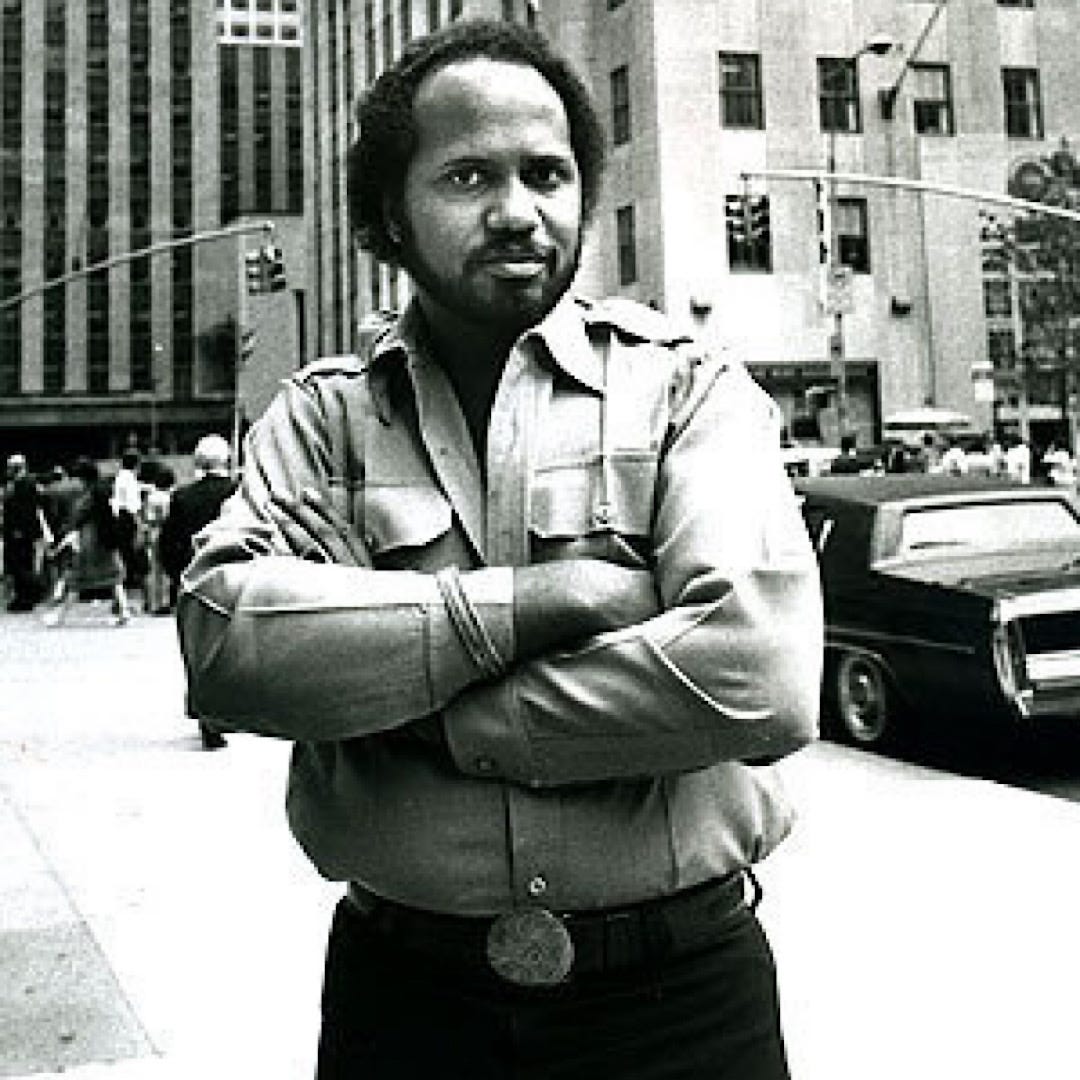
Not long afterward Saint returned to Chicago to produce Big City Blues, a documentary for CBS News during the years when the major networks still regarded documentary filmmaking as part of their public responsibility. He hired me to shoot production stills, and through that assignment I entered a world I had not even known existed. Saint himself had traveled an extraordinary path. He emerged from the Black Power movement, inherited journalism almost by birth from his father, St. Clair T. Bourne Sr., one of the distinguished figures of New York’s Black press, and became part of the groundbreaking public television series Black Journal, the first national weekly television program created to report Black life from a Black perspective. Eventually he left institutional television behind to make films independently, convinced that some stories demanded a freedom that established organizations rarely granted.
“Communities don’t begin inside institutions. Institutions eventually discover communities that have already built themselves.”
Looking back now, I realize that Saint’s greatest achievement may not have been any single documentary he directed. It was the community he quietly assembled around himself. If he believed in you, you found yourself drawn into a network that stretched across the United States and far beyond it. Introductions happened almost casually. One day you found yourself talking with a photographer whose work you had admired for years. Another day it was a playwright, a novelist, a filmmaker, or an activist whose name you previously knew only from magazines and book jackets. Saint never presented these encounters as favors. He simply assumed that people committed to the work ought to know one another. It was an act of generosity so natural that I don’t think any of us fully appreciated what he was building while he was building it.
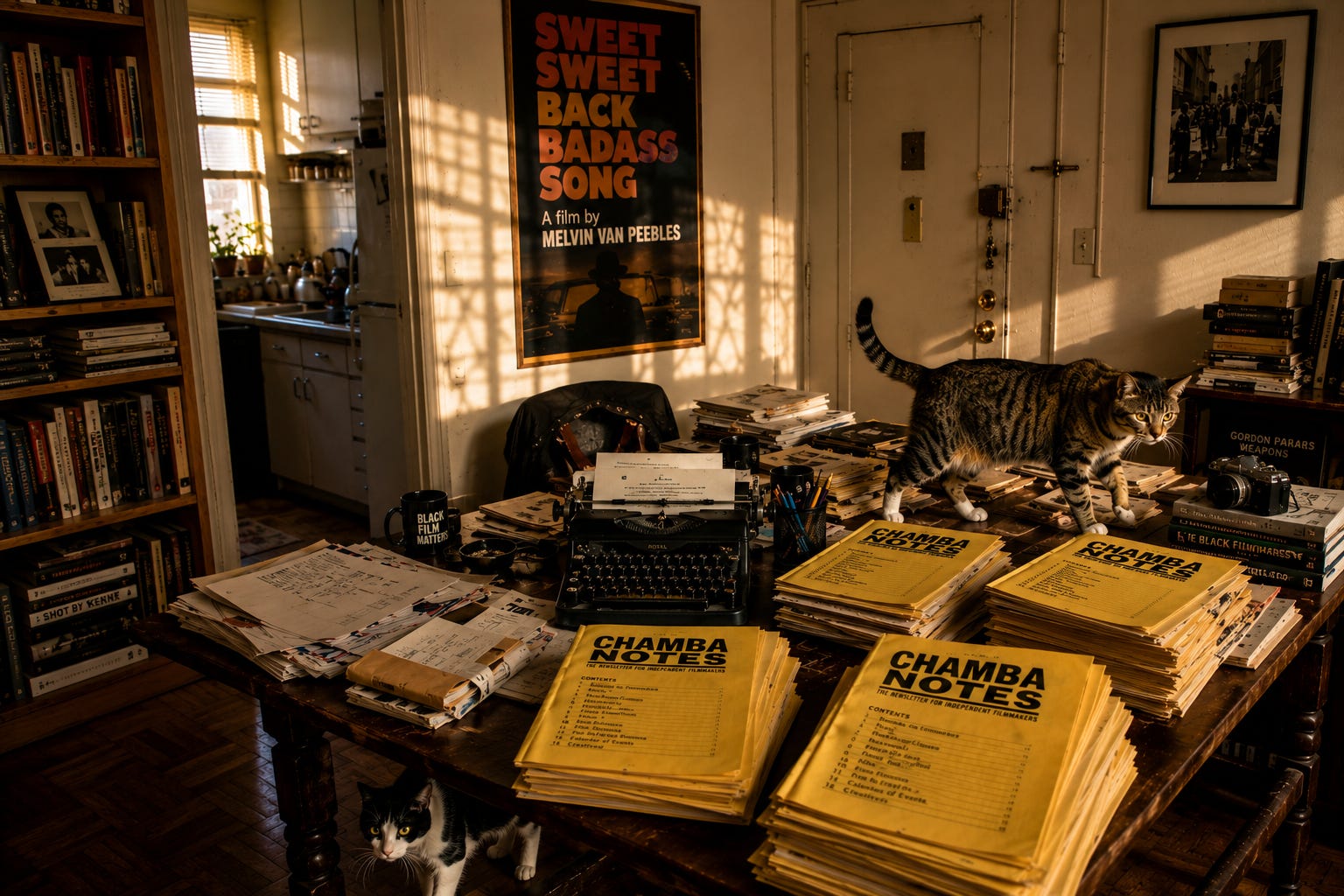
His apartment on 105th Street and Broadway became one of the centers of that world. To anyone else it might have appeared to be another Upper West Side apartment, but to me it felt like a crossroads where Black cinema, jazz, politics, literature, and international culture met almost daily. The rooms were filled with books, manuscripts, correspondence, photographs, film cans, and newspapers. Large windows stayed open whenever the weather allowed, and a breeze moved easily through the apartment while the sounds of Broadway drifted up from the street below. Two cats, Max and Mingus, wandered comfortably among the stacks of paper as though they understood this was their kingdom as much as Saint’s. Max Roach’s Freedom Now Suite or Charles Mingus’s Haitian Fight Song often played on the turntable, not as background music but as another participant in the conversation. Everything about that apartment suggested that art was not something separated from ordinary life. It was ordinary life.
The center of the apartment was neither the living room nor the shelves lined with books. It was the kitchen table. That was where Saint assembled Chamba Notes, his quarterly newsletter for independent filmmakers. Long before the internet connected artists across continents with a click, Chamba Notes served as one of the essential lifelines of Black independent cinema. Grant announcements, festival news, essays, screenings, fellowships, production opportunities, and reflections on the state of the field all passed across that table before finding their way into envelopes addressed to filmmakers scattered across the country. Watching Saint work there, surrounded by Max and Mingus while jazz floated through the apartment, I could not have known that I was witnessing something far more important than the production of a newsletter. I was watching an infrastructure being built, one envelope at a time.
Only much later did I realize that the set where I met Antoine had begun at that same kitchen table.
---
Part Two
That connection—the kitchen table, the introduction, the set—is the thread I want to follow now, because I don’t think it was incidental. Looking back, I realize that what Saint was building at 105th and Broadway could never have fit inside the language we use today. We would probably call it a network, but that word feels too transactional. It wasn’t networking. It was stewardship. Saint understood that artists working in isolation eventually disappear, not because they lack talent but because they lack community. His apartment, Chamba Notes, the endless introductions, the screenings, the phone calls, and the conversations over coffee were all expressions of the same belief: independent filmmakers had to build an infrastructure for one another because very little infrastructure had been built for them.
That philosophy revealed itself in the way Saint spoke about younger filmmakers. He never carried himself like a gatekeeper protecting his place in the culture. He was endlessly curious, especially when something genuinely new appeared on the horizon. While much of the entertainment industry regarded music videos as disposable advertising, Saint saw something entirely different. He watched young directors experimenting with rhythm, montage, color, performance, and narrative in ways that conventional filmmaking rarely permitted. He was convinced that a new visual language was emerging, and rather than dismiss it because it belonged to a younger generation, he wanted to understand it.
That curiosity was what led him to introduce me to Eric Meza in the first place—the producer behind the very set where I would meet Antoine. Eric had begun producing television commercials before moving into the rapidly expanding world of music videos. Saint admired him enormously. He spoke about Eric and the young filmmakers around him with unmistakable excitement, convinced that they were inventing an entirely new entertainment form. He thought I should know them. More than that, he thought I should be working with them. Saint had a remarkable instinct for placing people in the path of opportunity, not because he could predict success, but because he trusted that creative people grew by being surrounded by other creative people. Through Eric I met Peter Allen, and through Peter I ended up on that set at all. None of it felt historic at the time. It felt like another day’s work among young filmmakers trying to invent something before anyone else realized it was being invented.
“What looked like promotion was, in fact, one of the great film schools of the late twentieth century.”
It is difficult now to remember a world before MTV transformed music videos into a global phenomenon. At the time, record executives routinely questioned whether anyone would watch a promotional film more than once. Their imagination ended with marketing. They could not yet see that music videos would become one of the most important laboratories in modern cinema. Freed from the commercial expectations of feature filmmaking and the rigid conventions of network television, directors suddenly had permission to experiment.
They compressed stories into four minutes, borrowed from painting, dance, fashion, documentary, surrealism, and performance art, and learned to solve visual problems under impossible deadlines and modest budgets. What looked like promotion was, in fact, an extraordinary film school.
Many of the filmmakers who emerged from that world would go on to reshape contemporary cinema, bringing with them a visual vocabulary born not in Hollywood but in an entirely different ecosystem. Antoine Fuqua was one of them. So were many others whose careers would eventually redefine the look and rhythm of American filmmaking. Saint recognized that long before most critics, producers, or studio executives did. He wasn’t simply watching music videos. He was watching the future of cinema arrive.
My own relationship with Eric and Peter did not end when those productions wrapped. Independent filmmaking has a way of folding time back upon itself. People disappear for years, then reappear carrying entirely new stories. Decades later Peter and I crossed paths again while he was developing *Book of Swords*, a martial arts feature starring one of the actors made famous through the Mortal Kombat franchise. It reminded me that careers in independent cinema are rarely linear. They are more like rivers that separate and merge again, carrying old friendships into entirely new landscapes.
During those same years I found myself traveling constantly. London. Tokyo. Film festivals. Productions. Meetings that sometimes led nowhere and sometimes altered the course of my life. Somewhere along the way I stopped thinking of my work as belonging to one city or even one country. The most important conversations I was having about Black cinema were increasingly international. The people I admired moved between continents almost as naturally as they moved between film sets.
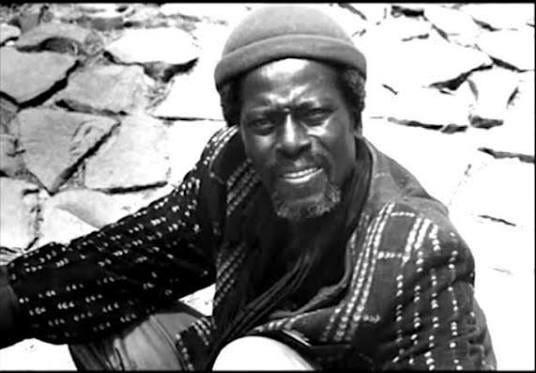
Looking back, I realize I had been prepared for that long before I understood it. Saint’s apartment was never simply a New York apartment. It was a crossroads. Djibril Diop Mambéty might be there. A playwright might arrive. A photographer would stop by. Someone had just returned from Africa. Someone else was leaving for Europe. Ideas traveled through those rooms before they traveled through institutions. The apartment functioned almost like an unofficial embassy for Black independent culture, a place where filmmakers from different countries recognized one another before the rest of the world had learned their names.
Years later, when I reconnected with Mandla Dube after first meeting him in London, that international conversation simply continued. By then I had spent years researching the remarkable story of Yasuke, the African samurai. Mandla wanted to make a feature film. I had been developing a documentary. Rather than competing, we combined our efforts. What eventually became *Yasuke: Way of the Butterfly* did not emerge from Hollywood. It grew through a conversation between South Africa, Japan, and the United States, eventually bringing together Mandla’s Pambili Media and Tokyo’s Toei Studios. It struck me that some stories seem to find their natural homes only after they have crossed oceans.
It was somewhere during those years of moving between countries, festivals, apartments, film sets, and collaborations that I began thinking of many of us as cultural refugees. I did not mean that we lacked a home. I meant that we were often searching for places where our stories could breathe freely. Sometimes those places were institutions. More often they were kitchens, borrowed offices, newsletters assembled by hand, conversations after screenings, or friendships that stretched across continents. We carried our culture with us because we could never assume someone else would preserve it.
Here is the part of the story I have been circling without landing on.
Saint died in December 2007. He was sixty-four. A tumor that had sat quietly in his brain for years finally demanded surgery, and the surgery took him—not the tumor itself, but the complications that followed it. He had kept working almost to the end, the way people do when the work has never once been separated from the self doing it. There was no succession plan for what he’d built, because nobody had ever treated it as an institution in the first place. It was a man, a kitchen table, a typewriter, and an address book. When the man went, the machinery didn’t get inherited by a foundation or absorbed into a university archive with a paid curator waiting to receive it. It went to his sister, Judith, a lawyer by training, who spent years afterward doing the quiet, unpaid, unglamorous work of sorting film cans and correspondence into something that might one day have a permanent home. As of a few years ago, that home still hadn’t been found. The paper trail of one of the most important connective institutions in Black independent cinema was still, essentially, homeless.
Sit with that next to the billion dollars.
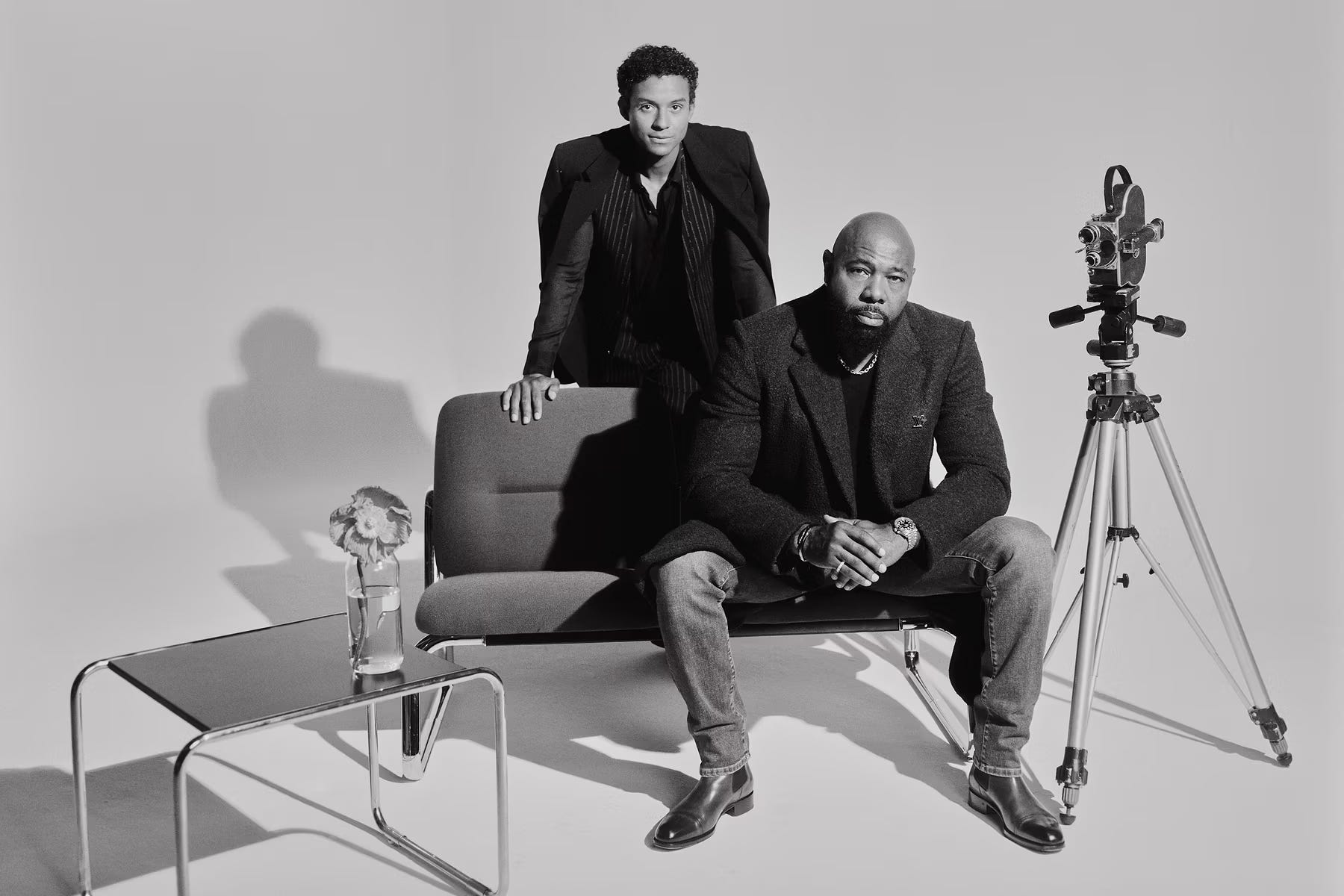
Antoine Fuqua’s Michael did not need a single dollar of my attention to succeed—the box office has already spoken. But nothing about that success sent so much as a fellowship, an archive grant, or a line item back toward the ecosystem that trained the generation of filmmakers Fuqua came out of. Music videos became a film school because directors like Saint’s friends were locked out of the one Hollywood already ran. Chamba Notes became essential infrastructure because no studio, no network, no guild ever built the thing it was quietly replacing. The industry did not fund that infrastructure while it was alive, and it did not mourn it, in any material sense, once its builder was gone. It simply kept doing what it has always done: harvesting talent from ecosystems it refuses to be responsible for.
A billion-dollar film can be measured. The value of a single introduction cannot.”
That is the billion-dollar paradox, stated plainly. An industry can recognize genius the instant it becomes profitable and remain permanently uninterested in the conditions that produced it. Fuqua’s Hannibal gets shelved not because Fuqua lacks power now, but because the same industry that will spend a billion dollars marketing a film it already trusts will not spend a fraction of that on a story it hasn’t been trained to see the value of yet—the exact blindness Saint spent his life working against, on no budget, with no institutional cover, entirely on his own time.
Cultural refugees, then, isn’t only a way of describing artists searching for places where their stories can breathe. It’s a description of what happens when an industry treats your infrastructure as disposable. You build the kitchen table because no one will build the boardroom. You mail the newsletter because no wire service will carry the story. You do it for free, for decades, and when you die, the thing you built doesn’t get folded into the institutions that profited from it. It waits in boxes for someone’s sister to find it a home.
I don’t say this to diminish what Saint gave us, or what Fuqua earned, or what any of the filmmakers who passed through that apartment went on to build. I say it because the warmth of that kitchen table has let me avoid, for most of this essay, the harder thing sitting underneath it: an industry that is very good at applauding survivors and very bad at funding the structures that kept them alive long enough to survive. Saint is gone. The next kitchen table hasn’t been funded either. Somewhere right now, someone is doing what he did—by hand, unpaid, on borrowed time—and the industry that will one day profit from whoever they mentor still has no plan to notice them until the box office tells it to.
This essay is based on the author’s personal recollections of working with St. Clair Bourne, Eric Meza, Peter Allen, and Antoine Fuqua, as well as his experiences founding the Blacklight Film Festival and participating in the international community of independent filmmakers.
Further Reading
Bourne, St. Clair. Making Black Waves: The Story of Black Journal. San Francisco: California Newsreel, 1988.
Bourne, St. Clair. The Black and White of Color: Black People in American Television Since 1948. New York: Third Press, 1990.
Massood, Paula J., and Valerie Smith, eds. The Oxford Handbook of American African American Cinema. New York: Oxford University Press, 2013.
Guerrero, Ed. Framing Blackness: The African American Image in Film. Philadelphia: Temple University Press, 1993.
Diawara, Manthia. Black American Cinema. New York: Routledge, 1993.
Reid, Mark A. Redefining Black Film. Berkeley: University of California Press, 1993.
Van Peebles, Melvin. Sweet Sweetback’s Baadasssss Song: A Guerilla Filmmaking Manifesto. New York: Thunder’s Mouth Press, 1971.
Rogers, J. A. World’s Great Men of Color. 2 vols. New York: Macmillan, 1972.
Bambara, Toni Cade, ed. The Black Woman: An Anthology. New York: Washington Square Press, 1970. (Included because Bambara’s work and later filmmaking embodied the independent Black artistic ecosystem discussed in the essay.)
Chamba Notes. Various issues. New York: Chamba Media.
St. Clair Bourne's archives (along with his father's work) deserves an archive somewhere. Spike at NYU? HBCU? Hopefully someone steps up. Appreciate the knowledge and background, Mr. Webb.
Well said, weed hopper. Well said