
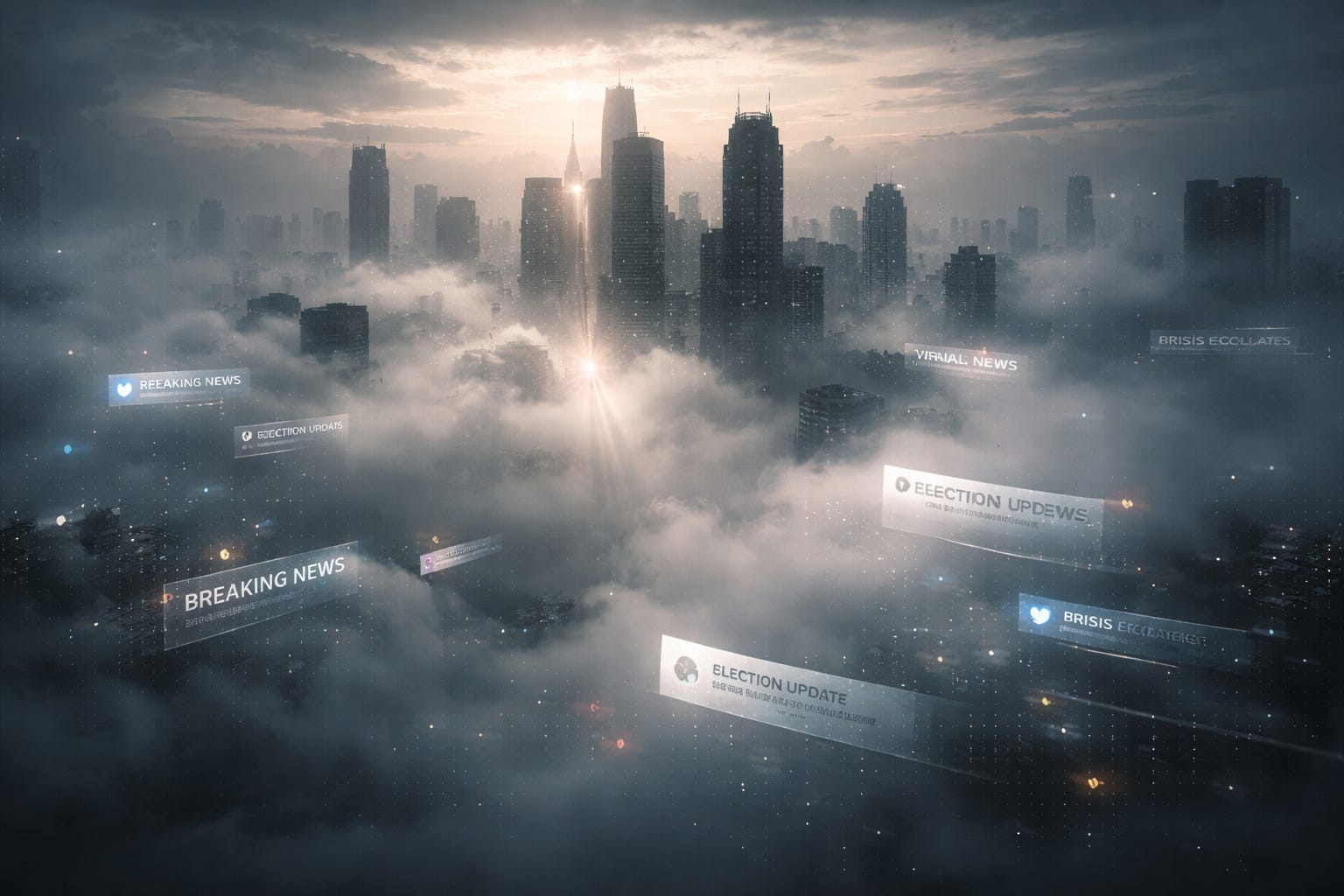
Cutting Through the Fog
Narrative Warfare from Chicago to the Global Information Battlefield

by Floyd Webb
Introduction: A Series on Narrative Warfare
The essays that follow examine a problem that has become central to modern political life: the struggle over narrative.
Politics has always involved competing interpretations of reality. Governments frame events, institutions amplify those frames, and public understanding forms somewhere between information and persuasion. In the twentieth century this struggle unfolded through newspapers, radio, and television.
Today it moves through a far more complex system — one shaped by think tanks, political messaging operations, global media companies, and digital platforms whose algorithms reward speed and emotional reaction.
The result is an environment where narratives can spread with extraordinary velocity, often hardening into conventional wisdom before verification has time to catch up.
This series explores that environment from three angles.
“Cutting Through the Fog” describes the informational atmosphere in which modern political narratives circulate.
“A Citizen’s Field Guide to Deconstructing Narrative” offers practical tools readers can use to evaluate those narratives.
“The Anatomy of a Narrative Attack” traces how a single claim can move from institutional framing to amplification and normalization.
Together they lead to a simple conclusion.
Narrative power is not mysterious.
It is structural.
And once citizens understand how that structure works, they gain something the architects of narrative warfare depend on denying them:
time.
Time to question.
Time to verify.
Time to think before accepting the story as reality.
In an age of accelerated information, that pause may be one of the most important civic acts available to us.
“When the media talks about Chicago or Iran, same shit different bottle.”
—Jesse B. Semple III
“War is the realm of uncertainty.”¹
— Carl von Clausewitz
“Tell no lies. Claim no easy victories.”²
— Amílcar Cabral
Chicago is where I first saw the fog.
Not battlefield fog. Narrative fog.
I have lived long enough in this city to recognize when a story is forming before the evidence catches up with it. I watched it happen in the long aftermath of the killing of Fred Hampton, when the official account of the police raid hardened into public memory long before the courts began uncovering what had actually happened. I saw it again during the turbulent years of Harold Washington, when Chicago’s political establishment constructed its own mythology of crisis around the city’s first Black mayor.
And I am watching it again now.
The media narrative surrounding Chicago mayor Brandon Johnson has developed with striking speed and uniformity. Turn on local television, scan national commentary, or scroll through social media and certain themes repeat almost rhythmically.
Chicago is collapsing.
The mayor is incompetent.
The city is ungovernable.
Criticism of elected officials is part of democratic life. But the architecture of this narrative—its speed, repetition, and consistency across platforms—suggests something larger than ordinary political disagreement.
In the first months of the administration, a single approval-rating poll circulated with remarkable speed through the media ecosystem. Within forty-eight hours the number appeared across commentary programs, opinion columns, and social media feeds as if it were a definitive measure of the city’s political reality. The repetition created its own momentum. What began as one data point quickly hardened into a storyline.
Look closely and you begin to see where some of the framing originates.
Policy reports produced by the Illinois Policy Institute, a conservative think tank affiliated with the national State Policy Network, have played a notable role in shaping the conversation around Johnson’s approval ratings and municipal policy debates. The organization’s own 2024 annual report boasts that it was “the first to poll voters on [Johnson’s] approval rating,” and that the number it produced quickly became “a recurring theme in the narrative of his administration.”
Pause on that sentence.
A think tank is not simply analyzing the narrative. It is describing its role in creating one.
The Illinois Policy Institute is not unusual in this respect. Like many ideological research organizations, it sits within a larger donor and advocacy ecosystem connected to the national conservative policy movement, including networks associated with the Koch and Bradley foundations. Investigations by journalists have documented how such institutions form pipelines through which research, commentary, and media amplification move together. The Institute also operates the Illinois News Network, a media outlet that distributes stories aligned with its policy agenda.
None of this requires a conspiracy.
It requires only a structure.
What begins as a policy argument becomes something else: a perception of reality.
The Machinery of Narrative
Once you see the structure, you begin to notice the pattern everywhere.
First comes the originating frame.
In wartime it appears through intelligence briefings or military statements. In political conflict it emerges through think tanks, advocacy groups, or political consultants.
Second comes amplification.
Editorial pages repeat the claim.
Television panels debate it.
Political actors incorporate it into speeches.
Third comes normalization.
By the time citizens encounter the narrative, it no longer feels like an argument. It feels like the air everyone is breathing.
This pattern is deeply familiar to historians of war reporting.
In 1964 the Gulf of Tonkin incident was presented to the American public as a clear attack on U.S. naval vessels by North Vietnamese forces. The incident quickly produced the Gulf of Tonkin Resolution, authorizing the escalation of the Vietnam War. Decades later, declassified intelligence revealed that the second alleged attack almost certainly never occurred.³
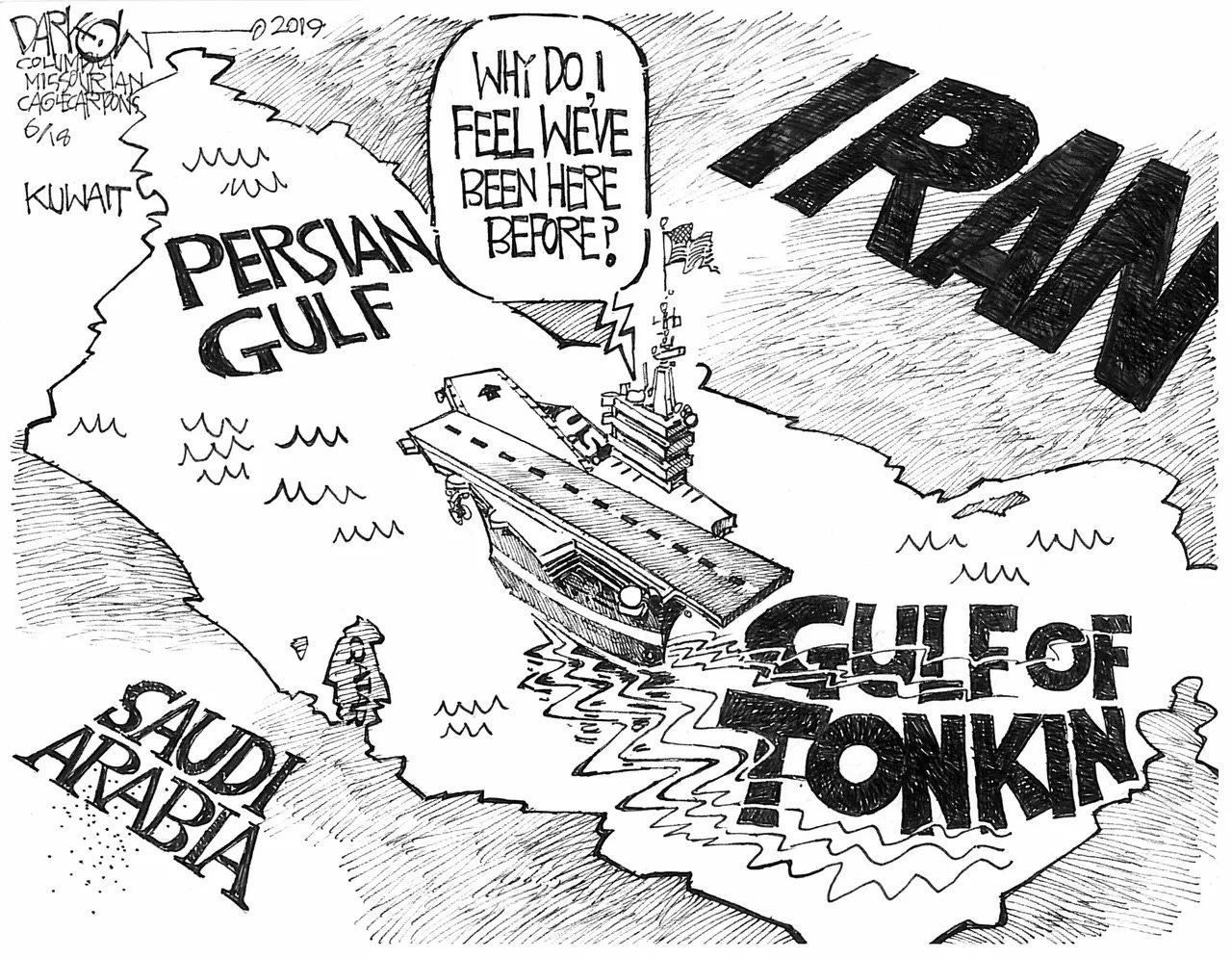
Another example appeared before the first Gulf War. A young Kuwaiti woman testified before Congress that Iraqi soldiers had removed babies from hospital incubators and left them to die. The emotional testimony became a powerful justification for military intervention.
The story was later revealed to have been organized through a public relations campaign involving the firm Hill & Knowlton.⁴
The scale of these events was global, and their consequences far more devastating than the fate of any municipal administration. But the mechanism is the same: an originating claim, rapid amplification, and the gradual hardening of narrative into accepted truth.
The fog of war is not only the chaos of battle. It is the fog of narrative.
Fog is not simply the absence of information. It is the presence of too much narrative moving faster than verification.
The Algorithmic Studio System
What has changed in the twenty-first century is the infrastructure through which narratives travel.
In the twentieth century Hollywood operated through what historians called the studio system. A small number of vertically integrated companies controlled the entire chain of cultural production. They owned the studios, controlled distribution, and decided which films would be made and which audiences would see them.
Directors and actors worked under contract, but the real power rested with studio heads who could determine which stories reached the screen.
That system was eventually broken by antitrust rulings. But a different version has quietly reassembled itself in the digital age.
Today the gatekeepers are not studio executives.
They are platform architectures.
Companies such as Google, Amazon, Apple, and Oracle control much of the digital infrastructure through which modern media flows. Platforms like YouTube, TikTok, and X (formerly Twitter) act as global distribution networks.
Their algorithms now perform the function that studio executives once performed.
They determine:
which stories rise
which voices disappear
which narratives achieve mass visibility
The new studio bosses do not select scripts.
They design algorithms that select for conflict.
In this environment a calm, fact-checked rebuttal is a box-office flop.
A viral half-truth is a blockbuster.
Political Power and Media Alignment
The infrastructure of narrative is not only algorithmic. Increasingly it is also aligned with political and economic power.
The platform X is owned by Elon Musk, whose companies operate at the intersection of federal contracts, defense technology, and political influence. The newspaper The Washington Post is owned by Jeff Bezos, founder of Amazon, whose cloud infrastructure hosts significant portions of the U.S. government’s data systems.
Meanwhile the proposed consolidation of Paramount Global under the leadership of David Ellison—backed by capital connected to Oracle founder Larry Ellison—illustrates how Silicon Valley infrastructure and traditional media institutions are becoming intertwined.
If you want to see how complex this alignment has become, look at TikTok.
Globally, TikTok remains a subsidiary of the Chinese technology company ByteDance, founded by Zhang Yiming and now led by Liang Rubo. ByteDance itself is majority owned by international institutional investors, including firms such as the Carlyle Group and General Atlantic, with founders and employees holding additional stakes.
In January 2026, in response to U.S. national security concerns, ByteDance spun off TikTok’s American operations into a new entity known as TikTok USDS Joint Venture LLC. Under that structure ByteDance retains a minority stake, while major investment partners—including Oracle, the private equity firm Silver Lake, and the Abu Dhabi-based technology investor MGX—hold substantial positions and governance roles. Oracle also serves as the platform’s U.S. cloud infrastructure provider.
In other words, TikTok is no longer simply a Chinese platform operating inside the United States. It has become a hybrid entity embedded in a complex web of global capital, technology infrastructure, and regulatory oversight.
This complexity often disappears in political rhetoric.
In a widely shared social media post, Senator Bernie Sanders warned that “one family… will soon control” a long list of media companies and platforms, concluding: “This is oligarchy.”
The claim captures a genuine anxiety about media concentration, but it also illustrates how easily the discussion can become blurred. Sanders’ list collapses together several separate corporate ecosystems—including Warner Bros. Discovery, Paramount Global, and TikTok—that are not actually owned by a single family.
Yet the broader concern behind the statement is not entirely misplaced.
What is emerging is not a single dynastic media empire but a dense network of ownership, infrastructure, and political influence in which a relatively small number of technology firms and investment networks shape the environment through which narratives circulate.
The fog does not require conspiracy.
It requires alignment—a convergence of interests between institutions that exercise political power and the systems that shape public perception.
Over the last eighteen months this alignment has become more visible as governments, technology firms, and media companies reorganize themselves around the economics of digital platforms and artificial intelligence. Streaming consolidation, regulatory pressure on social media, and national security disputes over platforms like TikTok have brought states and technology companies into closer negotiation than at any previous moment in the modern media era.
The ownership structure of TikTok may seem far removed from the political battles unfolding in Chicago. But the connection lies in the infrastructure of narrative itself. The same platforms that carry geopolitical claims across continents also carry local political messaging across neighborhoods.
The machinery that amplifies a mayoral approval poll is the same machinery that spreads wartime propaganda.
The fog does not require conspiracy.
It requires alignment.
Politics as Narrative Warfare
Politics has often been described as war without bloodshed.
Modern political conflict increasingly unfolds within the same information systems that shape our understanding of war itself. The objective is not territorial conquest but narrative dominance—the ability to define what events mean before competing interpretations can take hold.
Chicago’s political discourse may seem far removed from distant battlefields.
But the mechanisms are strikingly similar.
Frames originate from institutional actors with ideological objectives. Media amplification spreads them rapidly. Algorithmic platforms accelerate their circulation. Within days the narrative hardens into conventional wisdom.
The fog forms.
Thinning the Fog
The uncomfortable truth is that no individual act of media literacy can dismantle this machinery.
Slowing down before sharing a headline will not restructure the digital economy. Reading multiple sources will not dissolve the concentration of media infrastructure.
But awareness still matters.
The fog loses some of its power the moment we recognize how it forms.
Understanding that narratives originate from institutions with strategic objectives changes how we interpret them. Recognizing that algorithms amplify emotional conflict helps us resist their pull. Supporting independent journalism and local storytelling institutions helps create alternative spaces where narratives can be tested against lived reality.
In Chicago, thinning the fog does not mean pretending that individual vigilance can dismantle the entire information economy.
It means rebuilding spaces where narratives can be contested in real time.
For decades this city sustained institutions that did precisely that: community newspapers, independent radio stations, political organizations, cultural spaces, and film festivals where competing interpretations of events could surface.
When those institutions weaken, narrative power concentrates.
The task is not merely to read the news more carefully.
It is to rebuild the local storytelling infrastructure that allows communities to challenge dominant narratives.
Back to Chicago
Which brings me back to Chicago.
The narrative battles surrounding Mayor Brandon Johnson are not merely local political drama. They are a small window into the larger system through which modern societies construct political reality.
Think tanks produce frames.
Media institutions amplify them.
Platforms accelerate them.
What appears to be spontaneous public consensus often begins as something far more deliberate.
The fog is everywhere now.
But once you learn how it forms, you begin to see through it.
Democracies survive not because the fog disappears.
They survive because enough of us build institutions strong enough to tell our own stories back.
In Part Two, we will explore the practical tools citizens can use to evaluate the stories moving through the information system.
In Part Three, we will examine how those stories travel — from think tanks and political messaging operations to media amplification and algorithmic acceleration.
Floyd Webb is a Chicago-based filmmaker, writer, and founder of the Blacknuss Network, an independent media platform dedicated to global Black cinema and cultural analysis.
This essay is part of the Narrative Warfare Trilogy.
Blacknuss.tv | Blacknuss.tv | bfmmag.com
Further Reading
Cabral, Amílcar. Return to the Source: Selected Speeches of Amílcar Cabral. New York: Monthly Review Press, 1973.
Clausewitz, Carl von. On War. Translated by Michael Howard and Peter Paret. Princeton, NJ: Princeton University Press, 1984.
Fanon, Frantz. The Wretched of the Earth. Translated by Richard Philcox. New York: Grove Press, 2004.
Herman, Edward S., and Noam Chomsky. Manufacturing Consent: The Political Economy of the Mass Media. New York: Pantheon Books, 1988.
Benkler, Yochai, Robert Faris, and Hal Roberts. Network Propaganda: Manipulation, Disinformation, and Radicalization in American Politics. Oxford: Oxford University Press, 2018.
Wu, Tim. The Attention Merchants: The Epic Scramble to Get Inside Our Heads. New York: Knopf, 2016.