
DISPATCH FROM OCCUPIED CHICAGO
CONFRONTING AI - After the End of the World: We Begin the Next

by Floyd Webb
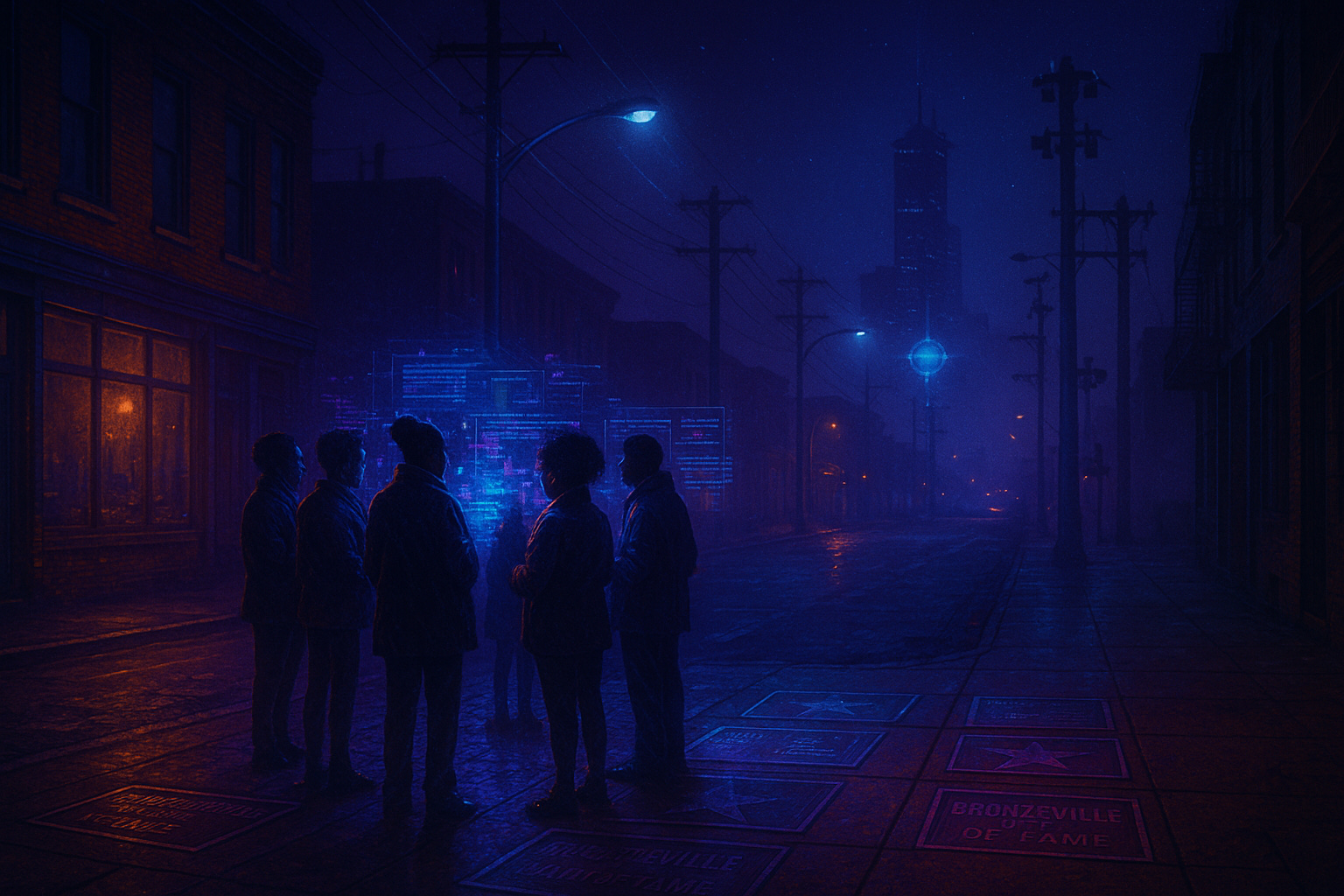
Chicago, Occupied Zone A—
Some nights the city exhales like a wounded animal, its breath fogging the sodium-lit dusk as if trying to warm itself against the cold machinery creeping in from every direction.
We live past the event horizon of the old world now, scavenging meaning from the wreckage of yesterday’s guarantees.
And still—still—we sketch blueprints for reconstruction with one hand while bracing the other on the barricades, listening for the metallic murmur gathering at the edge of the block.
We must design a future worth living while fighting off the one already being installed around us.
In this dispatch—written from the resistant streets of a city that feels more like a corporate testing ground than a home—I find myself asking a question forced upon us by machines we never requested and markets we never authored:
How do we resist an authoritarianism driven by capital and enforced by algorithm—
a system that dreams of utopia for the wealthy while consigning the rest of us to the engineered precarity of someone else’s world?
OCCUPIED CHICAGO: GROUND LEVEL
Here, the barricades are not only concrete.
They are psychic, cultural, economic, and algorithmic.
In the West Loop, a tenant union is fighting a “smart” building management system that trades reduced rent for biometric data—iris scans at the door, movement logs in the hallways.
In Rogers Park, the neighborhood council fractures over the city’s “Predictive Coordination Interface,” a shiny tool that promises efficient snow removal and trash pickup but demands that all public camera feeds be routed into a live analysis grid shared with the police.
In Little Village, the sky-blue ShotSpotter poles on 26th Street stand watch, recording street life while missing gunfire half the time.
Across the South Side, elders remind us: Chicago has been occupied before—by capital, by police, by the state. This newest occupation is simply more seamless and silent.
These metaphors are not exaggerations; they arise from lived experience.
The line between symbol and infrastructure has collapsed.
We are not threatened by AGI—not the hypothetical future.
The danger is the aftermath of the AI that already governs us now.
THE AFTERMATH: WHAT TODAY’S AI HAS ALREADY DONE
Let’s speak plainly.
AI has militarized our streets.
ShotSpotter misfires have sent police to the wrong block in 89% of reviewed cases.
AI has automated economic abandonment.
A 2019 lending algorithm charged Black and Latino borrowers higher interest rates, digitally redrawing Chicago’s red lines.
AI has erased workers.
At Amazon’s Goose Island warehouse, automated termination systems fire humans before managers know their names.
AI has colonized public space.
CTA stations, police body cams, private Ring feeds—Chicago itself is now a sensory network.
AI has devoured culture.
Our words, images, and histories are scraped without consent and fed into models sold back to us as “innovation.”
These are not glitches.
They are the blueprint.
WINGROVE, KIPLING, NAIPAUL — AND WHY WE REFUSE THEIR FEARS
David Wingrove’s The Broken Wheel imagines a future Earth rearranged into rigid strata—an architecture of obedience and sealed-off mobility.
Its horrors are physical, not digital.
This is not Chinese futurism.
It is Western panic—an imperial projection in the lineage of Kipling and Naipaul.
But we do not inherit that panic.
We inherit Fanon’s fire.
A dying colonialism is not the collapse of order—
it is the beginning of possibility.
THE LOGIC OF EMPIRE IN THE AGE OF ALGORITHMS
The true adversary is not a corporation or a CEO.
It is a logic—an algorithmic empire whose capital is data and whose currency is control.
Even Geoffrey Hinton—the so-called “Godfather of AI” and architect of the very neural systems now reshaping our world—has stepped away from the corporate labs to issue warnings about the accelerating logic of automation. Not warnings of rogue superintelligence or sci-fi apocalypse, but of the quiet, structural harms already unfolding: synthetic misinformation that corrodes democracy, automated surveillance that intensifies policing, and economic systems designed to erase workers rather than empower them. Hinton’s concerns are not the panic of an alarmist; they are the testimony of someone who helped build the machine and now sees how easily it can become an instrument of empire. His shift from researcher to whistleblower underscores the truth at the core of this dispatch: the danger is not hypothetical AGI—it is the real, existing AI being deployed to manage, predict, and discipline our lives.
And when we place Hinton’s warnings alongside the scholarship of Ruha Benjamin and Simone Browne, the picture sharpens into something far more grounded than Silicon Valley’s fantasies of rogue superintelligence. Benjamin shows how algorithmic systems reproduce racial hierarchies at scale, turning technological “innovation” into a new grammar of structural inequality. Browne traces the lineage of surveillance from the slave ship to the city streetlight, revealing how Blackness has always been the test case for new technologies of control. Hinton warns about what AI might become; Benjamin and Browne remind us what it already is—a layered, historical apparatus designed to track, predict, and discipline. In Chicago, these insights converge: ShotSpotter, CPD’s facial recognition lattice, biometric tenancy systems in the West Loop, and citywide camera grids are not accidents of the future—they are the latest chapters in an old story. Together, they reveal that the algorithmic empire is not emerging; it is already here, and it began with us
We are up against an empire built from the fusion of corporate optimization, state surveillance, and automated governance.
AFROFUTURISM AS THE CARTOGRAPHY OF SURVIVAL
And yet, even under this algorithmic occupation, we are not without maps for the road ahead. Contemporary Afrofuturist writers have been sketching its contours long before Silicon Valley learned to pronounce “AGI.”
In Sorrowland, Rivers Solomon showed how a Black body can defy a biopolitical regime engineered to surveil and mutate it.
Tochi Onyebuchi’s Goliath imagines cities hollowed out by abandonment and rebuilt by those left behind—a parable for Chicago’s fractured geographies.
Tlotlo Tsamaase’s Womb City gives us a society governed by biometric surveillance and predictive policing so total it erases consent—a mirror of the ShotSpotter mics over our own heads.
And across these futures, Namwali Serpell, Nnedi Okorafor, and the voices of Africa Risen remind us that memory, community, and insurgent imagination are technologies of survival.
What looks like collapse to empire is often the first heartbeat of another world.
WHAT EMPIRE FEARS MOST
Empire fears what it cannot model:
People building power it cannot quantify.
Workers refusing to code their own chains.
Artists reclaiming the cultural materials models depend on.
Neighborhoods building parallel infrastructures.
Cities placing limits on automated policing.
Movements that outrun predictive analytics.
Empire fears the Fanonian subject—
the human being who no longer believes domination is inevitable.
That is the breach in the architecture.
That is the glitch in the code.
RECONSTRUCTION: IN THE RUINS, THE NEXT WORLD BEGINS
Reconstruction is not abstract.
It is a field guide.
Below are prototypes already emerging:
1. Local Sovereignty
Barcelona’s Data Commons lets residents—not Amazon—govern municipal data.
2. Worker Power
Kenyan data annotators unionized in 2024.
Google engineers refused to build Project Maven.
3. Cultural Defense
The Obsidian Collection, CRATES, Nota AI, and RAIL licenses reclaim culture from algorithmic extraction.
4. Parallel Infrastructures
Uptown mutual aid groups use Signal and Element to coordinate logistics—networks invisible to predictive policing.
5. A New Political Imagination
Institutions built for dignity, not data throughput.
A refusal to treat optimization as a moral value.
6. Cross-Movement Solidarity
Climate justice, abolition, housing, tech accountability—united because AI has united the harms.
7. A Morality of Collective Survival
Choosing community as our organizing principle.
Rejecting despair as politics.
CONCLUSION
What we are attempting here in occupied Chicago is what people have always done in the shadow of empire:
Reject inevitability.
Construct possibility.
With our own hands.
This is the beginning of reconstruction after the end of the world.
We begin the next world now.
FURTHER READING (Appendix)
(use as Substack endnotes)
Afrofuturist / Africanfuturist fiction:
Rivers Solomon — Sorrowland
Tochi Onyebuchi — Goliath
Tlotlo Tsamaase — Womb City
Namwali Serpell — The Old Drift, The Furrows
Nnedi Okorafor — Remote Control, Lagoon
Andrea Hairston — Master of Poisons
Africa Risen anthology — ed. Sheree Renée Thomas et al.
Critical theory & history:
Frantz Fanon — A Dying Colonialism
Saidiya Hartman — Wayward Lives, Beautiful Experiments
Simone Browne — Dark Matters: On the Surveillance of Blackness
Shoshana Zuboff — The Age of Surveillance Capitalism
Ruha Benjamin — Race After Technology
AUTHOR’S NOTE: Why Afrofuturism Belongs in This Series
Afrofuturism is not an aesthetic add-on to this dispatch—it’s the narrative technology of survival. It is the intellectual and imaginative tradition that refuses the inevitability of empire, algorithmic or otherwise. While Silicon Valley dreams of AGI as a new frontier, Afrofuturist writers and thinkers have long mapped the realities of surveillance, occupation, and data colonialism. They offer not escape but orientation: blueprints for living, resisting, and rebuilding after systems designed to erase us. Afrofuturism is how we chart the next world while standing in the ruins of the present one.