
Flaming Gone Nuclear: From Utopian Internet to the Bamboozled Nation
From Satire to Smear: How America Learned to Love the Lie

by Floyd Webb
The internet was once hailed as a utopia. In its early days, visionaries spoke of it as a commons of knowledge, a democratic agora where hierarchies would collapse, communities would flourish, and the human mind would finally be free. It was imagined as a new Enlightenment, a library without walls.

But as philosopher Bernard Stiegler warned, every technology of memory carries a poison as well as a cure. The net’s promise of knowledge also contained its opposite: the proletarianization of attention, the outsourcing of thought, the erosion of judgment.
“Stupidity is not ignorance; it is the organized destruction of the capacity to think.” – Bernard Stiegler, For a New Critique of Political Economy
By this definition, the internet has become not a utopia of knowledge but a machine of stupidity. Designed to capture attention and amplify outrage, it produces belief without evidence, loyalty without proof, and suspicion without end.
To understand how we arrived here—to understand Twitter wars, algorithmic outrage, and QAnon—we must look to their historical antecedents. The story of flaming runs deep in American culture, a lineage tracing from satire to smear, from charlatans mocked by Mark Twain to politicians protected by J. Edgar Hoover.
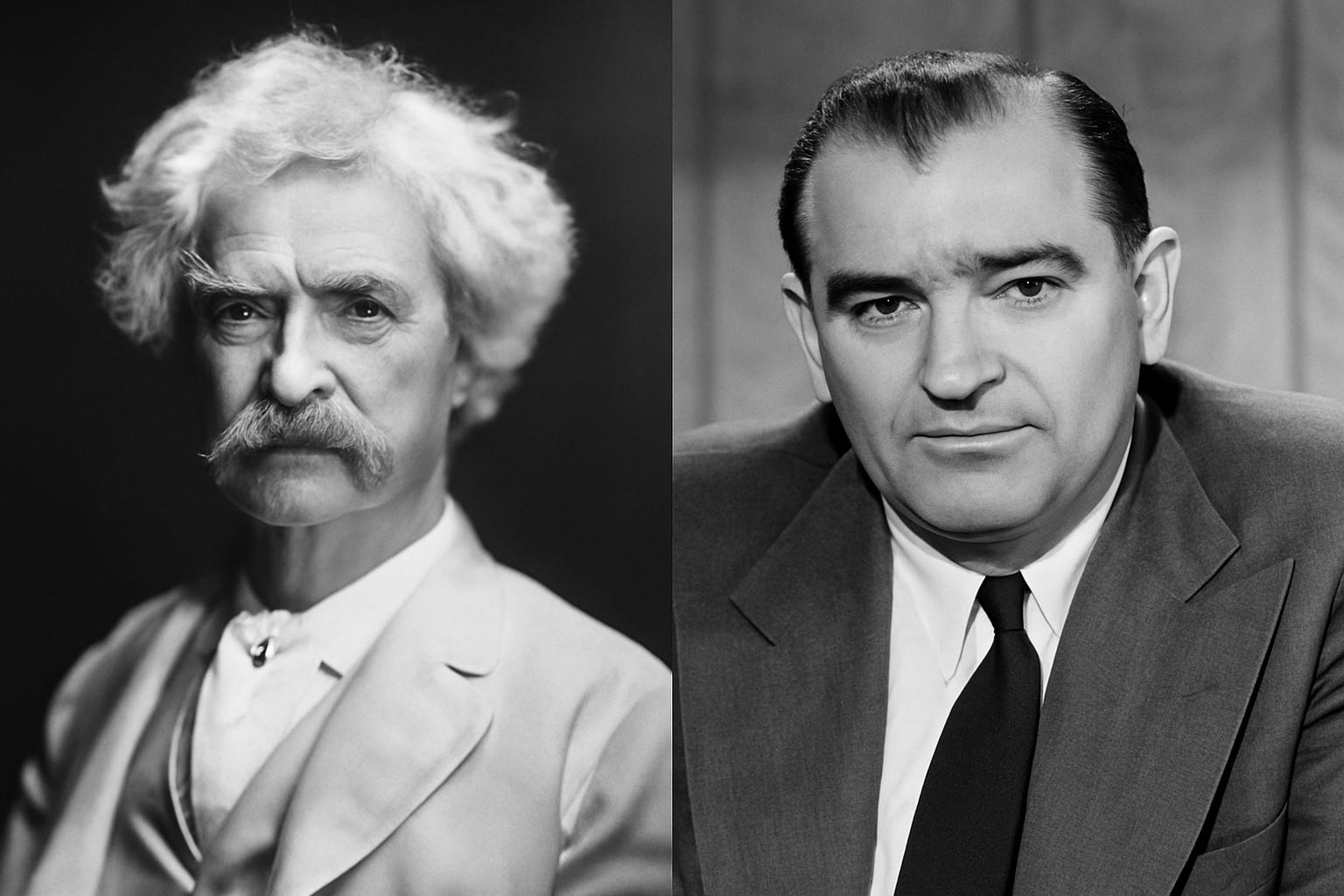
Twain: Satire as the First Flame
Long before message boards and social media, Mark Twain styled himself a muckraker. He relished ridiculing charlatans, politicians, and the “only native criminal class”—Congress.
“There is no distinctly native American criminal class except Congress.” – Mark Twain, Following the Equator
Twain’s flames were deliberate acts of social criticism, clothed in humor but sharpened with moral intent. His flaming was satire aimed upward at power; McCarthy’s would later be smear aimed downward at dissent. The difference is crucial: one used ridicule in the service of truth, the other in the service of power.
Twain also knew how easily people could be fooled, how quick they were to embrace illusion:
“It’s easier to fool people than to convince them that they have been fooled.” – Attributed to Mark Twain
McCarthy: From Satire to Smear
By the 1950s, Twain’s satirical flame had morphed into Joseph McCarthy’s political bonfire. Armed with televised hearings and lists of supposed communists, McCarthy transformed accusation into theater.
“I have here in my hand a list of 205… a list of names that were made known to the Secretary of State as being members of the Communist Party.” – Joseph McCarthy, Wheeling, WV speech, 1950
It scarcely mattered whether evidence existed. The accusation itself was enough to ruin careers and reputations. McCarthy’s flames, unlike Twain’s, were not critique but coercion—demanding obedience through fear.
And yet McCarthy was never truly held accountable. In 1954 the Senate finally voted to censure him for “conduct unbecoming,” but this was a slap on the wrist delivered after years of destruction. He kept his seat, faced no legal repercussions, and drank himself to death a few years later. None of the “lists” he brandished ever contained a single substantiated name.
This is the larger truth: American politics has rarely imposed immediate consequences for bad-faith accusation. Accountability, when it comes, is delayed, partial, and obscured. McCarthy’s case set the precedent that smear could succeed, that truth could be optional, and that political flaming would be punished only when it embarrassed the institution, not when it ruined lives. Because there was never any qualified pushback against his behavior, the style endured—and we live now with its fallout.
Roy Cohn and J. Edgar Hoover: Smear as Statecraft
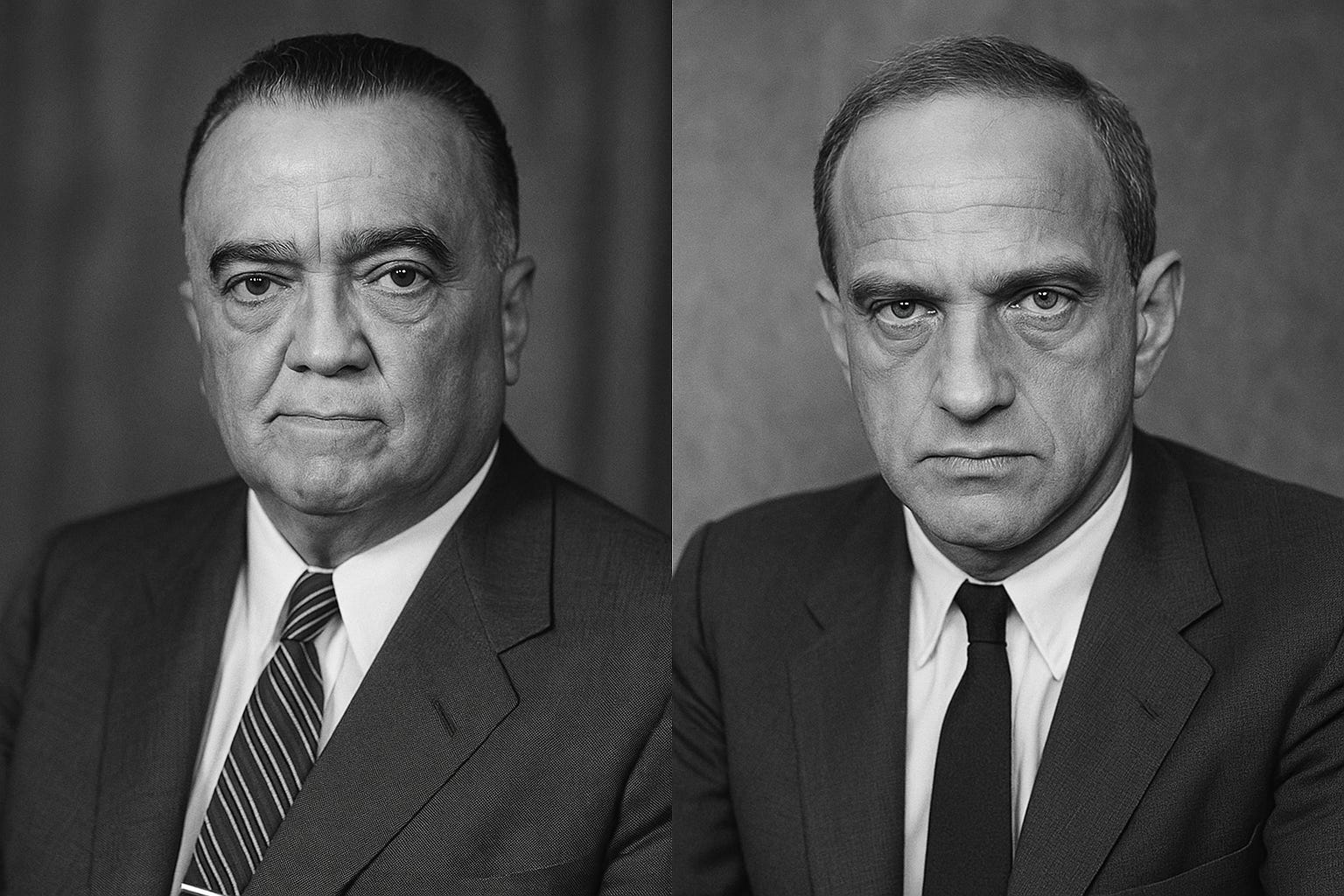
McCarthy eventually collapsed under the weight of his own recklessness. But his young counsel, Roy Cohn, carried the torch. Trained under J. Edgar Hoover at the Justice Department, and placed with McCarthy by Hoover’s recommendation, Cohn brought the FBI’s culture of suspicion directly into Senate investigations.
Cohn perfected the tactic of accusation without evidence: smear first, prove later—or never. Hoover, meanwhile, institutionalized flaming at the state level. Through COINTELPRO, he targeted civil rights leaders and activists, spreading rumor and innuendo to discredit them.
“The Negro youth must be made to understand that if he goes to jail, he will be left to rot there.” – J. Edgar Hoover, internal FBI memo on civil rights activists, 1960s
What had begun as Twain’s satirical ridicule, and then McCarthy’s televised smear, was now bureaucratic procedure, embedded in the machinery of government.
Trump: The Protégé and the Amplifier
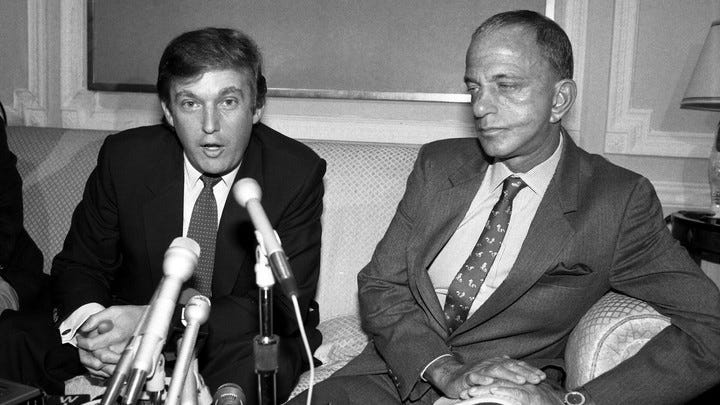
Donald Trump, Cohn’s most famous protégé, absorbed every lesson. Attack relentlessly. Never admit fault. Turn every critique back on the accuser. Truth is irrelevant; heat matters more than light.
With Twitter as his stage, Trump elevated flaming to presidential strategy. He governed through insults, nicknames, and accusations, each tweet a miniature McCarthy hearing broadcast to the globe.
“An ‘extremely credible source’ has called my office and told me that Barack Obama’s birth certificate is a fraud.” – Donald Trump, Twitter, 2012
The difference was scale. Twain had readers. McCarthy had a television audience. Trump had algorithms that rewarded every provocation with instant reach. Flaming was no longer episodic; it was systemic, the logic of governance itself.
Faith and the Bamboozled Nation
Why are we so easily bamboozled? Twain saw it in the gullibility of his age; McCarthy weaponized it; Cohn and Hoover entrenched it; Trump monetized it. Beneath it all lies something deeper in American culture: a training in faith-based acceptance.
Certain strands of American evangelical and fundamentalist thought valorize belief without evidence, treating doubt not as inquiry but as betrayal. Preachers from Billy Sunday’s revival tents to the Moral Majority era equated skepticism with disloyalty, teaching that faith is virtue, doubt is sin.
This is not unique to religion. It reflects a broader cultural preference for certainty and simple narratives over doubt and complexity. Religious expression has been one powerful vehicle for this impulse, but not the only one.
Conspiracies like QAnon thrive on this foundation: secret knowledge, prophetic revelations, martyrs and heretics. The flaming style—mockery, suspicion, denunciation—becomes the liturgy of a secular faith.
Thus the question: has America become the bamboozled nation, primed to confuse accusation with truth, spectacle with evidence, heat with light?
This cultural predisposition soon found its perfect medium.
The Internet as Nuclear Reactor
The internet didn’t invent flaming—it amplified it beyond recognition. What Twain practiced with wit, what McCarthy staged on television, what Hoover institutionalized in files, and what Trump weaponized on Twitter—all of it now lives inside a global machine that feeds on outrage.
The internet is the nuclear reactor that superheated this longstanding cultural element. Without proper containment—without digital control rods and firebreaks—the reaction threatens to go critical. The fallout is the pervasive stupidity Stiegler described—a contaminated information environment that poisons public discourse.
Flaming is not a bug of the digital age; it is the central feature of platforms designed to monetize attention. As Stiegler would put it, stupidity has become infrastructure: a system for manufacturing suspicion and loyalty without proof, in which everyone is a flamer and everyone a target.
This is not to say the digital realm is devoid of light. The same networks that spread conspiracy theories also empower activists, journalists, and educators. They enable marginalized voices to speak, movements to organize, and truths to surface that legacy media ignored. But the dominant economic incentives of today’s platforms have catastrophically tilted the scales toward outrage and suspicion, overwhelming the possibilities of resistance.
Hope After the Flames
The story so far could leave us in despair. But history also shows us that flaming need not only destroy. Twain wielded ridicule against fraud. Communities have resisted smear campaigns. Even in the nuclear age of digital outrage, there are ways back.
Rebuild Critical Literacy. Integrate media literacy into school curricula that explicitly teaches students how rhetorical tactics like smears, scapegoating, and conspiracy logic operate—tools to inoculate against being bamboozled.
Create Digital Firebreaks. Just as firebreaks in forests slow the spread of wildfire, digital firebreaks could include platform designs that slow the viral spread of unverified claims, or moderation systems that reward civility and evidence instead of outrage.
Demand Accountability. McCarthy was censured only after years of damage. Today, flaming politicians are often rewarded with clicks and airtime. This cycle will only break when bad-faith tactics are penalized—for instance, by media outlets refusing to platform known purveyors of smears, or by voters rejecting candidates whose primary mode of engagement is flaming.
Reinvent the Net. If technology is a pharmakon—both poison and cure—then we must imagine curative platforms: designed not to exploit attention but to cultivate it, privileging reflection over reaction, complexity over certainty.
“The pharmakon is both remedy and poison. The question is not whether to reject it, but how to take it.” – Bernard Stiegler, Technics and Time, 1
A Stieglerian internet would not be free of flame, but it would channel fire toward light, not destruction.
Conclusion: Firebreaks, Not Extinction
The flames have indeed gone nuclear. From Twain’s sparks of satire to McCarthy’s bonfires, from Hoover’s files to Trump’s tweets, we have rehearsed the art of accusation for more than a century.
But hope is not refuge—it is practice. The work ahead is long: unlearning credulity, rebuilding trust, and creating firebreaks that contain the blaze without extinguishing passion.
If America is the bamboozled nation, then the task is not only to diagnose the fire but to recover the capacity for light—for critique, for reflection, for truth—in a library that, for now, has become a furnace.
Addendum: A Lineage of American Bamboozlers
McCarthy was never an accident. He was the heir to a proud American tradition — the fine art of duping a nation. One grifter hands the torch to the next, each burning the country in their own way. His story does not stand alone. He is but one act in a recurring American drama where spectacle and deception have played as powerful a role as policy. A brief lineage makes the point:
• P. T. Barnum (1850s) — Though not a politician, Barnum’s career as a master showman established the American appetite for spectacle, exaggeration, and hoax. His carnival of illusions was a training ground for the politics of hype.
• Andrew Johnson (1865–1869) — As president after Lincoln, Johnson bamboozled poor whites with appeals to racial resentment, sabotaging Reconstruction and civil rights in the name of “restoring order.”
• James G. Blaine (1880s) — Nicknamed “the Continental Liar from the State of Maine,” Blaine embodied the Gilded Age’s corruption, backroom deals, and political graft.
• Huey P. Long (1930s) — The “Kingfish” combined genuine redistribution with authoritarian theatrics, leaving Louisiana dazzled and divided.
• Father Charles Coughlin (1930s) — America’s “radio priest” turned the new mass medium into a pulpit for fear, conspiracy, and anti-Semitism.
• Joseph McCarthy (1950s) — The great accuser, waving blank pieces of paper as “lists” of traitors, conjuring fear out of thin air.
• Richard Nixon (1950s–1970s) — From Red-baiting campaigns to the Watergate cover-up, Nixon perfected the politics of suspicion and deceit.
• Spiro Agnew (1970s) — Nixon’s vice president, who honed the art of media-bashing with venomous alliteration, turning criticism itself into an enemy.
• Ronald Reagan (1980s) — The “Great Communicator,” who wrapped economic austerity and covert wars in a Hollywood glow of optimism.
• George W. Bush (2003) — The Iraq War, justified by phantom weapons of mass destruction, was among the grandest bamboozles in modern history.
• Donald Trump (2016–) — The heir to Barnum, Trump blurred politics with reality television, transforming disinformation into daily theater.
Together they mark a through-line: a republic often entranced, misled, or entertained into submission. McCarthy was not the beginning, and Trump is not the end. The bamboozlement of America is a tradition—one that Twain skewered with wit, McCarthy exploited with fear, and future generations will confront in their own forms.
Further Reading
• Mark Twain, The Mysterious Stranger (1916): Twain’s late, dark satire on illusion and human folly. Full text (Project Gutenberg)
• Richard Hofstadter, The Paranoid Style in American Politics (1964): The classic essay on conspiracy, fear, and American political theater. Harper’s Archive
• David Brion Davis, The Fear of Conspiracy (1971): A foundational study of conspiracy thinking in U.S. history.
• Ellen Schrecker, Many Are the Crimes: McCarthyism in America (1998): A definitive history of McCarthy’s tactics and impact.
• Christopher Lasch, The Culture of Narcissism (1979): How media and spectacle eroded truth and civic life.
• Neil Postman, Amusing Ourselves to Death (1985): Television and the transformation of politics into entertainment.
• Bernard Stiegler, Technics and Time, 1: The Fault of Epimetheus (1994): On technology, memory, and the shaping of collective consciousness.
• Naomi Oreskes & Erik Conway, Merchants of Doubt (2010): How deception campaigns bamboozled the public on smoking, climate, and beyond.
• Timothy Snyder, On Tyranny: Twenty Lessons from the Twentieth Century (2017): Short lessons on resisting political manipulation.