
FRAME WARS
Cinema, Behavioral Capture, and the Stories That No Longer Need Permission

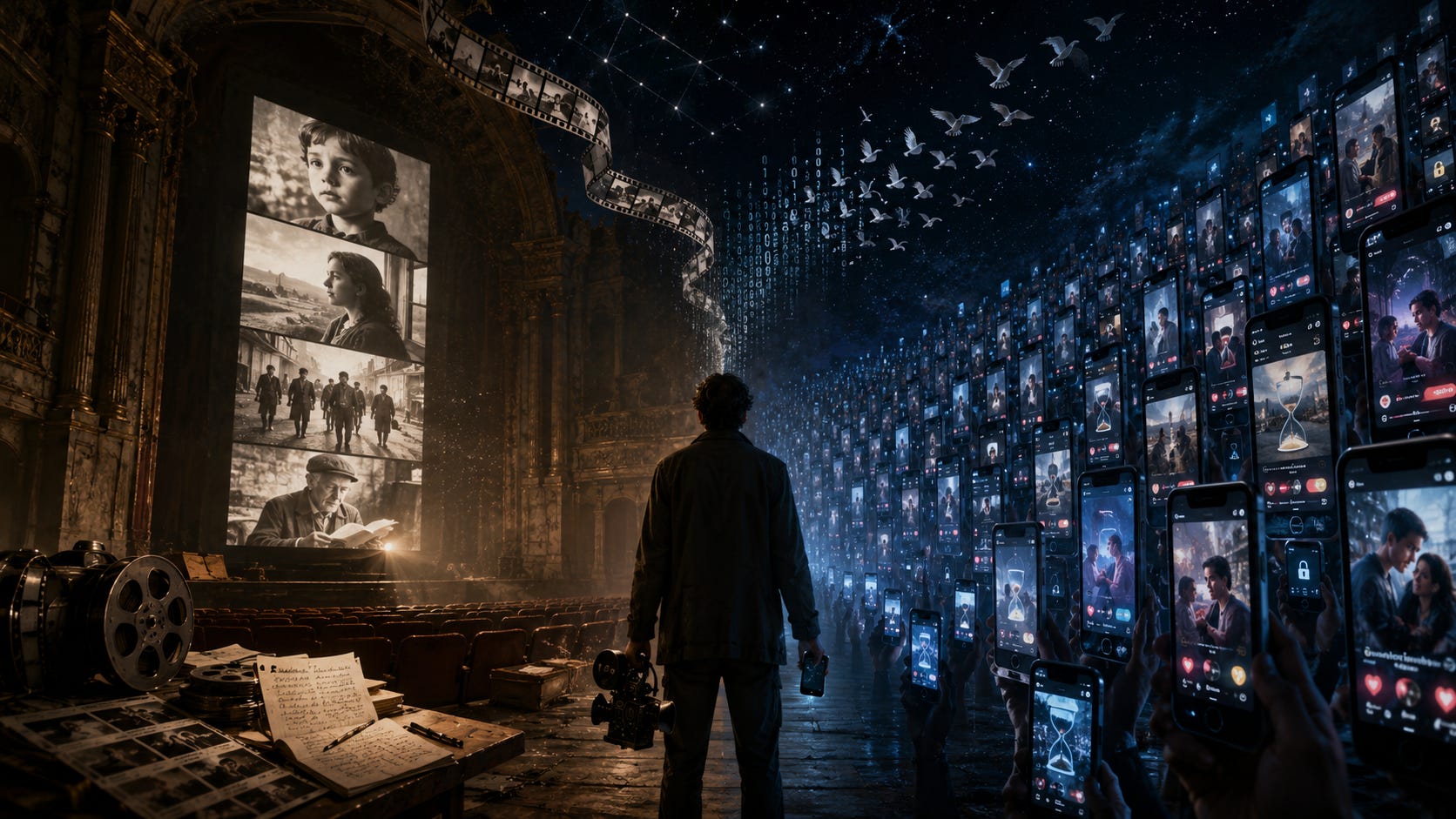
by Floyd Webb
The vertical frame itself is innocent. The feed is not.
I saw hyperbole, and that made me suspicious.
The announcements spoke of billions of dollars flowing into vertical entertainment. Platform partnerships were offered as proof that a new cinematic form had arrived. The language carried the familiar perfume of inevitability: this is the future, platforms are democratizing cinema, creators are finally being elevated.
Hyperbole does not always mean someone is lying. More often, it signals that the story being told has drifted away from the machinery underneath it. The words become larger as the reality becomes harder to see.
So I followed the money. I began trying to separate the claims from the infrastructure supporting them, and what emerged was not one expanding art form but two largely separate worlds occupying the same frame.
In one, filmmakers and visual artists are exploring the vertical image as a formal choice, discovering how it alters our relationship to the body, architecture, movement, intimacy, and space. This work circulates through museums, experimental-film programs, gallery installations, and occasional commercial commissions. It asks what the upright frame might reveal that the horizontal frame does not.
In the other, billions of dollars are being invested in serialized microdramas engineered for mobile consumption, algorithmic retention, and repeated payment. Here, the frame is not primarily a language. It is an instrument. Its purpose is not to deepen attention but to hold it long enough for the next transaction.
The frame may be vertical in both worlds, but the intentions beneath it could hardly be further apart.
One asks what the image can reveal.
The other asks how long the image can keep you from looking away.
For the purposes of this essay, cinema means work in which formal choices serve human meaning, where frame, duration, sound, movement, and sequence become arguments about the world rather than architecture for behavioral capture.
The Split Screen
I use the word bifurcation deliberately.
A bifurcation occurs when one structure divides into branches that begin operating independently of one another. This is more than a range running from commercial to experimental. The two worlds of vertical filmmaking have developed different capital flows, different audiences, different methods of distribution, and increasingly different ideas about what the image is for.
The first branch treats the vertical frame as a visual language.
Damien Chazelle’s The Stunt Double, made for Apple’s “Shot on iPhone” campaign, composes movement specifically for the upright screen. The format is not an inconvenience to overcome but a condition that shapes the action itself. Xavier Dolan’s Mommy, though not a vertical film, uses its almost square frame to create a similar sense of emotional compression. The image appears to press inward upon the characters, turning confinement into something the viewer can feel.
The Sonic Acts Vertical Cinema project pushed the form in another direction, using 35mm film projected vertically onto monumental screens. In that setting, the upright image was no longer merely a phone orientation. It became architecture. It towered over the audience.
These works demonstrate that the vertical frame has genuine cinematic possibilities. It can attend to faces, bodies, buildings, trees, doorways, and public space in ways that widescreen sometimes cannot. It can make height intimate. It can make enclosure visible. It can reorganize our sense of where the human figure belongs inside the image.
But this branch remains relatively small. It must be sought out. It waits inside museums, festivals, galleries, and specialized screenings.
The second branch does not wait to be found.
It arrives in the hand.
The narrative becomes the interface. The story becomes the store.
The Machinery
ReelShort, DramaBox, and similar platforms have transformed the vertical frame into the delivery mechanism for an enormous microdrama industry.
The episodes often last one or two minutes. The stories stretch across forty, sixty, sometimes ninety installments. The first episodes are free. What follows must be unlocked through digital coins, subscriptions, or repeated advertising views.
The cliffhanger, under these conditions, is no longer simply a storytelling device.
It becomes the payment mechanism.
Each episode ends at the point of maximum emotional incompletion. The lover enters the wrong room. The hidden heir is recognized. The dead spouse opens her eyes. The audience is not given time to sit with what has happened because sitting with it is not the business model. The viewer is placed into a minor state of withdrawal and offered immediate relief for a small fee.
The story becomes the store.
This does not mean the people making these productions lack talent. Real actors, cinematographers, editors, costume designers, technicians, and production crews work on them every day. Many are simply making a living in an entertainment industry that has become increasingly unstable. Some will undoubtedly find expressive possibilities inside the form, just as artists have always found ways to work within commercial constraint.
But the economics do not merely surround the work. They shape it.
Production schedules compress. Visual language simplifies. Dialogue repeats itself because audiences may be distracted. Faces must remain legible on small screens under almost any conditions. Characters must announce themselves quickly. Every scene must accelerate toward another interruption because interruption is what produces the next payment.
What appears to be a new grammar is often an old commercial grammar broken into smaller, more profitable units.
The vertical frame is not the real innovation.
The monetization system is.
Visibility Architecture
Platforms do not need to censor difficult work. They only need to make it difficult to encounter.
That is what I mean by visibility architecture.
A thoughtful documentary can be uploaded. An experimental vertical film can be completed. A first-time filmmaker can publish something formally daring or historically necessary.
None of that guarantees that anyone will see it.
Platforms determine which images appear before us, how frequently they return, and which emotional behaviors are rewarded. Work that requires patience enters this environment at a disadvantage. Work engineered for immediate recognition, outrage, romance, fear, or suspense arrives already optimized for circulation.
The platform does not have to tell a filmmaker no. It can simply decline to place the work before an audience.
The old gatekeeper sat across a table.
The new gatekeeper disappears into the feed.
The vertical frame itself is innocent.
The feed is not.
Chicago, April 2026
This was the framework I carried with me into the Chicago AI Film Festival.
I expected another conversation about technology. Instead, I encountered something more interesting and, in some ways, more hopeful.
Many of the people screening work did not describe themselves as traditionally trained filmmakers. They admitted that plainly. They had not passed through film school, studio development, television commissioning, or the independent-film institutions that once determined who was prepared, equipped, or permitted to make moving images.
What they possessed instead was the desire to tell a story.
That desire turned out to be the most important fact in the room.
They had ideas they wanted to bring to life, and the technology allowed them to begin without first convincing a producer, a commissioning editor, a grant panel, a studio executive, or anyone else empowered to decide whether their imaginations were worth financing.
Kimberly Offord’s The B-Side: The Future Is Past moved through speculative fiction into the Jim Crow South. Aaron Liberman’s Before Mount Rushmore: The Story of Spotted Tail returned a Lakota leader to the historical record and placed him at the center of his own story.
What mattered was not merely that artificial intelligence had been used to make the work. Technology by itself is not vision, and novelty is not meaning. What mattered was that an idea had crossed the distance into material form.
A story that might once have remained in someone’s head now existed in the world.
That, to me, is the genuinely revolutionary promise of artificial intelligence.
Not that everyone can now produce more content.
That people can make stories the permission structure has repeatedly refused.
The studio once said no across a table. The algorithm says nothing. It simply declines to show the work.
For most of cinema’s history, that distance between imagination and realization was guarded by money. Cameras, film stock, laboratories, editing systems, sound stages, crews, costumes, locations, and visual effects required substantial resources. Even digital production, which lowered many of those barriers, left others standing. Historical reconstruction and speculative worlds remained far beyond the reach of many independent storytellers.
AI changes that equation.
It does not eliminate the need for research, judgment, craft, rhythm, performance, or cinematic intelligence. In careless hands, it can produce imagery as hollow as anything created by more expensive means. But it can narrow the distance between an idea and its realization.
A person with a story no longer has to wait for an institution to agree that the story deserves to exist.
That is democratization worth defending.
The New Gatekeeper
I do not dismiss formal training. Quite the opposite.
I have spent too many years making, programming, and studying films to believe that access to tools automatically produces understanding. A camera does not teach composition. Editing software does not teach duration. A prompt does not teach history. Image generation does not teach why one image belongs after another.
The arrival of new makers creates a responsibility as well as an opportunity.
They must be able to ask what the frame does to meaning. They must understand how images carry ideology, how montage manufactures association, how sound alters memory, and how every technical decision can also become an ethical one.
I have stood in the darkroom at Tuley Park with photographers working in chemical baths and actual film stock. The constraint slows them down. They must expose deliberately, develop patiently, and remain with the image long enough to discover what they have actually made.
That slowness produces a kind of knowledge.
The danger is not that new filmmakers lack institutional credentials. Many great filmmakers have lacked them.
The danger is that platforms will persuade them that formal understanding is unnecessary, that reach can replace composition, engagement can replace meaning, and retention can replace reflection.
A filmmaker may no longer depend upon a studio executive, but may become dependent upon an algorithm whose decisions are harder to question because they cannot be seen.
The old permission structure was explicit.
The new one withholds visibility.
The Inversion
This is where the rhetoric surrounding AI and vertical entertainment begins to invert reality.
The extraction economy borrows the language of liberation. Creators are being elevated. Barriers are disappearing. New voices are flourishing.
Some barriers truly are disappearing.
I witnessed that in Chicago.
But the system attracting the largest investment is not necessarily the system supporting the most necessary stories.
One expands the number of people capable of making images.
The other narrows the kinds of images most people are likely to encounter.
Those are not the same revolution.
At precisely the moment when technology makes previously impossible stories possible, platform economics threaten to bury them beneath an industrial abundance of designed distraction.
The problem will not be a shortage of images.
The problem will be finding the ones that matter.
Category Laundering
As microdrama expands, it increasingly acquires the outward signs of artistic legitimacy: festivals, awards, branded competitions, professional panels, sponsorships, and categories honoring cinematic achievement.
Some of the work receiving those honors may deserve them. The vertical frame is capable of beauty, and commercial production does not automatically exclude artistic value.
But institutions must still be able to distinguish between formal innovation and an efficient sales mechanism.
A monumental celluloid installation, an intimate phone documentary, an independent dramatic experiment, and a seventy-episode pay-per-cliffhanger romance may all occupy the same rectangle. They are not therefore engaged in the same activity.
The danger is not simply that bad work may receive prizes.
The danger is that language loses its power to make distinctions.
Once extraction can successfully describe itself as democratization, criticism begins to sound elitist. Any demand for rigor becomes gatekeeping. Any discussion of form becomes nostalgia. Any distinction between cinema and content becomes an attack on ordinary audiences.
That is a convenient arrangement for the platform.
It no longer has to defend the machinery. It can accuse anyone who examines it of resisting the future.
What Cinema Requires
Cinema has survived every technological transformation thrown at it.
It survived sound, color, television, videotape, digital cameras, computer-generated imagery, streaming, and the phone. It will survive artificial intelligence.
The frame changes.
The deeper obligation does not.
Cinema asks someone to shape time and image into meaning. It asks someone else to meet that work with attention.
The people I encountered in Chicago reminded me that cinema has always renewed itself through outsiders carrying stories institutions did not yet know how to value. The history of the medium is filled with people who arrived from somewhere else, carrying images that did not fit the categories already waiting for them.
The question is no longer whether such people can make those stories.
Increasingly, they can.
The question is whether we will ever be allowed to see them.
Will a story about Black life, Indigenous memory, or an unprofitable corner of history reach ten million people or ten thousand? Will it travel because an audience chooses it, or disappear because a platform finds it insufficiently compulsive? Will the same technologies that break the old permission structure simply construct a new one, governed not by executives in offices but by invisible calculations of retention?
The extraction system does not need to prohibit worthwhile stories.
It needs only to make them difficult to encounter.
That is how the bifurcation holds: meaningful work becomes easier to make and harder to find, while work designed for behavioral capture becomes unavoidable.
The promise of new technology must be larger than producing more material for platforms to monetize. It must include the possibility that stories once denied permission can enter public memory, find audiences, and alter how we understand the world.
Otherwise, we have not democratized cinema.
We have merely turned the screen sideways and built a more efficient marketplace inside it.
About the Author
Floyd Webb is a Chicago filmmaker, photographer, writer, and media historian. His work explores the intersections of technology, memory, cinema, and Black cultural history. He is the author of the Remain Human essay series on Substack, examining how artificial intelligence and emerging technologies are reshaping culture—and what remains uniquely human in the process.
Further Reading
Chazelle, Damien, dir. The Stunt Double. Apple, 2020.
Dolan, Xavier, dir. Mommy. Metafilms, 2014.
Elsaesser, Thomas, and Malte Hagener. Film Theory: An Introduction through the Senses. 2nd ed. New York: Routledge, 2015.
McLuhan, Marshall. Understanding Media: The Extensions of Man. New York: McGraw-Hill, 1964.
Omdia. “Microdramas Overtake Streamers on Mobile Engagement.” London: Omdia, 2026.
Sonic Acts. Vertical Cinema. Amsterdam: Sonic Acts Foundation.
Zuboff, Shoshana. The Age of Surveillance Capitalism: The Fight for a Human Future at the New Frontier of Power. New York: PublicAffairs, 2019.