
Grave 672
On Erasure, Necropolitics, and the Unfinished Business of Mississippi

by Floyd Webb
“Not everything that is faced can be changed, but nothing can be changed until it is faced.”
— James Baldwin
I was born in Mississippi. I left Mississippi. I carry Mississippi in my body the way a man carries shrapnel — lodged, never fully gone, aching when the weather changes. I am in my seventies now, a child of Jim Crow, a migrant son of the Great Migration, one of the thousands who rode the Illinois Central north toward Chicago, toward the Up South industrial corridors where the forges and stockyards promised something that was not quite freedom but was at least distance. Distance from the fields. Distance from the terror. Distance from the graves.
I thought I had put distance between myself and those graves.
I was wrong.
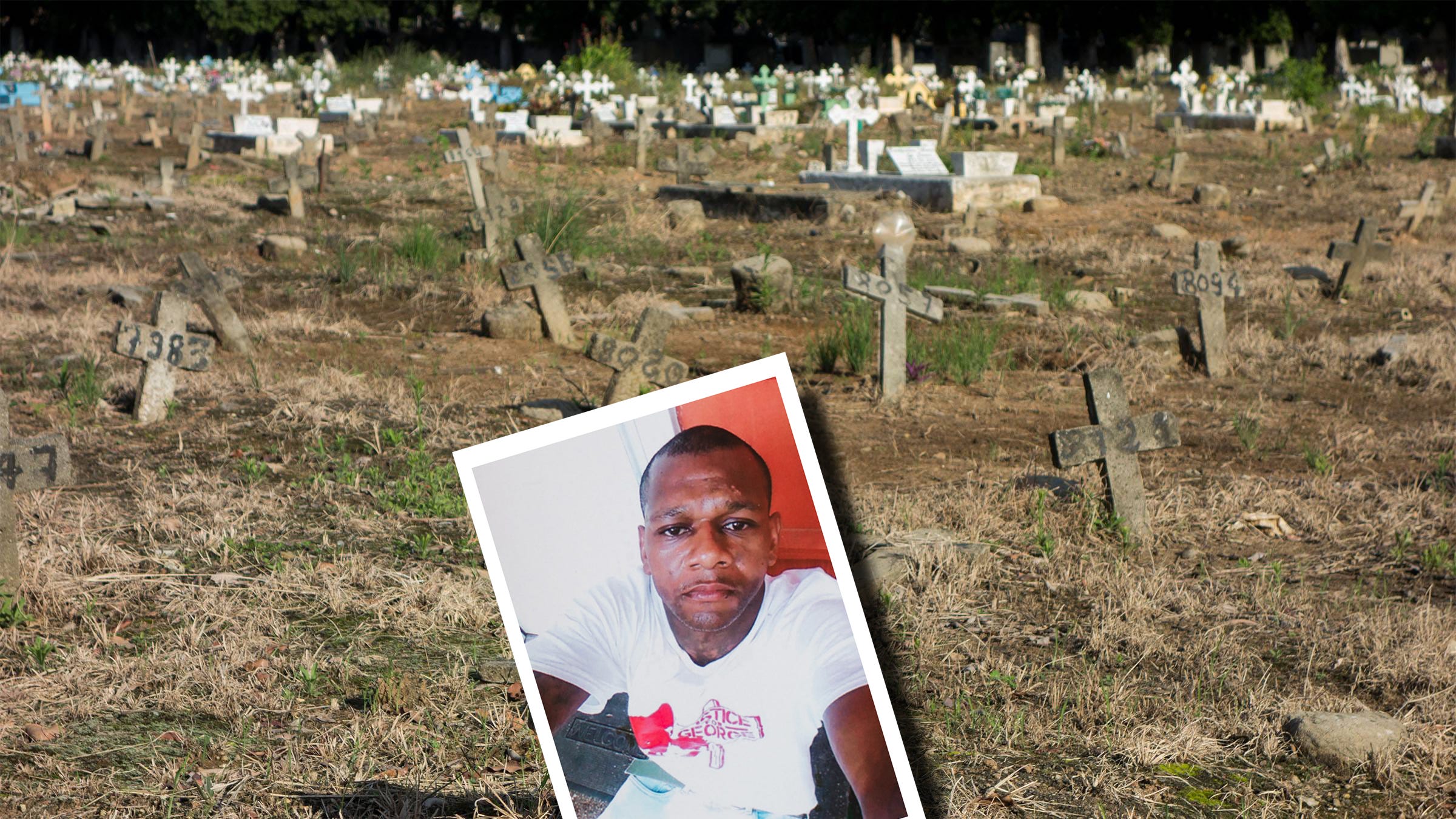
A metal rod in the ground stamped with the number 672. That was how the state of Mississippi recorded the death of a man named Dexter Wade — killed by a police car in Jackson in March 2023, buried behind a jail in Hinds County without his family’s knowledge, despite having identification on him. He had a name. He had a mother. He had a life. His mother did not know he was dead. His mother did not know he was in the ground. The state knew both of these things and said nothing.
This is not 1880. This is not 1930. This is not 1955. This is not the 1960s. This happened between 2016 and 2023, in the twenty-first century, in Jackson, Mississippi. Two hundred and fifteen bodies in unmarked ground. Families who were never called. Numbers where names should have been.
Mississippi Goddamn.
The Architecture of Disposability
Achille Mbembe, writing about what he calls necropolitics, asks us to look beyond the simple question of who is killed and to examine instead who is granted a death. Not just an ending, but a recognized ending — a death that counts, that is mourned, that enters the human record. His argument is that sovereign power, in its fullest and most violent expression, is the power to determine whose death registers and whose does not.
Grave 672 is not a number. It is the state’s answer to that question.
Mbembe describes what he calls “death-worlds” — social conditions in which certain populations are rendered as the living dead, kept in existence but stripped of the political and ontological weight that transforms a life into a loss when it ends. The 215 people buried behind the Hinds County jail were not victims of a secret conspiracy. They were victims of something more banal and therefore more devastating: a system that simply did not register their existence as requiring notification. The machinery of the state knew who they were — Dexter Wade had identification — and chose, procedurally, administratively, with paperwork and county ordinance, to say nothing.
This is what Mbembe means by the void in colonial governance. Not a hole in the system. A feature of it. These 215 people did not slip through the cracks. The cracks were constructed for them.
The Plantation Ledger, Translated
Frantz Fanon understood that colonial violence does not announce itself as violence. It announces itself as procedure. As administration. As the proper management of a difficult situation involving, as the officials in Jackson put it, “unclaimed remains.”
“Unclaimed remains.” As if Dexter Wade were lost luggage. As if the 215 people buried in numbered ground had simply failed to arrange for their own collection. The passive construction does enormous ideological work: it shifts responsibility from the state that withheld notification to the families who were never given the chance to claim.
In The Wretched of the Earth, Fanon describes a colonial world cut in two by a line that is maintained not only by force but by language — by the vocabulary of order and management that the colonizer deploys to convert atrocity into paperwork. I grew up in that language. I learned early that some words were traps: words like “vagrancy” and “loitering” and “pauper” that translated Black existence into administrative categories that justified whatever happened next. “Pauper’s graveyard.” That phrase belongs to the same family. It is the plantation ledger translated into county ordinance.
Fanon also taught us that the colonized world produces what he called the zone of non-being — a psychic and social space where the humanity of certain people is not so much denied as simply not consulted. The officials in Jackson did not wake up every morning and decide to dehumanize the poor Black residents of Hinds County. They simply operated within a system where those residents existed, when they died, only as a logistical matter to be resolved. Number the rod. Mark the ground. File the paperwork. Move on.
What My Body Knows
James Baldwin warned that the Black American past is not a wound to nurse but a fact to face. He meant that the facing was itself an act of resistance — that refusing to look away, refusing to let the weight of history be managed into something comfortable, refusing to accept the official language of progress, was the first and hardest kind of work.
I am a witness. Not a witness in the legal sense, not someone who happened to be present at a specific moment, but a witness in the sense that Baldwin meant — someone whose body carries evidence of what the official record refuses to hold. I was born in Jim Crow Mississippi. I have a body that remembers what the state’s paperwork does not. I rode north on the Great Migration not as a statistic in somebody else’s sociology but as a child who understood, without being able to name it, that the land and the state and the law were organized around the premise that I was expendable.
I am seventy-something years old and I am writing with tears in my eyes because I thought that when I read about numbered graves in Mississippi I would be reading about history. And instead I am reading about 2016. About 2019. About 2023. About a man named Dexter Wade whose mother did not know he was in the ground.
Baldwin told us this was coming. He told us in 1963, in “The Fire Next Time,” that the history “is longer, larger, more various, more beautiful, and more terrible than anything anyone has ever said about it.” He told us that the republic would not save itself, that it would not even see the need until it was far too late, that the willingness to look at what had been done would be the test of whether anything could be changed. The republic failed that test in 2016 and 2017 and 2018 and 2019 and 2020 and 2021 and 2022 and 2023, in a field behind a jail in Jackson, Mississippi, 215 times.
The Continuity Is the Argument
There are those who will say that this is not what it looks like. That it was a known site, not a secret. That the county followed procedure. That the failures were administrative, not intentional. That it is not fair to reach for the language of colonialism and necropolitics when what we have here is, at worst, an underfunded and overwhelmed county bureaucracy.
I have been hearing that argument my entire life. I heard it in Mississippi when I was a child. I heard it in Chicago when the stockyards and the redlines and the contract selling carved out the South Side as a sacrifice zone. I heard it every time the official language of administration was deployed to explain why the outcomes for Black people kept rhyming with the outcomes under systems that everyone had officially renounced.
Mbembe’s insight is that the continuity itself is the argument. You do not need a conspiracy. You do not need intent. You need only a system that, generation after generation, produces the same results — that renders the same bodies into numbers, the same deaths into logistics, the same mothers into people who find out from an attorney rather than from the state. That continuity — the same outcome across centuries, administrations, and zip codes — is what necropolitics looks like when it is working as designed.
Dexter Wade was born in the twenty-first century. He died in the twenty-first century. He was buried in the twenty-first century. And every structural condition that put him in that field with a number instead of a name is older than anyone alive. That is not bureaucratic failure. That is inheritance.
What we are looking at in Hinds County did not begin in 2016. Counties across Mississippi have long maintained burial grounds for the poor, the incarcerated, and the unclaimed — places where bodies were reduced to case numbers and ledger entries long before digital databases replaced paper files. The technology has changed. The logic has not. The plantation ledger did not disappear. It modernized.
The Color Line Did Not End. It Was Administered.
W.E.B. Du Bois declared that the problem of the twentieth century was the color line. He meant the enforced boundary between Black humanity and full recognition — political, legal, social, ontological. He meant that the organizing principle of American life was the systematic exclusion of Black people from the category of those whose lives counted, whose deaths registered, whose futures were legible to the state as futures worth protecting.
The problem of the twenty-first century is the persistence of white supremacy. Not the hooded variety — though that persists too — but the administrative variety. The kind that does not require a burning cross because it has a county ordinance. The kind that does not need a mob because it has a procedure. The color line did not end. It was municipalized, digitized, and filed under “unclaimed remains.”
Two hundred and fifteen bodies. That is the number we know because someone looked. Because a mother refused to stop asking. Because a civil rights attorney filed the right motions and found the right records. The question the number raises is not how this happened. The question is: how many fields are there that no one has looked at? How many counties across Mississippi, across the Deep South, across the industrial corridors of the Up South where the Great Migration deposited its children, are maintaining their own numbered grounds? How many mothers are waiting for a call the state has already decided not to make?
If there are 215 bodies in one county’s field, the honest reckoning is that 215 is not a count. It is a sample. Dexter Wade’s number was 672 — which means the system had been running, unexamined, long enough to reach 672 before anyone noticed. What that number suggests about the numbers we will never see — the ones never assigned, the fields never examined, the families that stopped waiting before anyone thought to look — is not a mystery. It is an arithmetic of erasure that has been operating since the overthrow of Reconstruction, when the brief window of Black political life was slammed shut and the long administration of Black disposability resumed.
Du Bois was writing about a line. I am writing about its persistence. About a century and a quarter of the same system wearing different administrative uniforms. About the fact that I was born in Mississippi under Jim Crow, rode north to escape it, and am sitting in my seventies reading about a field in Hinds County that was active last year. The line did not move. We moved. And the line was there when we arrived.
The Form Is the Argument
Nina Simone wrote “Mississippi Goddam” in 1964, after Medgar Evers was shot in his driveway and four little girls were killed in Birmingham. She called it a show tune. She was not joking. She understood that in 1964, Black rage required a container — the bright tempo, the familiar melody, the genre that signaled “look at us entertaining you” — because naked fury aimed directly at white America would be refused before it finished its first sentence. The show tune was a strategy of address. It got the rage into the room by making the room feel safe long enough to hear it.
The essay refuses that strategy. Not because the danger has passed — it has not — but because the essay makes a different wager about address. It does not ask permission to be heard. It does not dress its argument in a form designed to lower the audience’s defenses. It names what it is: testimony, analysis, accusation. It identifies its own anger in the first paragraph and declines to apologize for it. The essay, as a form, says: I am not smuggling this in. I am handing it to you directly and requiring you to decide what you will do with it.
This matters because the state’s primary tool — as Fanon understood — is the management of address. The county ordinance, the press release, the official statement about “unclaimed remains”: these are all forms. They are genres designed to control how the information lands, to soften the crime into procedure, to make the reader feel that the appropriate response is administrative concern rather than outrage. The show tune smuggles rage inside entertainment. The official statement smuggles erasure inside bureaucracy. The essay refuses both. It insists on its own genre: the genre of witness, of reckoning, of the named thing.
I am a man in his seventies, born in Jim Crow Mississippi, writing in 2025 about a field that was active in 2023. I am not Simone’s audience and I am not writing for hers. I am writing for the record — the actual record, the one the county did not keep, the one the metal rod cannot hold. I am writing because Baldwin was right that nothing can be changed until it is faced, because Fanon was right that the form of the accusation is itself political, and because Mbembe is right that the question is not only who is killed but who is granted a death — a real death, a named death, a death that a mother is told about.
This essay is what I can give Dexter Wade instead of a name in the ground. It is not enough. Nothing written is enough. But it is the form available to me, and I am using it without disguise, without the show tune’s borrowed cheer, without asking the reader to be comfortable first.
His name was Dexter Wade. He was somebody’s son. He deserved to have his mother know what happened to him. He deserved a name on the ground instead of a number. He deserved to be the last one.
He was not the last one. That is what I cannot stop facing.
Floyd Webb is a writer, filmmaker, and media organizer based on Chicago’s South Side.
Further Reading
Achille Mbembe
Necropolitics. Durham: Duke University Press, 2019. Trans. Steven Corcoran. The foundational text for this essay’s framework. Mbembe’s argument that modern sovereignty is defined by the power to administer death — who gets a recognized death and who does not — is essential reading for anyone seeking to understand the structural logic behind what happened in Hinds County.
On the Postcolony. Berkeley: University of California Press, 2001. Mbembe’s earlier and equally essential study of power, violence, and the management of Black life under colonial and postcolonial governance. Provides the broader theoretical architecture within which necropolitics operates.
Critique of Black Reason. Durham: Duke University Press, 2017. Trans. Laurent Dubois. Mbembe’s sweeping historical and philosophical account of how Blackness has been constructed, deployed, and weaponized by Western modernity. Extends the argument of this essay from Mississippi to the structure of the modern world.
Frantz Fanon
The Wretched of the Earth. New York: Grove Press, 1963. Trans. Constance Farrington. Preface by Jean-Paul Sartre. Fanon’s analysis of the colonial world as a world cut in two — maintained by force, language, and the systematic management of the colonized’s humanity — is the theoretical spine of Section II of this essay. Required reading.
Black Skin, White Masks. New York: Grove Press, 1952. Trans. Charles Lam Markmann. Fanon’s earlier study of the psychic damage inflicted by colonial racism and the construction of the “zone of non-being.” The psychological dimension of what it means to be rendered administratively invisible.
James Baldwin
The Fire Next Time. New York: Dial Press, 1963. Baldwin’s double essay — a letter to his nephew and a long meditation on race, religion, and the American future — remains the most urgent statement of what it means for Black Americans to bear witness to a history the republic refuses to face.
Notes of a Native Son. Boston: Beacon Press, 1955. Baldwin’s first essay collection, including his devastating meditations on the death of his father, the Harlem riots, and what it means to carry a country’s history in a Black body. The foundational text for understanding Baldwin’s theory of witness.
No Name in the Street. New York: Dial Press, 1972. Baldwin’s most politically direct book, written in the wake of the assassinations of King, Malcolm X, and Medgar Evers. His account of witnessing — and what the witness owes the dead — speaks directly to the argument of this essay.
W.E.B. Du Bois
The Souls of Black Folk. Chicago: A.C. McClurg & Co., 1903. Du Bois’s diagnosis of the color line as the organizing problem of the twentieth century — invoked directly in Section V of this essay. One hundred and twenty years later, the diagnosis holds.
Black Reconstruction in America 1860–1880. New York: Harcourt, Brace and Company, 1935. Du Bois’s monumental account of the brief democratic experiment of Reconstruction and its violent overthrow. Essential for understanding why the arithmetic of erasure in Hinds County is not an aberration but a continuation.
Nina Simone: Critical and Biographical
Brooks, Daphne A. Liner Notes for the Revolution: The Intellectual Life of Black Feminist Sound. Cambridge: Belknap Press of Harvard University Press, 2021. The essential critical text for understanding how Black women musicians — including Simone — used musical form as political argument. Brooks’s analysis of “Mississippi Goddam” illuminates exactly what this essay argues about the show tune as a strategy of address.
Simone, Nina, with Stephen Cleary. I Put a Spell on You: The Autobiography of Nina Simone. New York: Pantheon Books, 1992. Simone’s own account of writing “Mississippi Goddam,” her political radicalization, and the cost of Black rage expressed in public. Read alongside the Brooks for the full picture.
On Mass Incarceration, Black Death, and Administrative Violence
Stevenson, Bryan. Just Mercy: A Story of Justice and Redemption. New York: Spiegel & Grau, 2014. Stevenson’s account of capital punishment, wrongful conviction, and the systematic devaluation of Black life in the American legal system. The administrative apparatus Stevenson describes is the same one that produced Grave 672.
Hartman, Saidiya. Lose Your Mother: A Journey Along the Atlantic Slave Route. New York: Farrar, Straus and Giroux, 2007. Hartman’s meditation on the afterlife of slavery — on what it means for Black Americans to exist in a present shaped entirely by a history that has never been fully reckoned with. The companion text to this essay’s argument about persistence and inheritance.
Hartman, Saidiya. Wayward Lives, Beautiful Experiments: Intimate Histories of Riotous Black Girls, Troublesome Women, and Queer Radicals. New York: Norton, 2019. Hartman’s reconstruction of the lives of young Black women in the early twentieth century — lives that the official record refused to hold. A model for the kind of counter-archive this essay is attempting to contribute to.
Alexander, Michelle. The New Jim Crow: Mass Incarceration in the Age of Colorblindness. New York: The New Press, 2010. Alexander’s landmark account of how mass incarceration became the successor system to Jim Crow — maintaining the racial caste system through the administrative language of criminal justice rather than the explicit language of segregation.
Foner, Eric. Reconstruction: America’s Unfinished Revolution, 1863–1877. New York: Harper & Row, 1988. The definitive historical account of Reconstruction and its overthrow — essential context for understanding why the “arithmetic of erasure” this essay describes has roots that reach back to 1877.
Beautiful Floyd! Your writing is poetry that packs a punch. Thank you.
Mississippi goddam!!!