
HOLLYWONT
A Field Note on Catharsis, Control, and the Cinema They Keep Making for Us

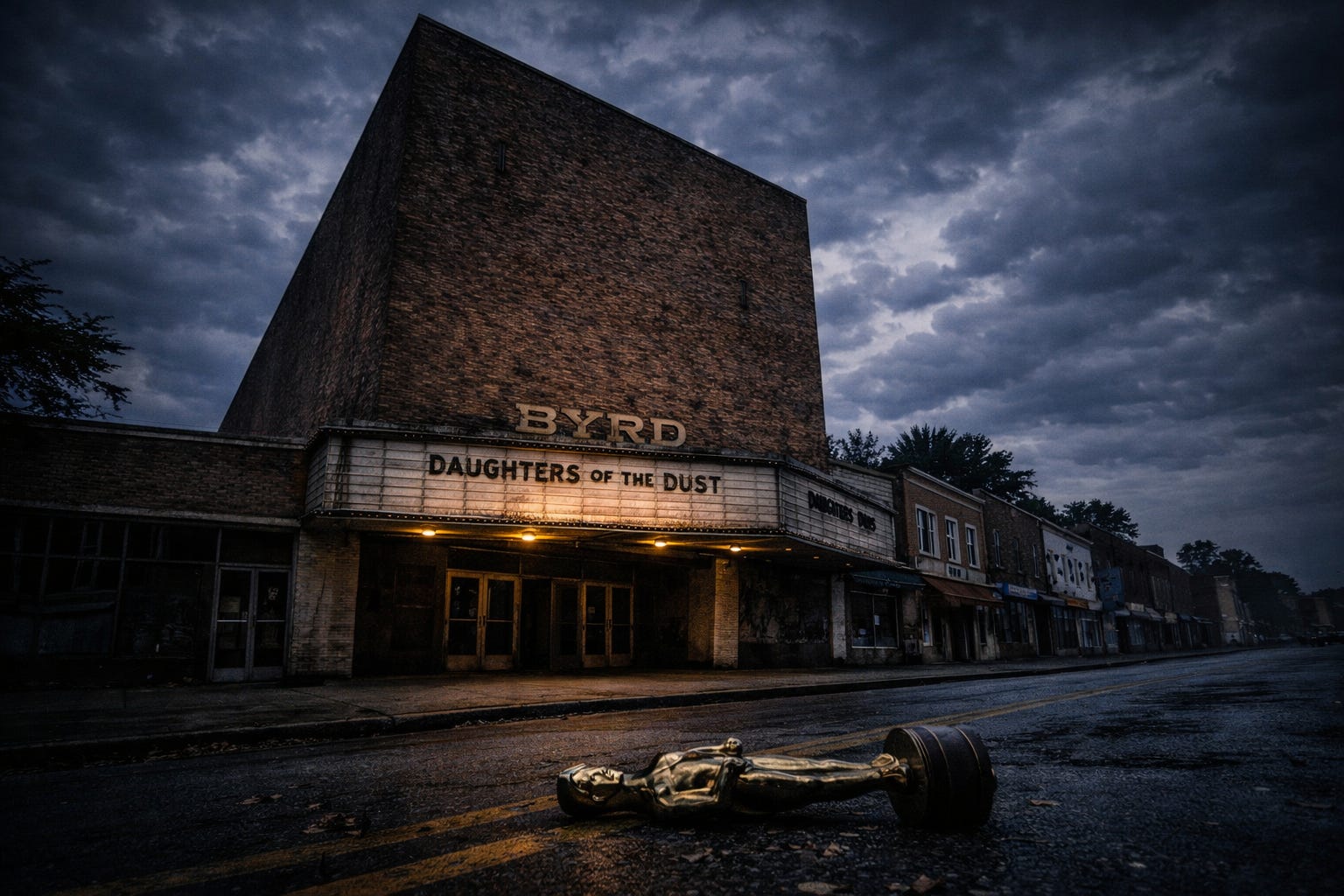
by Floyd Webb
PART ONE — THE DIAGNOSIS
“Tell no lies. Claim no easy victories.” — Amílcar Cabral
A NOTE BEFORE WE BEGIN
I don’t drink. I don’t smoke. I don’t smoke reefer. I don’t do drugs.
I solved that problem by the time I was thirteen—not through religion or ideology, but through a simple realization. I prefer to live in a cognitive and sensual world I can navigate clearly, unimpeded, fully mine. The substances got in the way of that, so I put them down and never picked them back up.
I mention this because it tells you something about the kind of person you are reading. I have never been drawn to consuming what everyone else is consuming simply because everyone else is consuming it. I have never needed the crowd’s experience to validate my own. That instinct runs through everything I do, including how I watch films and what I am willing to say about them afterward.
People draw hard lines around the things they love—films especially. Express a dissenting view about a beloved film and the response is rarely intellectual. It becomes personal, defensive, as if one person’s honest analysis threatens the validity of everyone else’s experience.
It does not.
My conclusions are my own. They are reached through fifty years of experience in Black diaspora cinema—curatorial, critical, and biographical. I was born in Clarksdale. I grew up on the South Side of Chicago. I have lived long enough to watch the same gestures repeated across decades with different casts and better production budgets.
Let me be clear about something before we go further. To everyone who won awards on Sunday night—congratulations, genuinely. The people involved in the making of cinema work extraordinarily hard. They navigate brutal bureaucracies, impossible financing structures, and grinding production processes to bring moving images into the world. The craftspeople, designers, crews, and performers are top-flight people doing difficult work with skill and dedication.
And the directors—we have no idea the challenges they face to make the films they want to make. We have no idea what compromises they are forced to accept simply to survive within this apparatus. The distance between the film a director imagines and the film capital permits is a distance most audiences never see and never measure. I salute all of them.
And the screenwriters.
I cannot move forward without naming them specifically. In a structure that extracts from everyone, the screenwriter pays the highest price. They are the origin point—the imagination that builds the world, populates it, and gives it language, moral weight, and dramatic structure. Without the writer there is no film. There is no director’s vision to realize, no performance to give, no award to collect.
And yet the screenwriter has the least power to protect what they made once the money enters the room. Notes come. Rewrites are demanded. The script passes through hands that have a financial relationship to it rather than an imaginative one. Replacements happen. Credit gets disputed. The original vision—the thing that existed on the page before the machinery touched it—recedes draft by draft.
I salute them above all, because they are where cinema begins—and where the machine reaches first.
My criticism is not of these individuals.
The choices made within these films are shaped by capital. To be inside the system at all requires acquiescing to it. That is not weakness. That is the condition of survival within a specific infrastructure.
What I analyze is pattern. What I analyze is system. What I analyze is the framework that determines which stories get told, which third acts get written, which deaths get authored, and which films never find an American distributor no matter how necessary they are.
The people are not the target.
The machine is.
What follows will create tension among people who love these films. Good. If your love for a film cannot survive one person’s honest analysis, then the love deserves closer examination.
I am not here to be liked.
I am here to be accurate.
FEBRUARY 26TH
On February 26th, 2026, I screened Jean-Claude Barny’s Fanon in Chicago.
It was a sold-out room—the kind of silence that is not absence but complete attention. The audience knew what it was watching and gave the film everything it asked for. When it ended, nobody left. The discussion went long because what Barny had put on screen opened something that needed to be spoken.
I left that screening with something I want to be precise about.
Not inspiration.
Not pride.
Not the warm afterglow of a good film well received.
Resentment.
The measured, analytical kind that comes not from disappointment but from comparison. From knowing what cinema is capable of when it operates at full power without the system’s permission. From having just witnessed it—and from knowing simultaneously that Fanon has no American distributor. That it will not be in the conversation. That the room I just left—sold out, silent, attentive, alive—is not a room the existing distribution structure built, served, or even knows exists.
It was not absence.
It was exclusion.
What the system cannot absorb, it renders invisible.
THE AWARDS
Two weeks later, the Academy Awards happened.
I didn’t watch. I knew where it was going before the envelope opened. I will watch it later, outside the spectacle, fast-forwarding through the ritual to see what I need to see without letting it absorb me.
At the 98th Academy Awards, One Battle After Another, directed by Paul Thomas Anderson, won Best Picture. I saw it, and I respected it. The action sequences operated at a level of pure craft. The villainy was compelling enough to draw you in. It was precise, controlled, effective.
I also saw Sinners. The technical achievement of a lead actor playing against himself in composite—passing a cigarette to himself in a single unbroken moment—was astonishing. Not spectacle, but precision. Spiritual and technical at the same time.
Two different films. Two different registers of excellence. One won. One didn’t.
Craft is not a lie. But craft also functions as cover. The beauty of the shot makes you forget what isn’t being shot. The perfection of the sequence makes you forget whose politics are being managed inside it.
Craft is the system’s good faith offering—the thing it gives you so you don’t notice what it’s withholding.
That outcome was not surprising.
It was confirmation.
HOLLYWONT
Hollywont. Hollyaint. Hollycaint.
Three words. One diagnosis.
Hollywont, because the choice is deliberate. The structure knows what it is doing when it shapes a narrative and determines which politics survive the final reel. Hollyaint, because suppression is embedded in its nature. A system grounded in capital and empire does not accidentally produce liberation cinema. Hollycaint, because even when the talent and intention are present, the structural demand for compromise is non-negotiable.
The price of entry is paid in the third act—in who lives, who dies, and what meaning that death is allowed to carry.
Achille Mbembe names the mechanism: Necropolitics—the power to determine who dies, when, and what their death is permitted to mean.

The genre kills its radicals with tremendous care.
That is not accident.
That is authorship exercised at the level of power.
A NOTE ON WHAT EXISTS OUTSIDE THIS SYSTEM
There is a boundary to what I am describing, and it needs to be named.
This was sharpened for me in a recent exchange with Jon Jost, whose work exists largely outside the industrial conditions I am analyzing here.
The cinema I am describing—script-driven, capital-dependent, distributed through controlled channels—is not the totality of cinema. It is a system. A dominant one. But not the only one.
There are films that do not begin with a script. There are films that do not require this apparatus. There are films that refuse narrative as their organizing principle altogether—essay films, improvisational works, hybrid forms that think rather than resolve.
The screenplay is not the origin of cinema.
It is the origin of a particular system of cinema.
The existence of these works does not contradict the argument.
It clarifies it.
It shows that the limits of the system are not the limits of cinema.
Because what becomes visible is not only how the system produces films—but how it determines what is allowed to be seen at all.
What the system cannot absorb, it renders invisible.
THE GENRE AND ITS GRAMMAR
If this is structural, it has a history. Hollywood has a genre that has been running for fifty years on schedule: the Black militancy film. It begins with Gordon Parks, is industrialized through Blaxploitation, and is systematically contained.
Blaxploitation aestheticized Black power while draining its politics. The revolution became style. The struggle became backdrop. Even attempts to break the form retained its grammar—the solitary figure standing in for collective struggle.
Then the silence.
The gap between the early 1970s and the present is not absence.
It is policy.
The dismantling of the Black Arts Movement and its distribution networks ensured that the conditions necessary for these films to exist were removed.
What we are not permitted to see is managed as precisely as what we are shown.
CLOSING
This is not about bad people making bad decisions.
This is about a system that knows exactly what it is doing.
It knows what to produce.
It knows what to suppress.
It knows what to reward.
And it knows what must never fully appear.
What must never be allowed to exist long enough to matter.
And what must be neutralized before it can change anything.
Part Two — The Evidence — continues Sunday.
Floyd Webb is the founder of the Blacklight Film Festival, established 1982, and the curator of BlacknussNetwork.com, Blacknuss.tv — a developing streaming channel, dedicated to global Black diaspora cinema and bfmmag.com, a black film magazine inline. He has been building alternative infrastructure for fifty years.
Further Reading
Frantz Fanon, Black Skin, White Masks (New York: Grove Press, 1967).
Achille Mbembe, “Necropolitics,” Public Culture 15, no. 1 (2003): 11–40.
Ed Guerrero, Framing Blackness: The African American Image in Film (Philadelphia: Temple University Press, 1993).
Ward Churchill and Jim Vander Wall, The COINTELPRO Papers (Boston: South End Press, 1990).
Melvin Van Peebles, Sweet Sweetback’s Baadasssss Song (1971), film.
Michael B. Gillespie, Film Blackness: American Cinema and the Idea of Black Film (Durham: Duke University Press, 2016).
Paul C. Taylor, Black Is Beautiful: A Philosophy of Black Aesthetics (Malden: Wiley-Blackwell, 2016).
Going to have to vehemently disagree.
"In a system that extracts from everyone the screenwriter pays the highest price. They are the origin point — the imagination that builds the world, populates it, gives it language and moral weight and dramatic structure. Without the writer there is no film. There is no director’s vision to realize. There is no performance to give. There is no award to collect......Without the writer there is no film."
You are writing about a narrow bandwidth of "film/cinema" - about narrative theatrical cinema as authorized and produced by an industry which is a propaganda system built around an ideological system - capitalism - for which the primary intentions are (a) to produce a profit and (b) express ideas which confirm its ideological foundations. This can be in Hollywood or Bollywood, or many other centers of film industry production.
There are other films/cinemas which do not begin with these premises, and which - amongst other things - do not require a script writer, nor most of the industrial apparatus, and do not require expressing the ideological beliefs of that system. Of course it is in effect a banned cinema, censored, usually with the instinctual knee-jerk a priori censorship of the assertion "but it won't make money/does not have an audience." It is not allowed to have an audience, a priori. And ergo, inside the system, should not exist.
I make such cinema. Even the few films of mine which received theatrical distribution, such as All the Vermeers in New York (ran 6 months in Chicago back when), had no script at all. Many of my films are not narrative at all but are loose essays, mixtures of narrative and quasi-documentary and essay. No, they don't make money, not because they couldn't, but because the entire system around them doesn't want them at all because they do not support the industry/propaganda/capitalist foundation of US social culture.
www.thefilmsofjonjost.wordpress.com
your articles are so deep and intense and wonderfully meaningful.