
HOLLYWONT Part 2
A Field Note on Catharsis, Control, and the Cinema “They” Keep Making for Us

by Floyd Webb
PART TWO — THE EVIDENCE
“Tell no lies. Claim no easy victories.” — Amílcar Cabral
Part One established the diagnosis. This is the evidence.
⸻
THE PREFERENCE ESTABLISHED
Hollywood in the 1960s encountered the slave narrative in two forms and chose between them with clarity. The plantation romance made the Black body an object of transgressive desire. The maroon narrative—made not in Hollywood but in Cuba and Burkina Faso—made the Black body a sovereign subject of history. Hollywood won’t cross that line. It never has.
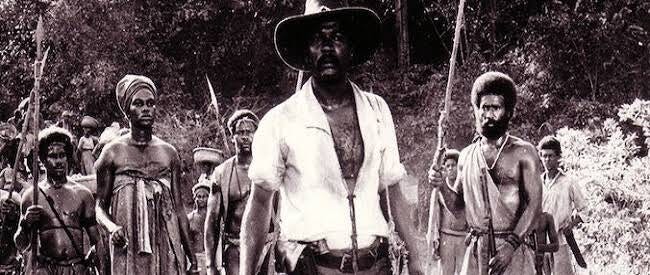
Sergio Giral’s Maluala—part of his slave trilogy—tells the story of a palenque: a community of escaped enslaved people who built autonomous settlements and defended them against colonial power. The maroon tradition. People who got free and stayed free.
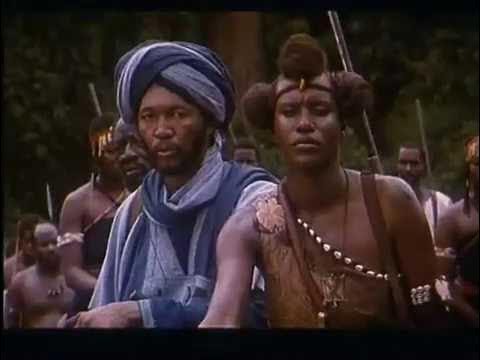
Med Hondo made Sarraounia in 1986 in Burkina Faso under the revolutionary government of Thomas Sankara—a leader who insisted his people were sovereign subjects deserving of their own history rendered honestly on screen. The Azna queen of Niger who refused submission to French colonial forces in 1899. Who led resistance. Who won battles. Who was not narratively defeated for the audience’s comfort.
Sankara was assassinated in 1987. The film survives.
The plantation romance keeps the Black body as object. The maroon narrative makes the Black body the sovereign subject of history. The market chose the plantation romance—novels that outsold revolt narratives by enormous margins, which told the industry everything it needed to know about what it could safely absorb. White audiences could consume Black bodies through forbidden sexuality—transgressive enough to feel daring, safe enough to leave slavery intact as atmosphere. The suffering was set dressing. The desire was the story.
⸻
THE EXCEPTIONS THAT PROVE THE RULE
There are always exceptions. That is how the rule proves itself. These films did not emerge from Hollywood’s permission structure. They emerged from its failures—its blind spots, its moments of desperation, its temporary collapse of control.
Jules Dassin—blacklisted, exiled, forced to rebuild his career in Europe—returned through a crack in 1968. Paramount needed something. The old genres were dying.
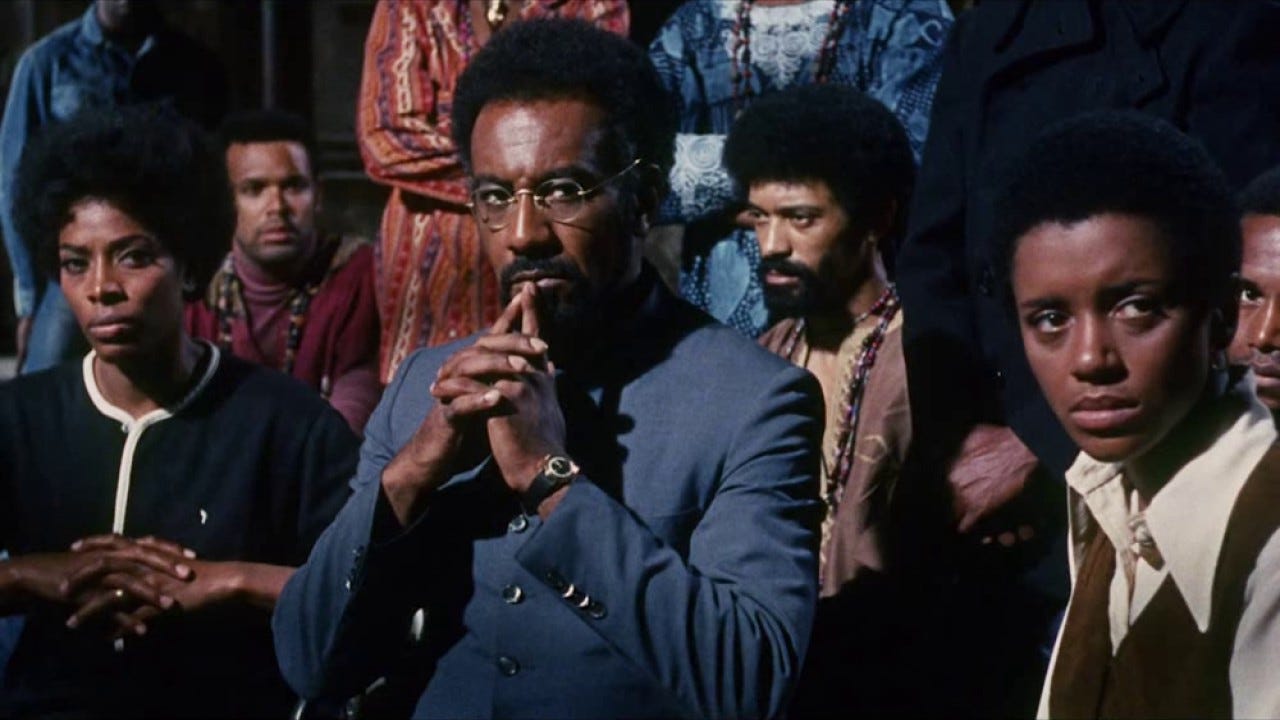
He made Uptight, a reworking of John Ford’s The Informer transposed onto the Black Power movement in Cleveland after the assassination of Martin Luther King Jr. Uptight does not offer moral distance. It sits inside the pressure of a movement under surveillance and fracture, and it does not look away.
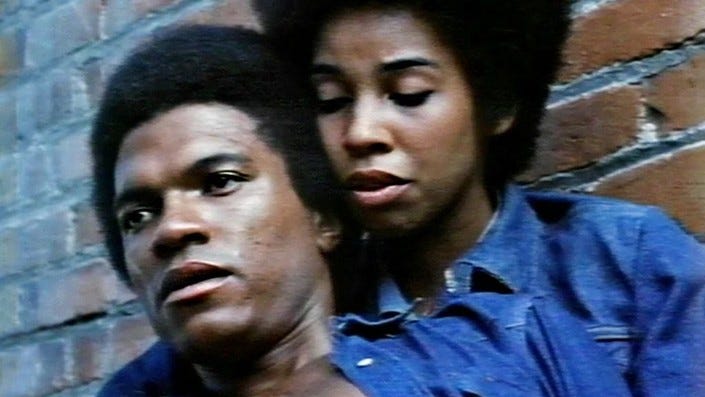
The Final Comedown (1972) was produced partly through Billy Dee Williams Enterprises—a production entity Williams established, like many Black actors of the period, as a strategic move toward narrative control—alongside writer-director-producer Oscar Williams, who was the primary creative force, and co-producers Edgar Charles and Mel Taylor. The conditions of production mirror the film’s political argument: a Black-controlled production infrastructure attempting to sustain itself inside an industry that would absorb the star while refusing the structure. The film follows a middle-class Black man politicized through lived experience. White radicals promise solidarity—and disappear when confrontation arrives. That absence is not subplot. It is the film’s political argument built into the structure of the story. The broken promise of interracial solidarity is not backdrop. It is the political architecture of the film.
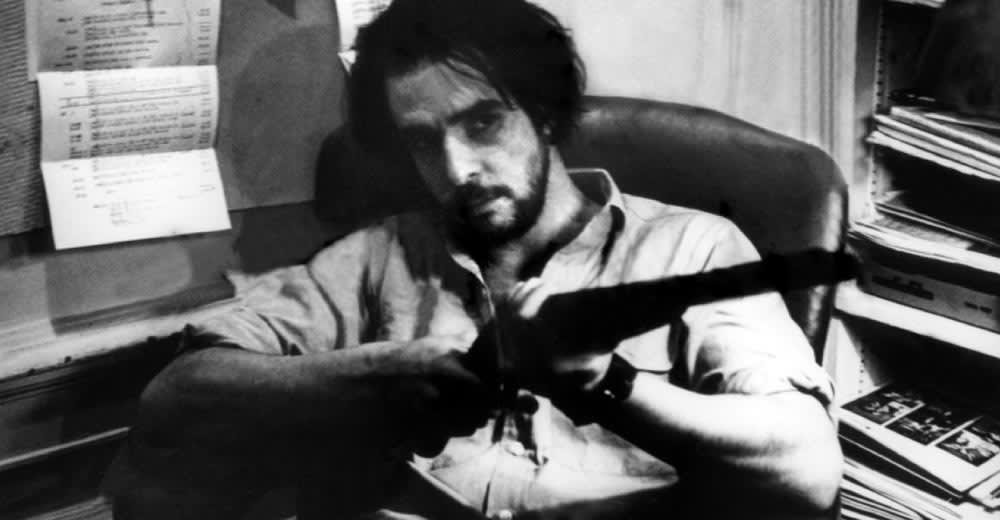
Robert Kramer’s Ice (1970) imagines near-future fascism and underground resistance. Shot in handheld 16mm, it rejects heroic centrality entirely. No singular savior. The camera distributes attention the way collective struggle distributes power—horizontally, unevenly, without the redemptive close-up the Hollywood system cannot stop reaching for. What distinguishes Ice within the international political cinema tradition is its refusal of charisma. The movement has no face because the movement is the point.
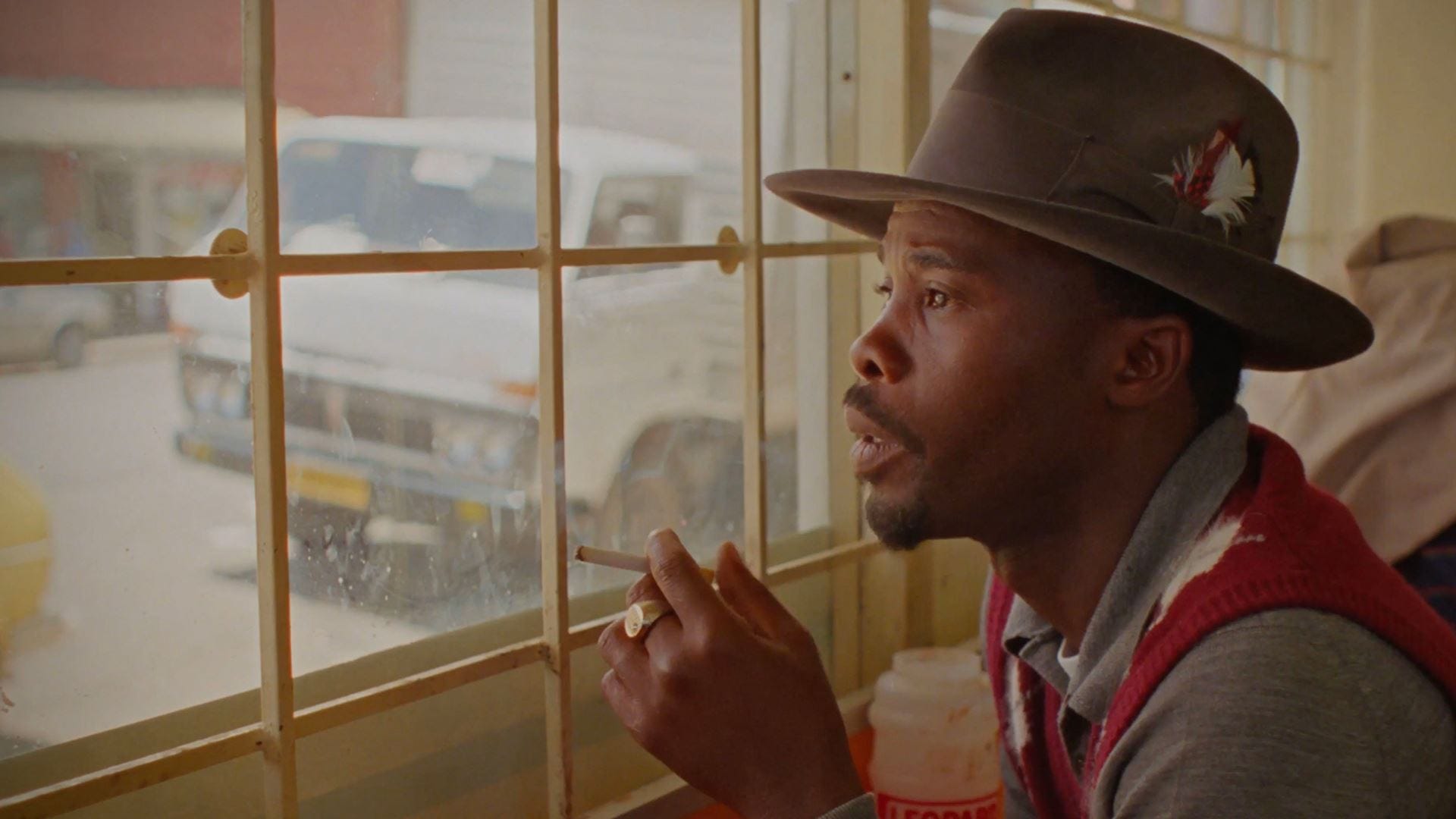
From apartheid South Africa came Mapantsula—made inside the system of oppression it was documenting. A street hustler named Panic, politicized not through ideology but accumulation, through pressure applied over time. The film’s crucial scene is not a speech or a conversion. It is the moment Panic realizes that after informing to the police, after giving them what they asked for, they will still process him the same way—as a body to be managed, expendable, interchangeable with every other Black man the system has already decided is a problem. The information he provided did not move him out of that category. It never could. No moral reset follows. No redemption arc. Politicization in Mapantsula is not a conversion experience. It is an accumulation. The person who emerges is still the person who went in, compromised in specific ways, carrying the past forward rather than erasing it.
These films share a quality Hollywood cannot reliably produce. They understand that collective struggle is not backdrop. It is the subject.
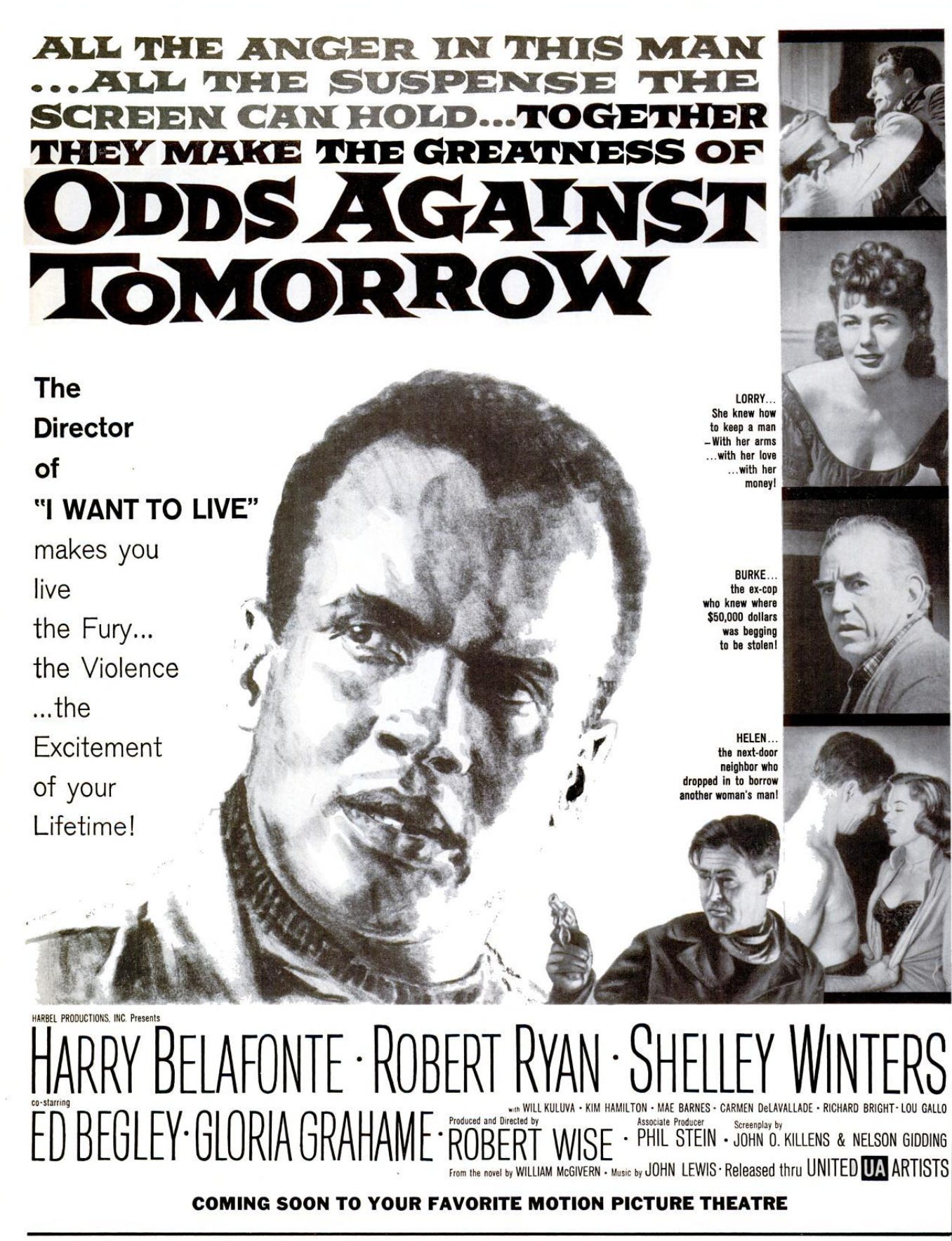
Harry Belafonte understood this at the level of production. Through his own company, he produced films in the late 1950s that moved against the grain of Hollywood’s racial and narrative constraints—most notably Odds Against Tomorrow and The World, the Flesh and the Devil. Both films were critically recognized for their ambition and thematic risk—Odds Against Tomorrow confronting racism within the structure of a heist film, The World, the Flesh and the Devil staging race, isolation, and desire in a post-apocalyptic frame that refused easy resolution.
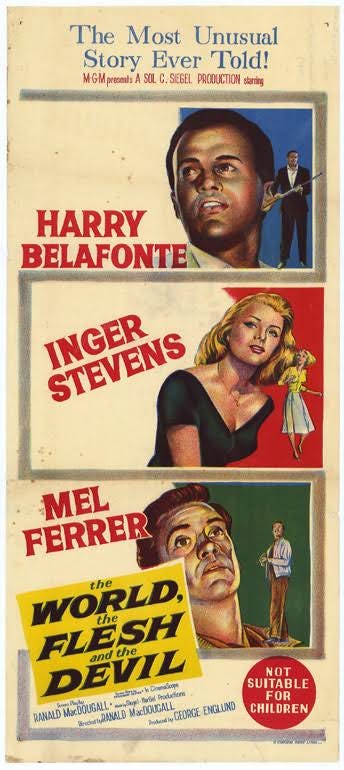
These were not marginal works. They were visible, discussed, and taken seriously. And yet that production pathway could not be sustained. The industry could accommodate the star. It could not accommodate the structure he was building. The films were received. The model was not adopted. The pathway narrowed. The experiment closed.
What makes this history more than a footnote is how thoroughly it has been forgotten. Belafonte remains widely remembered as a performer and activist. His work as a producer—his attempt to build a sustained pathway for Black-controlled film production—rarely enters the conversation. That absence is not neutral. It severs lineage. It forces each new generation to appear as if it is inventing autonomy for the first time. What disappears is not just a body of work, but the knowledge that such a structure was attempted and constrained. When the attempt is forgotten, the system no longer has to defend against it. The system does not only shape what can be made. It determines what can continue.
⸻
THE JUDAS CASE STUDY: COMPLICIT FICTION
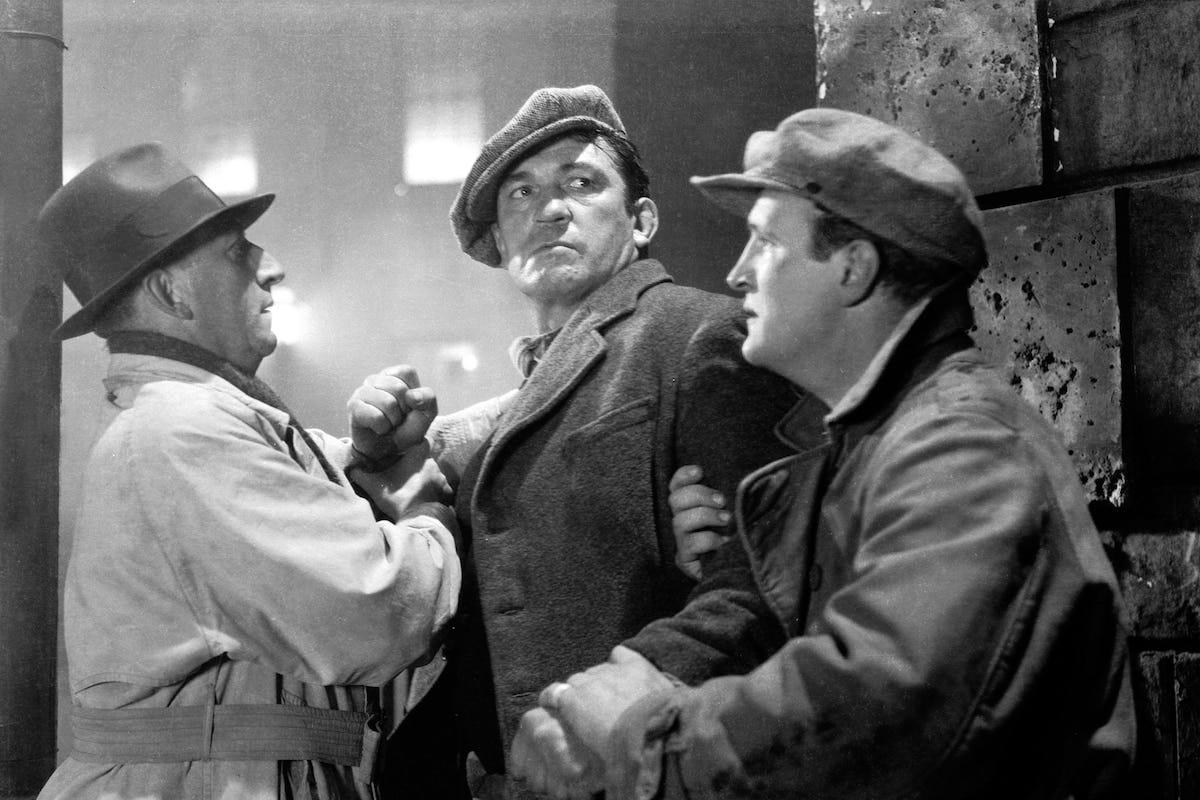
Look at what The Informer contains that Judas and the Black Messiah removes—and what that removal reveals. In John Ford’s 1935 film, Gypo Nolan is judged by the organization. The collective convenes, evaluates, decides, and acts. The community is sovereign. The informer must answer to the people he betrayed, not to an external power.
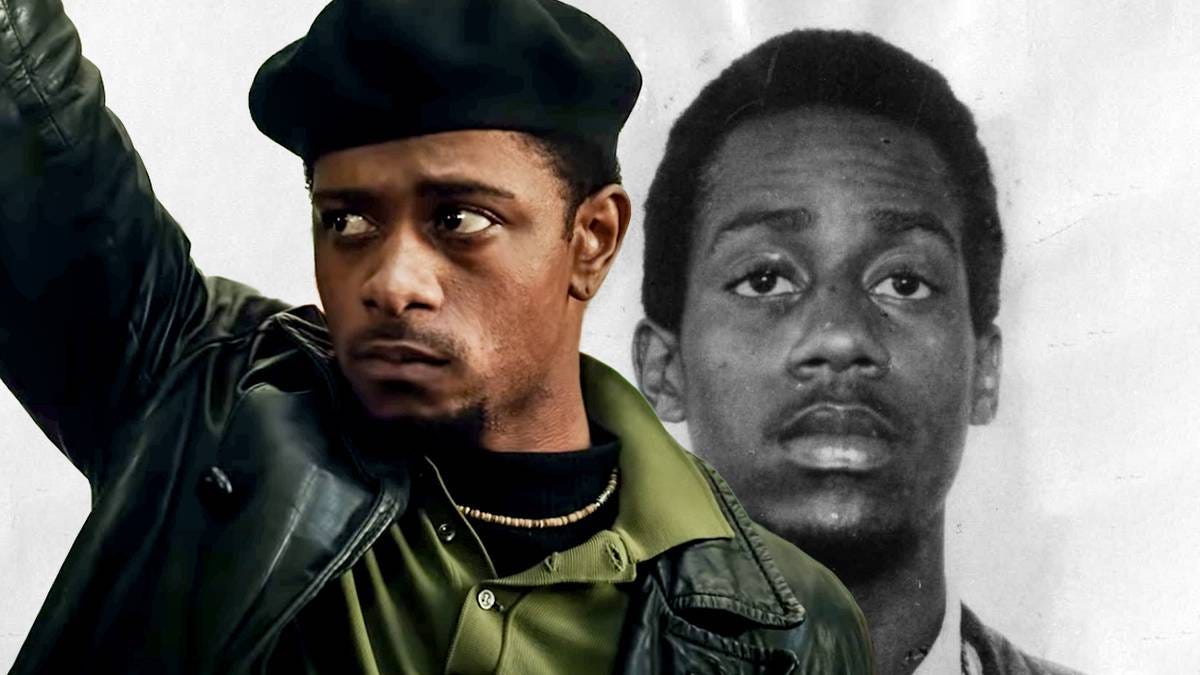
Judas removes that entirely. William O’Neal is never brought before the Party, never made to answer to the community he betrayed. His judgment is privatized—rendered as individual guilt, psychological torment, and a final title card. The state absorbs the moral accounting. Which means the film strips the Black Panther Party of the one element that would make it most politically dangerous to portray: sovereign collective judgment. The informant’s logic is embedded in the film’s own DNA.
But the deeper violation is not what is removed. It is what is inserted. Scenes with no documented historical basis: a Panther-initiated shootout, an execution of a downed officer. These are not dramatic compressions of real events. They are not composites of documented incidents. They are inventions—and they align precisely with the FBI’s COINTELPRO narrative, the program explicitly designed to surveil, disrupt, and destroy Black political organizations.¹ The film about the informant becomes structurally informed by the Bureau’s fiction. The Panthers still live. Witnesses exist. Which raises the question the film does not invite: was the truth unavailable, or was it inconvenient? Because the inserted violence performs specific ideological work. It makes state violence feel reactive—even in a film nominally about the assassination of Fred Hampton.
Now consider what is withheld. We do not fully see Hampton’s assassination. We do not see William O’Neal’s death at all. A title card tells us he died. It does not tell us how. O’Neal walked naked onto the Dan Ryan Expressway and into the path of a truck—a man so annihilated by what he had become, by the full weight of Fred Hampton’s blood on his hands, that his final act was to offer his body to the highway without the protection of clothing or darkness or any of the ordinary shields people use to survive. That is not ambiguity. That is confession written in concrete and headlights.
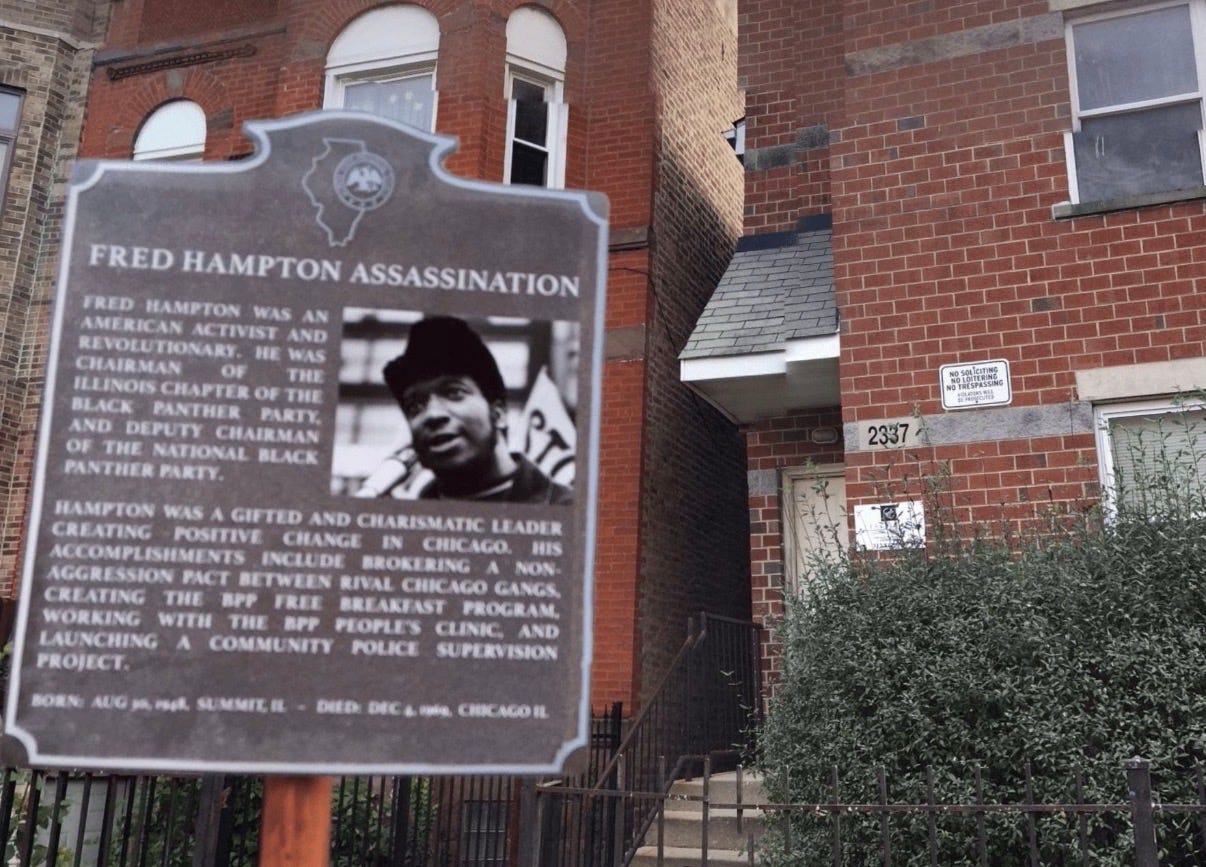
Two deaths withheld. Two catharses deliberately denied. And the geography matters. Fred Hampton was killed in Chicago. The building where he was assassinated no longer stands. The address remains. The street bears his name. The site has been absorbed into the city’s surface—a place you can pass without knowing what happened there. That is how memory is managed: what remains visible, what disappears.
Here is the film’s deep incoherence. It denies us Hampton’s assassination and O’Neal’s suicide—refusing Hollywood spectacle, which is the right instinct. But it also denies us the Panther Party’s sovereign judgment of O’Neal, substituting individual guilt for collective accountability. The film wants to have it both ways: politically serious enough to withhold spectacle, but not serious enough to show a revolutionary organization acting as a court. To show O’Neal’s death would complete the Informer logic—judgment rendered. To show Hampton’s assassination fully would complete the political logic—state murder, undeniable. Neither is allowed. What remains is feeling, not accounting.
Hollywood won’t show the Black Panther Party as a legitimate judicial authority. It will show them as martyrs. It will mourn them beautifully. It will not grant them sovereignty over their own history. This is complicit fiction—not propaganda, not hatred, but something more precise: a film that mourns beautifully while managing what its subjects are permitted to have been. Mbembe extended: not just sovereignty over death, but sovereignty over meaning.
⸻
THEN CAME WAKANDA
Wakanda begins as a question. What if Africa had never been penetrated, never colonized, never had its leaders eliminated? What if the resources stayed?
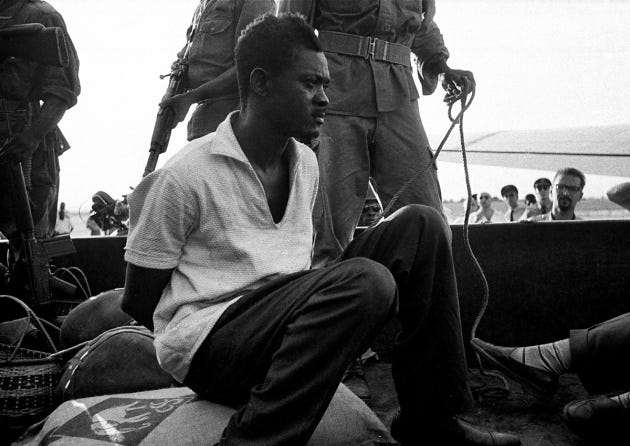
That is the Lumumba counterfactual—the world that should have been rendered as a political argument in four-color ink when Jack Kirby created the Black Panther in 1966, five years after the CIA and Belgian intelligence coordinated the murder of the democratically elected leader of the Congo. The Disney film took that counterfactual and introduced Killmonger as its answer.

But look closely. He is not a radical. He is a hustler. The distinction matters because the film’s central maneuver is substitution—not the defeat of a revolutionary, but the defeat of a counterfeit that allows the audience to feel they witnessed the suppression of Black liberation politics when they actually witnessed the removal of a well-dressed opportunist. Killmonger’s logic is acquisition throughout: the throne, the weapons, the empire. His father’s death made him hungry, not conscious. The Oakland origin story is real pain weaponized as personal justification for a power grab. He does not want to free anyone. He wants to be on top. When he takes the throne he declares that the sun will never set on the Wakandan empire. That is not Nkrumah. That is empire wearing pan-African language, and the film asks you to hear them as the same thing.
Watch the herb garden. He burns it—not because destroying it serves the people he claims to be liberating, but because it denies the throne to anyone after him. A liberator shares the source of power. A hustler destroys it so no one else can use it. The garden is the tell.
Ishmael Reed got there first. In Mumbo Jumbo—published 1972—Reed imagined the Mu’tafikah, a multiracial crew raiding Western museums to repatriate stolen objects back to the traditions that made them. Berbelang is among them. What Berbelang understands that Killmonger does not is that the objects are not inert. They carry obligation. They are sick in the museum’s dead storage—severed from the living traditions they were made to serve. Returning them is not politics. It is restoration. The theft is an act of healing directed outward, toward the cultures the colonial project plundered. Killmonger takes one object for himself, as credential. Berbelang’s theft is centrifugal—power moving outward, back to its origin. Killmonger’s theft is centripetal—everything moving inward, toward the throne. One is repatriation. One is rebranding. The film borrowed the museum. It did not reckon with what the museum means.
The museum scene critique is accurate—colonial theft named correctly, the audience invited to agree. But then the film does something precise: it validates that critique and installs Everett K. Ross, the CIA agent whose narrative function is to be saved, as a trustworthy ally. The museum is condemned. Langley is normalized. The film critiques 19th century colonial extraction while normalizing 21st century imperial intelligence—the same Agency whose involvement in Africa includes backing coups, destabilizing governments, and supporting the conditions that made Lumumba’s assassination possible. The same Lumumba whose story the Wakanda counterfactual was built to answer. The radical question—who owns African resources—is resolved through philanthropy. Not liberation. Not solidarity. Revolution managed into charity.

Now the structure. Wakanda is a monarchy—power through bloodline and individual combat, vibranium wealth concentrated at the top, gleaming towers and hovercrafts above, market vendors and traditional life at street level. The visual grammar of Hollywood’s idea of Africa at the bottom, the visual grammar of sci-fi empire at the top. Wakanda does not imagine an alternative to Western imperial hierarchy. It reproduces the structure and puts Black faces at the apex. The film does not imagine what liberation looks like. Only what succession looks like. The CIA agent gets saved. Wakanda opens to the world through charity and outreach. The Lumumba counterfactual resolved as a TED talk.
⸻
THE HAND AND THE VERDICT
To understand what one moment encodes—and what the film cannot recognize—we need a framework outside Hollywood’s moral imagination. Vusamazulu Credo Mutwa—South African Zulu sangoma and sanusi, author of Indaba, My Children (1964), the most comprehensive compilation of Zulu mythology and oral tradition committed to print, a national treasure honored at his death with a provincial state funeral—records the story of Luo. A man who strikes his mother, Nomkhubulwane, the sacred feminine, the Princess of Heaven, the Mother of the People, in a moment of overwhelming rage during a period of great chaos and tribal conflict.
When the conflict resolves and the full weight of what he has done descends on him—the violation of the sacred feminine, the breaking of the deepest covenant in the moral order—Luo does not wait for the community’s judgment. He gathers the village. He declares publicly that no man should ever lay a hand on a woman. And he cuts off his own hand—the hand he used—in public, as permanent penance, as testimony to future generations about the standard that must be maintained. This is not punishment. It is self-imposed justice. It is the moral order restoring itself through the one who broke it, the foundation of ethical instruction encoded in the oldest available tradition of the culture Black Panther claims as its setting.
Killmonger ruthlessly chokes and lifts an elderly Wakandan herbalist named Elder Bakari
.. He keeps both hands. He takes the throne. He dies in battle. The film never returns to that moment, never accounts for it. The violation registers as character texture—he is ruthless, he is dangerous, he is hungry—rather than as the cosmic disqualification it represents within the ethical framework of the very culture whose sovereignty he is claiming. Wakanda has no single ethical tradition—it is a composite, a pan-African pastiche drawing from Maasai, Xhosa, Dogon, and dozens of other cultures simultaneously. But the film invokes African sovereignty without accountability to any actual African moral order. Mutwa’s Zulu framework is not Wakandan—but it is real. And by that real standard, the throne was forfeit the moment the hand struck.
Within Mutwa’s tradition, Killmonger cannot be king. Not because T’Challa defeats him in combat. Because the hand that struck the elder already rendered the verdict. The throne was forfeit in that moment. Everything after is the machinery catching up to a judgment the film doesn’t know it already made. Luo is not a villain. He is a man overwhelmed by rage who does a terrible thing and then gathers the village and imposes justice on himself publicly so future generations will know the standard. Killmonger is a character whose rage is his flaw, whose hunger is his corruption, whose death is his consequence and the system’s resolution. One framework transforms transgression into ethical instruction that protects future generations. The other manages transgression into entertainment and calls it tragedy. Hollywood borrowed the aesthetics. It did not do the reading.
Three indictments. One structure. The hustler’s acquisition, the cosmological debt unpaid, the ethical verdict already rendered—and the system that required none of it to be recognized in order to distribute the film worldwide.
⸻
THE PURCHASE
Ryan Coogler is a skilled director. That is not in question. But the system sets the terms before production begins. It does not need to erase the story or deny what happened. It needs something more precise: to structure what can be seen, to narrow what can be imagined, to determine where the story is allowed to end.
The CIA agent is saved. The revolution becomes outreach. The counterfactual becomes reform. What begins as liberation resolves as management. What begins as rupture resolves as continuity. The system is patient. It does not require silence. It permits the story, then reorganizes its meaning. It allows the image, then removes its consequence. It stages the conflict, then purchases the resolution. Hollywood won’t silence the story. It will buy the ending—and that purchase is the system’s most precise instrument.
But the purchase does not stop at the ending. It extends backward—into memory. What was attempted, what briefly emerged, what could not be sustained—these are not simply lost. They are unremembered. The alternative pathways disappear not only from the industry, but from the story the industry tells about itself. When the attempt is forgotten, the system no longer has to defend against it. It does not only purchase the ending. It purchases the memory of what other endings were once possible.
It does not need to silence the story. Only to purchase its ending.
⸻
Part Three — The Counter and The Build — continues Monday.
⸻
Further Reading (Chicago Style)
1. Ward Churchill and Jim Vander Wall, Agents of Repression: The FBI’s Secret Wars Against the Black Panther Party and the American Indian Movement (Boston: South End Press, 1988).
1. Joshua Bloom and Waldo E. Martin Jr., Black Against Empire: The History and Politics of the Black Panther Party (Berkeley: University of California Press, 2013).
1. Achille Mbembe, “Necropolitics,” Public Culture 15, no. 1 (2003): 11–40.
1. Frantz Fanon, The Wretched of the Earth (New York: Grove Press, 1963).
1. Vusamazulu Credo Mutwa, Indaba, My Children (Johannesburg: Blue Crane Books, 1964).
1. Ishmael Reed, Mumbo Jumbo (Garden City: Doubleday, 1972).
1. Teshome H. Gabriel, Third Cinema in the Third World (Ann Arbor: UMI Research Press, 1982).
1. Michael T. Martin and Marilyn Yaquinto, eds., Redress for Historical Injustices in the United States (Durham: Duke University Press, 2007).
⸻
Floyd Webb is the founder of the Black Light Film Festival, established 1982, Blacknuss Network and the curator of Blacknuss.tv — a streaming channel dedicated to global Black diaspora cinema. He has been building the alternative infrastructure for fifty years.