
Indictment, War, and the Management of Dissent
Dispatch from occupied territory, where the lights are still on.

by Floyd Webb
Authors Note: I wrote this last night before this mornings news. I did not name the assholes. I do now.
Incentive and Consequence
I want to be precise, because precision is a form of respect for the dead.
Benjamin Netanyahu has faced corruption charges that have wound through Israeli courts for years.
Donald Trump has faced federal indictment.
Both men have stood under the shadow of legal accountability.
Both now prosecute a war.
I am not asserting conspiracy. I am asserting incentive structure — the same framework this essay applied to Woodrow Wilson, to post-9/11 America, to the securitization of Chicago’s South Side.
If incentives matter when they govern surveillance contracts and task-force authorizations, they matter when they govern war.
American soldiers are dying. Iranian Civilians are dying, it will be called collateral damage.
That is not abstraction. That is grief. That is folded flags and kitchen tables and mothers who will never again hear a key in the door at night. That is consequence borne by families who had nothing to do with anyone’s indictment.
The question I cannot set aside is simple:
Were those soldiers placed in harm’s way inside an incentive structure that also served the political survival of two men?
I do not know the classified intelligence.
I do know the pattern.
States under legal or political threat often expand the perimeter of crisis. External escalation compresses internal scrutiny. Accountability disperses in the smoke.
When I have remained silent in the face of a pattern I recognized, that silence cost something I could not recover.
War does not suspend dissent.
It reorganizes it.
This is where I land mine.
The lights are dimming!.
In Chicago, we’ve learned to watch the language before we watch the tanks.
When a former president was indicted and a new war erupted overseas, we did not treat it as two separate headlines.
We recognized an old pattern.
Legal jeopardy tightening at home.
National emergency expanding abroad.
Political science has studied this overlap for decades. The claim is simple:
Incentives matter.
War reorganizes domestic politics.
Opposition softens.
Media compresses into patriotic framing.
Legislative oversight becomes delicate.
Judicial deference increases under urgency.
This does not require dictatorship.
It requires emergency.
And emergency reshapes what institutions tolerate.
Woodrow Wilson used World War I to pass the Espionage Act of 1917, criminalizing dissent and imprisoning critics like Eugene V. Debs. The war did not abolish democracy. It narrowed it. Opposition became disloyalty. Speech became sabotage.
Democracy did not collapse.
It adjusted its boundaries.
After September 11, the United States built a counterterrorism architecture designed for foreign threat: expanded surveillance authorities, intelligence-sharing agreements, Joint Terrorism Task Forces, fusion centers.
The mechanics are not mysterious.
They are procedural.
In June 2020, leaked Department of Homeland Security intelligence bulletins described protests following George Floyd’s murder as providing opportunities for “violent opportunists” and warned of “domestic violent extremist” infiltration. The language did not charge protest as terrorism. It did something subtler: it categorized protest as a threat environment.
Once that classification occurs, information flows differently.
Local intelligence is routed into federal databases.
Joint task forces activate.
“Threat assessments” precede constitutional analysis.
Security logic prioritizes preemption.
Democratic logic prioritizes rights.
They are not the same.
The shift is not from protest to prosecution.
It is from protest to assessment.
That is the hinge.
In Chicago, we have already watched emergency become infrastructure.
After 9/11, the Chicago Police Department deepened integration with federal counterterror systems. By the mid-2010s, the city had built a surveillance grid: POD cameras, ShotSpotter acoustic sensors, license plate readers, and Strategic Decision Support Centers integrating live feeds with predictive analytics.
All justified under public safety.
In 2019, during hearings on what became the Smart Communities Ordinance, activists and civil liberties attorneys testified before City Council that the city was acquiring surveillance tools without public approval or impact analysis.
One speaker held up a map of camera density on the South Side and asked a simple question: “Who approved this?”
City officials responded that these tools were necessary for crime prevention and already operational. Oversight, they suggested, would follow.
Security logic moves fast.
Democratic oversight moves slowly.
The ordinance eventually passed in 2020, requiring Council approval before new surveillance technology could be deployed. But the infrastructure it sought to regulate was already embedded.
Then came the uprisings.
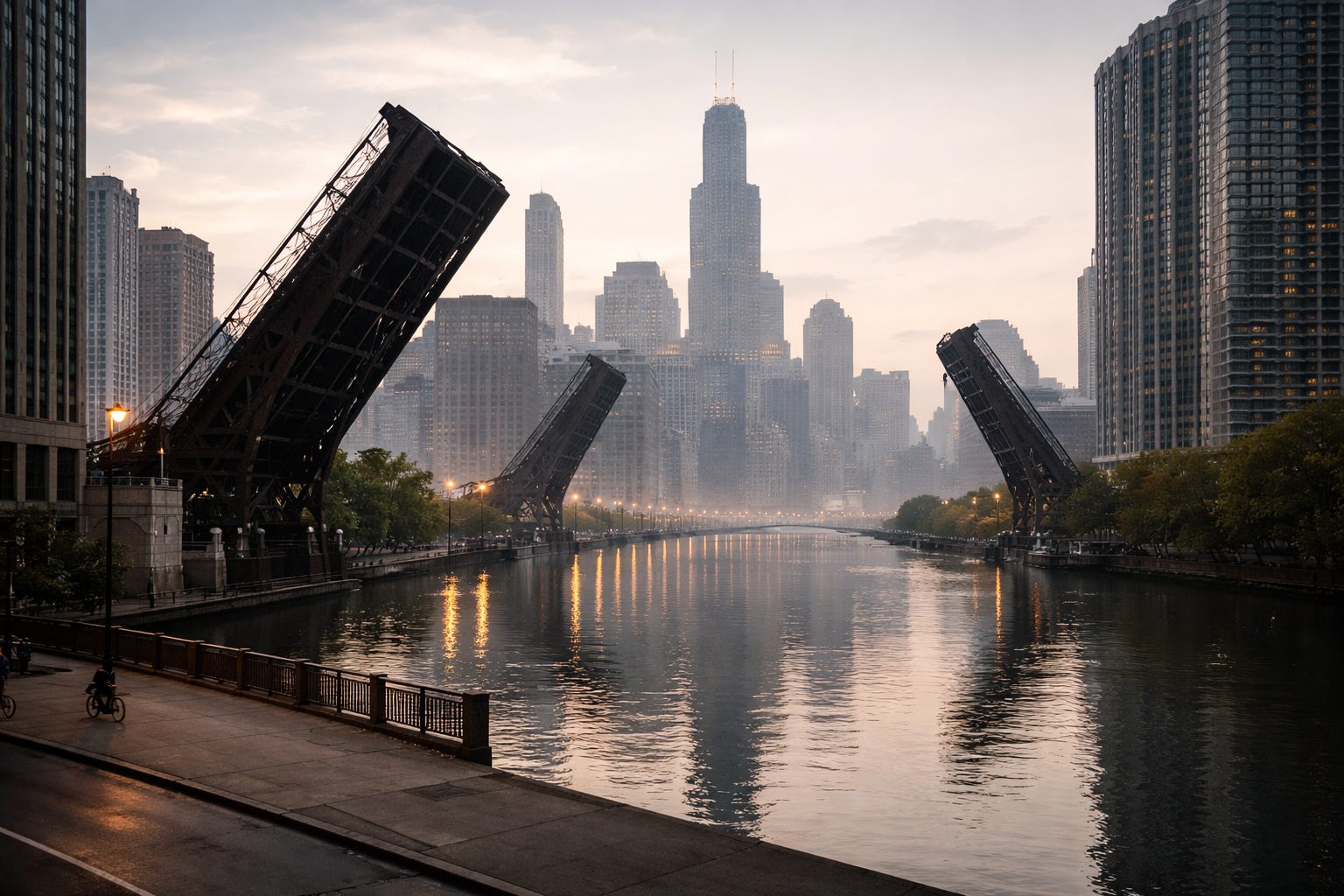
Downtown bridges were raised. Curfews imposed. The National Guard deployed.
From Bronzeville, the city did not feel poetic—it felt procedural, like access was being managed.
Chicago is not a dictatorship.
But it demonstrates how crisis accelerates installation, and how deliberation arrives after deployment.
Security infrastructure does not create political crisis.
But once it exists, it alters the calculus of crisis.
When executive power expands during war and surveillance architecture is already embedded domestically, the distance between foreign emergency and domestic management narrows. Tools built for threat containment become available for civic containment.
If legal jeopardy intensifies while war and protest intensify, institutions do not need to invent new powers.
They inherit them.
COINTELPRO treated civil rights organizing as subversion. The Red Scares treated ideology as existential threat.
The pattern is old.
What is new is the permanence of the architecture.
The most consequential democratic shifts do not begin with tanks. They begin with vocabulary.
Rights rarely disappear overnight. They are recalibrated during crisis—and normalized afterward.
The danger is not war alone.
The danger is not protest alone.
The danger is alignment.
History offers blueprints of erosion—and manuals of resistance.
That means the response cannot be theatrical.
It must be procedural.
We take elections seriously not as theater, but as infrastructure.
Infrastructure requires renewal votes, appropriations, memoranda of understanding, quiet committee decisions. Surveillance contracts expire. Data-sharing agreements require authorization. Task-force participation depends on political consent.
The architecture is durable.
It is not self-sustaining.
It requires cover.
It requires inattention.
This is what boring attendance looks like:
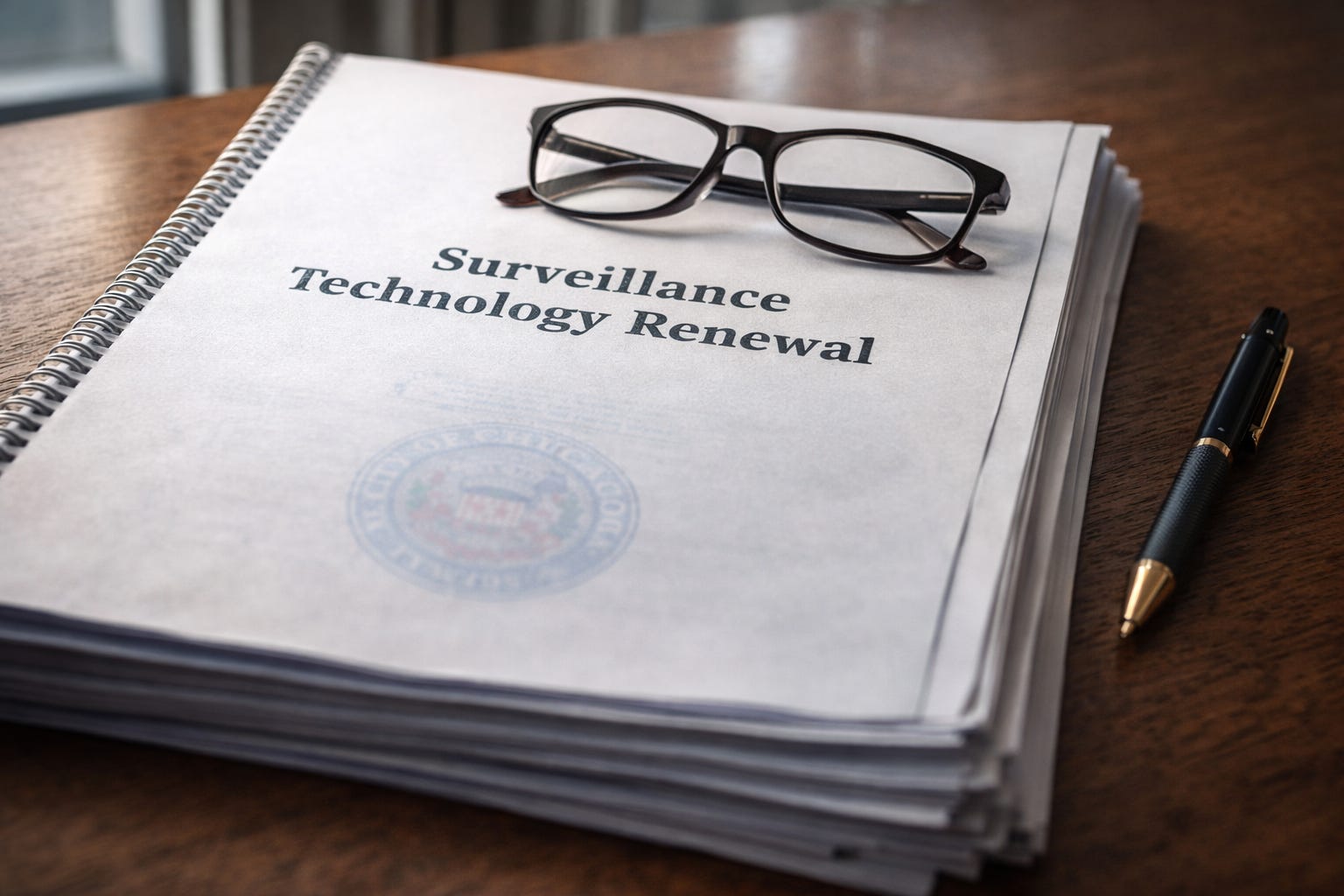
Reading the surveillance ordinance before it is renewed.
Attending the City Council hearing on license plate reader contracts.
Asking a district attorney candidate about data-sharing with federal task forces.
Following the budget line that funds the “temporary” security measure.
Democracy does not erode only because power expands.
It erodes when citizens disengage from the procedures that permit expansion.
From Bronzeville, the lesson is simple.
You don’t wait until the bridges are raised to ask who controls the levers.
That is the work.
Scholars of diversionary war have long noted that international crises can shift domestic political incentives without requiring deliberate orchestration.^1 Wartime civil liberties restrictions—from the Espionage Act to post-9/11 surveillance expansion—illustrate how emergency recalibrates institutional restraint.
Notes:
Jack S. Levy, “The Diversionary Theory of War: A Critique,” in Handbook of War Studies, ed. Manus I. Midlarsky (Boston: Unwin Hyman, 1989), 259–288.
John E. Mueller, “Presidential Popularity from Truman to Johnson,” American Political Science Review 64, no. 1 (1970): 18–34.
Geoffrey R. Stone, Perilous Times: Free Speech in Wartime from the Sedition Act of 1798 to the War on Terrorism (New York: W. W. Norton, 2004).
Espionage Act of 1917, Pub. L. No. 65-24, 40 Stat. 217 (1917).
USA PATRIOT Act, Pub. L. No. 107-56, 115 Stat. 272 (2001).
Senate Select Committee to Study Governmental Operations with Respect to Intelligence Activities (Church Committee), Final Report, S. Rep. No. 94-755 (1976).
Department of Homeland Security, Homeland Threat Assessment, October 2020 (Washington, DC: DHS, 2020).
City of Chicago, Municipal Code of Chicago § 2-120-815 et seq., “Smart Communities Ordinance” (2020).
Further Reading Section
Diversionary War & Executive Incentives
Jack S. Levy, “The Diversionary Theory of War.”
James D. Fearon, “Domestic Political Audiences and the Escalation of International Disputes,” American Political Science Review (1994).
Matthew Baum, Soft News Goes to War (Princeton University Press, 2003).
Wartime Civil Liberties
Geoffrey R. Stone, Perilous Times.
David M. Kennedy, Over Here: The First World War and American Society.
Korematsu v. United States, 323 U.S. 214 (1944).
Post-9/11 Security Architecture
USA PATRIOT Act (2001).
Brennan Center for Justice, “The Domestic Terrorism Framework” (2021).
Karen J. Greenberg, Subtle Tools: The Dismantling of American Democracy from the War on Terror to Donald Trump.
Protest, Securitization, and Intelligence
DHS Homeland Threat Assessment (2020).
ACLU, “Protesters as ‘Terrorists’: The Domestic Terrorism Framework and First Amendment Rights.”
FBI, “Black Identity Extremist” Intelligence Assessment (2017, leaked).
Chicago Surveillance Governance
City of Chicago, Smart Communities Ordinance (2020).
Lucy Parsons Labs, reports on CPD surveillance technologies.
Chicago Office of Inspector General, “Audit of CPD’s Use of Strategic Decision Support Centers.”
Well observed. Thanks. You’ve put in the clearest terms what all this craziness really means
Nice shot. Where'd you get it?