
Internet Shutdown & Net Neutrality
Connectivity, Surveillance, and the Discipline of Resilient Organizing

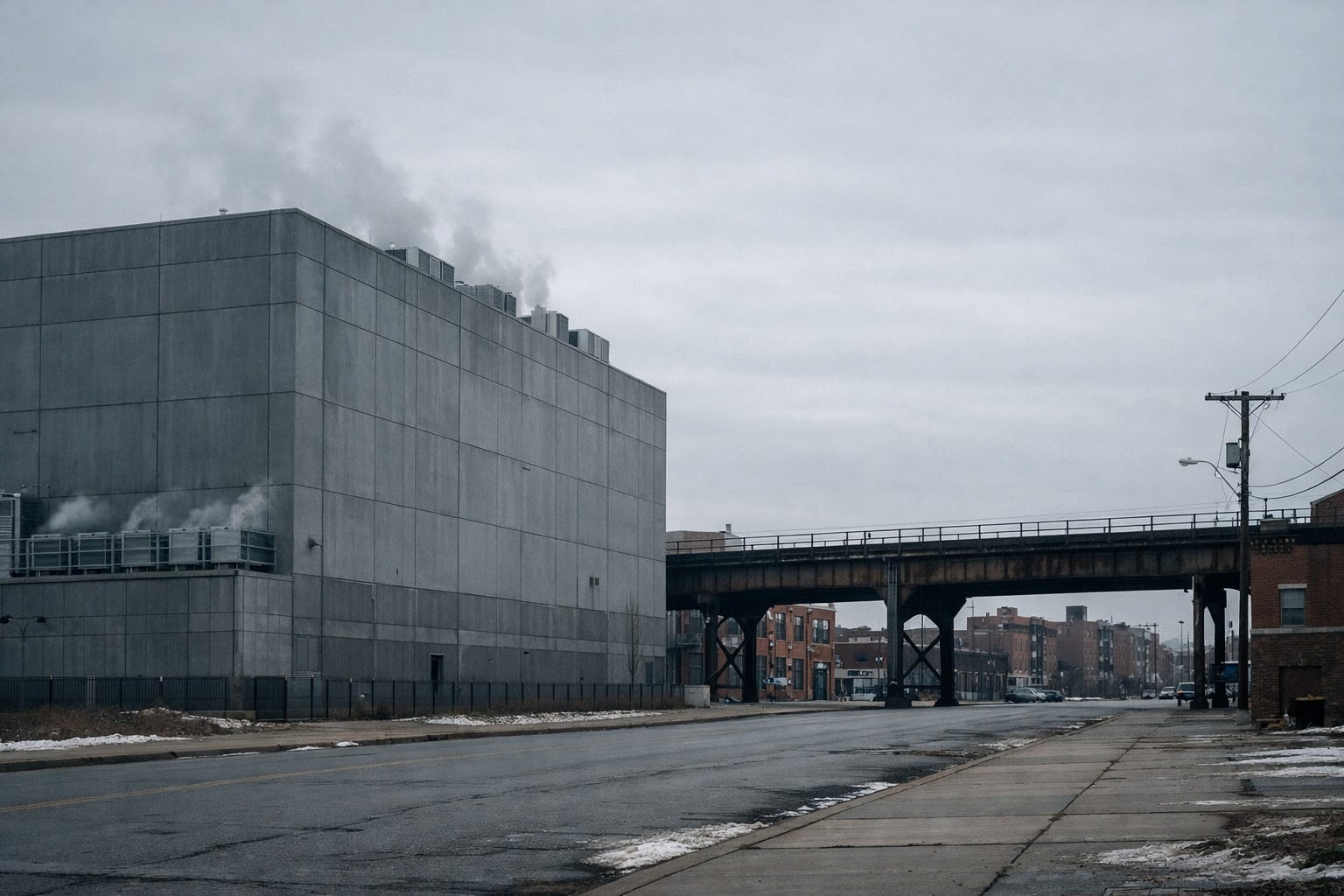
by Floyd Webb
In January of this year, my friend Raul in Uganda called me a few days before his country’s general election. He was worried. If the internet was shut down, he would not be able to work remotely. He would not be able to access his bank. Payroll would stall.
Two days before voting began, the network went dark.
The Uganda Communications Commission ordered a nationwide shutdown, citing public safety and the prevention of misinformation. Human rights organizations and opposition figures described it differently: narrative control, informational isolation, digital darkness as enforcement cover.¹
Raul was not thinking about geopolitics. He was thinking about whether his work would clear.
The network did not fail. It was suspended.
Raul’s shutdown was visible. America’s version has been gradual — layer peeled after layer peeled, with no single blackout to mark the transition. But the underlying condition is the same.
The network was never neutral. It was always subject to control: by owners, by regulators, by enforcement agencies. The only question has ever been whether that control was visible, contestable, and bounded.
This essay is about what I call resilient organizing — the practice of building communication and coordination systems that function even when dominant infrastructure is surveilled, discretionary, or partially constrained.
Collapse, Consolidation, and the Owners Who Survived
Between 2000 and 2002, the dot-com bubble burst. Venture capital evaporated. Telecommunications firms that had overbuilt fiber networks collapsed or were absorbed.
The firms that survived were those that owned something physical.
Cable operators. Last-mile broadband providers. Backbone carriers.
The “Wild Wild Internet” did not mature into democracy. It was reorganized around concentrated ownership and new revenue imperatives.
In 2002 and 2005, the FCC classified broadband as an “information service,” relieving providers of common-carrier obligations that required nondiscrimination. The Commission made that decision. Industry lobbied for it. Courts permitted it.
Discretion entered the system.
In 2015, the FCC imposed restraint by reclassifying broadband under Title II. Blocking, throttling, and paid prioritization were prohibited.
By 2025, a new Commission majority dismantled that restraint. Industry pressure and judicial skepticism toward agency authority cleared the path.
The baseline shifted from nondiscrimination as default to discretion as option.
An ISP that once could not slow your video now may — provided it discloses the practice in terms of service no one reads.
The network never went dark.
It was never suspended.
It was simply legible.
From Regulatory Capture to Instrumented Infrastructure
When neutrality protections lapsed and ownership concentrated, the market transformation was visible: fewer major ISPs, revised service tiers, sporadic throttling disputes.
The surveillance transformation was quieter.
Concentrated infrastructure ownership means concentrated data aggregation. A handful of firms now control last-mile access, backbone routing, cloud hosting, device ecosystems, and the advertising platforms that fund “free” apps.
Those same systems generate ambient behavioral data — location pings, browsing histories, device identifiers, biometric matches.
When federal agencies seek subscriber data, geofence warrants, or device identification, they negotiate with a small set of corporations rather than a diffuse market.
The network did not just become discretionary.
It became observable at scale.
Documented reporting confirms that federal agencies deploy cell-site simulators capable of identifying nearby mobile devices, purchase commercial location databases built from the advertising ecosystem, integrate facial recognition into enforcement workflows, and use drone surveillance at protests and public assemblies.²³⁴
These tools do not interrupt the network.
They operate within it.
The network stays on. Visibility increases.
Cell-site simulators mimic legitimate towers; phones connect without notification. Advertising-funded apps sell movement trails that become enforcement intelligence. Facial recognition systems aggregate images into predictive risk scoring — numerical assessments that determine who is stopped, questioned, or enrolled in monitoring.
This is not interruption.
It is instrumentation.
And instrumentation scales.
When I Say the Corridor Narrows
When I say “the corridor narrows,” I mean documented friction.
The legal corridor narrows when documentation near federal operations is reinterpreted as interference.
The operational corridor narrows when encrypted messaging groups are deanonymized through phone-number correlation and metadata analysis.
The political corridor narrows when drone surveillance appears at demonstrations before banners are even raised.
Connectivity continues.
But anonymity shrinks.
Observation precedes action.
Bronzeville: Infrastructure Encodes Power
When I describe digital surveillance as instrumentation, I am describing a relationship between infrastructure and power that has precedent.
Bronzeville shows how it worked before code.
The Illinois Central Railroad structured labor mobility while enabling white flight.
The Dan Ryan Expressway cut through Black neighborhoods in 1961, displacing thousands while accelerating suburban white commuting.
Redlined maps did not merely deny mortgages. Federal agencies and banks converted racial bias into data systems that categorized neighborhoods as “hazardous” or “declining.” Those classifications circulated through insurance, lending, and municipal policy.
Redlining aggregated racist assessment into cartographic fact.
Digital surveillance inherits that logic.
Commercial location databases do not mark territory as hazardous. They mark bodies as patterns requiring monitoring. The advertising ecosystem extracts movement data that becomes predictive risk scoring — numbers that determine who is stopped, questioned, or flagged for monitoring.
Each system was described as modernization.
Each reorganized civic life along racial lines.
The logic is continuous.
The capacity is escalated.
Railroads moved people.
Highways displaced them.
Redlining mapped them.
Digital infrastructure tracks them in real time.
Scale becomes quality.
What Resilient Organizing Actually Means
Modern protest is bandwidth-intensive. It relies on livestreaming, rapid mobilization, decentralized coordination.
But the activist who assumes WhatsApp is private is relying on a platform whose metadata circulates through corporate systems that contract with government agencies.
The disciplined organizer does not condemn the tool. They do not confuse it with a secure channel.
Resilient organizing means building redundancy across platforms without assuming any platform is neutral — maintaining SMS and voice trees in case data degrades — establishing offline rendezvous protocols independent of real-time feeds — separating public-facing communication from internal coordination devices — minimizing data retention in organizing workflows — operating with the understanding that metadata outlives messages.
Even encrypted conversations generate traffic patterns: timestamp correlations, network graphs of who contacts whom, location pings tied to device identifiers. The content may be secure. The fact of contact is not.
Resilience is not invisibility.
It is infrastructure awareness.
Understanding terrain means recognizing that every digital communication creates an observable record — that convenience and security exist in tension — that platforms enabling rapid coordination also generate the data streams fed into enforcement systems.
The network is not failing.
It is being finished.
Raul’s network went dark. Ours never does. That is not evidence of freedom. It is evidence of a different control regime — one that does not need to suspend service to discipline its users.
The wires were never neutral.
For a time, their bias was arguable, negotiable, even restrained.
That time is passing.
The network remains available.
It is no longer a commons.
It is contested terrain.
Not gonna leave you hanging’
Digital resilience is not a luxury; it is a question of civic sovereignty. When access to the internet is controlled by a small number of centralized providers, communities inherit not only convenience but vulnerability—technical, economic, and political. Building layered, locally governed infrastructure—mesh networks, municipal or cooperative fiber, fixed wireless backhaul, and licensed amateur radio—does more than protect against outages; it redistributes agency. Sovereignty in this context does not mean isolation from national or global systems. It means ensuring that when disruption occurs, a community retains the capacity to communicate, organize, archive, and speak in its own voice without waiting for distant institutions to restore the signal.
If we are serious about network neutrality and the possibility of shutdowns—whether caused by natural disaster, infrastructure failure, political interference, or corporate bottlenecks—then preparation must move from abstraction to infrastructure. Communities should think in layers: local mesh networking that allows neighborhoods to remain internally connected even if major ISPs fail, as demonstrated by NYC Mesh and Guifi.net; independent satellite uplinks that bypass damaged terrestrial lines, including services provided by HughesNet, Viasat, or Eutelsat; and amateur radio networks capable of transmitting essential data when broadband collapses, coordinated through groups such as Amateur Radio Emergency Service. Crucially, connectivity resilience depends on power resilience—solar and battery backups at libraries, cultural centers, and community hubs may matter more than bandwidth in the first seventy-two hours of any crisis.
Preparation is not paranoia; it is civic literacy. Just as communities prepare for storms with food, water, and evacuation plans, they should prepare for digital disruption with decentralized communications, redundant routing, and local data archiving. The policy debates around network neutrality underscore a deeper truth: control over access points determines whose voices remain audible when systems strain or fail. Building layered, community-owned infrastructure—rather than relying exclusively on centralized telecom monopolies—creates not only emergency continuity but democratic durability. In an era when internet shutdowns have become a documented global phenomenon, resilience is no longer a technical luxury; it is a public necessity.
Here are viable paths that don’t rely on Elon Musk or SpaceX. In one of my future essays I’ll run a verbal simulation of how we first prepare. In the kind of community networks we need to deploy.:
1. Other Satellite Providers (Non-Starlink)
If you want satellite redundancy without Starlink:
Viasat
HughesNet
Eutelsat
OneWeb
These use either geostationary or low-earth-orbit systems. They’re not as fast as Starlink in some cases, but for emergency continuity, speed isn’t the primary issue — access is.
2. Municipal or Cooperative Fiber
This is actually more structurally transformative.
Cities and co-ops build and own broadband:
EPB Chattanooga – Often cited as the gold standard of municipal broadband.
NextLight
Publicly owned fiber tends to be:
More resilient
Faster to restore locally
Not subject to private throttling decisions
If you’re thinking Chicago-scale civic strategy, this is long-game infrastructure sovereignty.
3. Fixed Wireless Backhaul (Point-to-Point)
Communities can install rooftop radios that connect building-to-building over miles.
Vendors like:
Ubiquiti
Cambium Networks
These systems:
Don’t depend on satellites
Can bypass damaged underground cable
Work well as part of a mesh backbone
If one node has a surviving fiber link, it can feed an entire neighborhood.
4. Community Cellular (Open Infrastructure)
Groups like:
Rhizomatica
Build small-scale, community-owned LTE systems using open-source cores and shared spectrum.
This is especially powerful in:
Rural regions
Politically fragile areas
Places vulnerable to centralized shutdown
5. Amateur Radio + Digital Gateways
Still one of the most resilient options.
Amateur Radio Emergency Service
Digital packet systems can transmit email-like messages even if broadband collapses entirely.
Not glamorous.
But extremely durable.
Sources
Reuters, reporting on Uganda’s 2026 election shutdown and reactions from human rights groups.
PBS NewsHour, “Immigration agents’ surveillance tools raise civil liberties concerns.”
Electronic Frontier Foundation, reporting on ICE commercial data acquisition.
ACLU documentation on cell-site simulator use in U.S. law enforcement.
For Deeper Reading
47 U.S.C. § 606 — Emergency Communications Authority
Safiya Noble, Algorithms of Oppression
Ruha Benjamin, Race After Technology