
REMAIN HUMAN
What a three-year-old, a cup of coffee, and a science-fiction admiral taught me about permission.

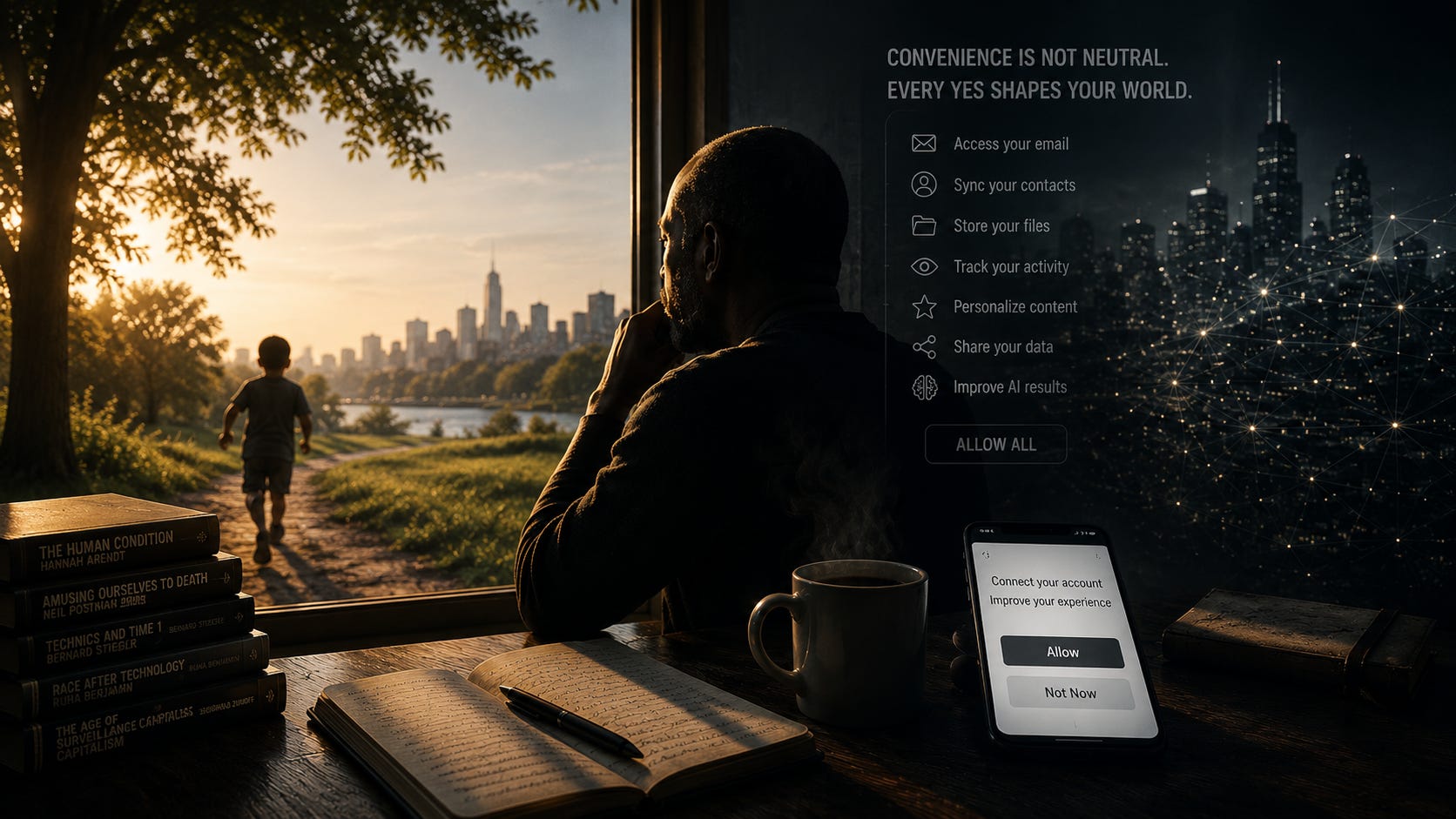
by Floyd Webb
A preface
Every technological revolution is remembered as a story about machines. History says otherwise. The steam engine reorganized labor before it transformed industry. The automobile reordered cities before it changed transportation. Television altered attention before it altered politics. The internet reshaped memory before it reshaped commerce. Ask anyone who no longer remembers a phone number they once dialed every day.
Artificial intelligence will be no different.
These essays are not about resisting technology. Nostalgia holds nothing for me, and there is no path back to an unconnected world anyway, short of apocalypse.
I am interested in something older than technology.
What habits, values, and ways of seeing remain distinctly human when increasingly intelligent systems become woven into everyday life?
The question belongs to anyone who has wondered whether convenience is always worth its price.
I do not expect these essays to produce definitive answers. They are attempts to think carefully while history is still unfolding. If there is a single principle running through these pages, it is a simple one.
Remain human.
Part One: Adama’s Rule
My son was probably three years old when he began sitting on my lap while I worked at my computer.
This would have been sometime in the mid-1990s, when home computers still felt more like curious machines than permanent companions. Every so often I would stop what I was doing and load one of the simple games he loved. Tiny eight-bit characters shuffled across the screen, jumped over obstacles, fired at cartoon enemies—up, down, back and forth, press Enter to fire—and ended with an explosion, cheerful music, and a shower of animated stars. His face would light up every time.
I decided when the game began and when it ended. Parents have always managed a child’s access to the things that captivate them, whether television, comic books, or the corner candy store. The computer was simply another doorway.
What I remember most is not the game itself.
After a few minutes he would climb down from my lap, look up at me, and ask, “Can we go outside now?”
The question has stayed with me for thirty years.
At the time I thought very little about it. Children move effortlessly between one fascination and the next. Outside there were trees to climb, sidewalks to explore, sticks that became swords or spaceships or fishing poles depending on the needs of the afternoon. The digital world had delighted him, but it had not replaced the physical one. He had enjoyed the spectacle without confusing it for life.
I have found myself returning to that memory often, though I could not explain why until recently.
One morning, while I was drinking coffee, a text message arrived from an AI service asking whether I would like to connect my email.
I hadn’t opened an app. I hadn’t sat down at the computer. The request had simply appeared on the phone in my pocket while I was holding a warm cup and still waking up.
“What the software was asking for was not my email. It was permission.”
Connect your account. Improve your experience. It was presented as a convenience, and I have no reason to doubt that it would have been one.
I did nothing.
The message remained on the screen while I finished my coffee.
My hesitation had nothing to do with distrust. I moved from film to digital photography, from analog editing rooms to nonlinear systems, from letters to email, from bulletin boards to the internet. Every meaningful tool I have learned has expanded some part of my creative life.
Yet I have also lived long enough to notice that every generation inherits a different relationship with its machines.
What the software was asking for was not my email.
It was permission.
Permission may be one of the defining words of our age. It is only after years of saying yes, one small reasonable yes at a time, that we discover we have assembled an entirely new relationship between ourselves and the technologies that accompany us through everyday life.
“Permission may be one of thedefining words of our age.”
That thought brought me back to Commander William Adama from the science fiction series Battlestar Galactica. After humanity narrowly escaped destruction because its own networked computers had been turned against it, Adama refused to reconnect his fleet. His ships would operate as isolated systems. They would sacrifice convenience in favor of resilience.
It is a compelling idea.
The safest machine is the one that is never connected.
For a moment I allowed myself to imagine following Adama’s advice literally. No email. No cloud storage. No artificial intelligence. No social media. No online banking. No digital maps.
Then I thought about making a doctor’s appointment, boarding an airplane, paying a bill, sharing a new essay with readers, speaking with friends scattered across several continents.
The fantasy collapsed almost immediately.
The network is no longer a place we occasionally visit. It has become part of the civic infrastructure through which ordinary life now moves. To refuse it entirely is not simply to reject a technology. It is, increasingly, to withdraw from forms of participation that have become woven into everyday existence.
And Adama’s threat is no longer quite our threat. He feared what the network could do to his ships—sabotage, the connection turned into a weapon. The modern danger rarely announces itself that way. Nothing attacks. The network simply absorbs: attention, presence, the shape of a morning, the ways of seeing. Not sabotage but capture. The ship survives; the crew slowly forgets there is anywhere else to stand.
Perhaps that is why I remembered my son asking to go outside.
His world still contained an obvious boundary between the machine and everything beyond it. Mine increasingly does not.
The challenge, then, is no longer how to avoid the network.
The challenge is learning how to enter it without allowing it to become the whole landscape.
That morning I closed the message and poured another cup of coffee. The heat of it, and I felt something arriving that no software had suggested: here comes another essay.
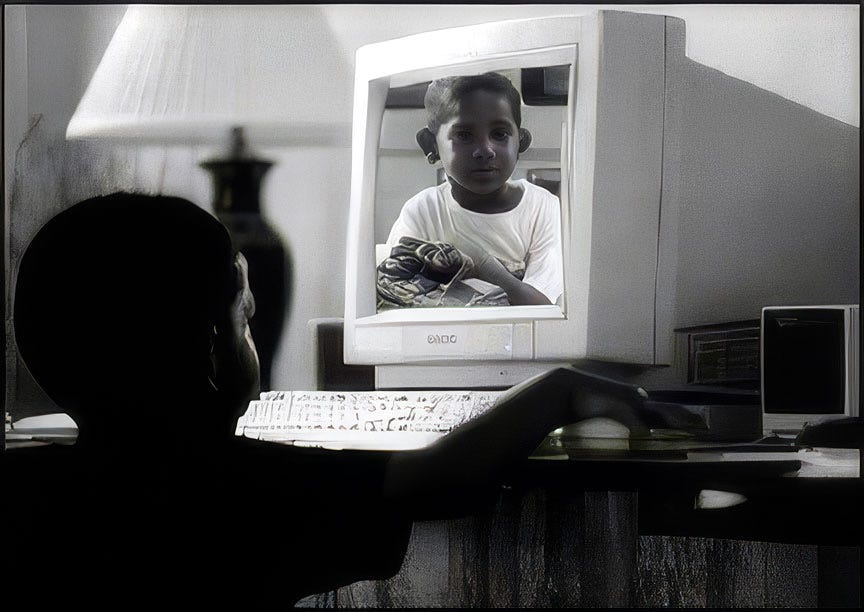
Floyd Webb is a filmmaker, photographer, curator, and writer whose work explores the intersections of Black culture, cinema, music, technology, and social movements. Born in Mississippi and raised between the Mississippi Delta and Chicago, he has spent more than five decades documenting artists, activists, and communities across the African diaspora.
Further Reading (Chicago Style)
The Age of Surveillance Capitalism. Shoshana Zuboff. New York: PublicAffairs, 2019.
Race After Technology. Ruha Benjamin. Cambridge: Polity Press, 2019.
Technics and Time, 1: The Fault of Epimetheus. Bernard Stiegler. Stanford, CA: Stanford University Press, 1998.
The Human Condition. Hannah Arendt. Chicago: University of Chicago Press, 1958.
Amusing Ourselves to Death. Neil Postman. New York: Penguin Books, 1985.
I liked this a lot. Thanks for it!
Nice. You're learnin'.