
The Bamboozle Economy
On the Exploitation of Dreams

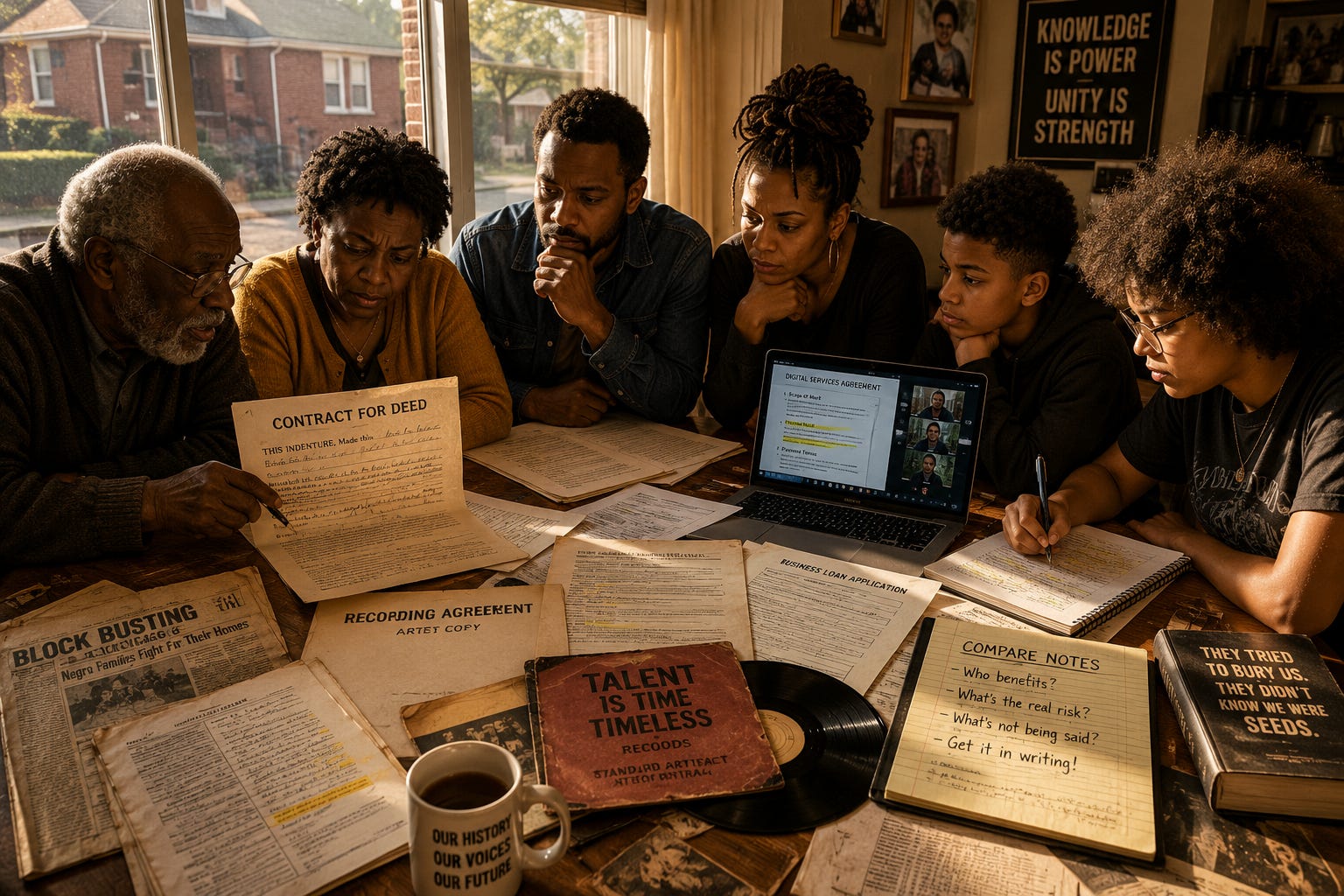
“You’ve been bamboozled. You’ve been hoodwinked. You’ve been led astray, run amok.”*
— Malcolm X
*“If you are silent about your pain, they’ll kill you and say you enjoyed it.”*
— Zora Neale Hurston
Malcolm said it in 1964. He was talking about politics. But the bamboozle is older than any election, older than any party, older than the republic that perfected it. The bamboozle is not a bug in the American economic system. It is one of its oldest and most durable revenue models.
From the snake oil salesman rolling into town on a painted wagon to the predatory lender offering mortgages to people who could never afford them, from the record executive who owns your masters before you understand what masters are to the sleek public relations company that finds your writing online and decides your fifty years of independent work is actually a gap in your portfolio they can fill — for a fee — the exploitation of aspiration remains among the most profitable industries this country has ever produced. What changes is the costume. What remains constant is the mechanism.
Herman Melville understood this before Malcolm. In 1857 he published *The Confidence-Man*, a novel set aboard a Mississippi River steamboat drifting through the American heartland. A shape-shifting con man moves among the passengers, presenting a different face to every potential mark. The novel was not merely a satire of nineteenth-century fraud. It was an anatomy of American belief itself. The steamboat became the internet. The confidence man acquired a website, client testimonials, a stock listing, and a Zoom account. The machinery remained the same.
The Anatomy of the Pitch
Every successful exploitation of a dream follows a familiar structure. It begins with flattery disguised as recognition. Before you walk into the room — or join the Zoom call — they have already studied you. They know what you want to hear because they have read your biography, your work, your public-facing hunger for acknowledgment. The first thirty minutes is not really a sales pitch at all. It is a mirror. They reflect your dream back to you, enlarged, legitimized, and placed just within reach, creating the impression that they possess a special insight into your future when what they really possess is a practiced understanding of aspiration.
This is followed by manufactured urgency. The opportunity is fleeting. The window is closing. Others are waiting. The relationships that make this possible may not be available next month. The urgency is artificial, but it works because it attaches itself to the dream’s own momentum. You’ve waited this long. Why wait any longer?
Finally comes the soft commitment. Not quite a contract and not quite a handshake, but something deliberately suspended between the two. A number on a page. An informal understanding. A promise of movement. The vagueness is not accidental. The vagueness is the product. In any future dispute, the ambiguity belongs to them and the exposure belongs to you.
Paper Theater
A friend and his son once spent months trying to raise $50,000 in order to secure a promised $500,000 business loan. The company supplied documentation, updates, forms, revisions, and requests. The paperwork accumulated like evidence of seriousness. Nothing was happening underneath it.
I think of this as **Paper Theater**: the performance of legitimacy designed to consume a victim’s time, energy, and hope while the actual transaction — which is extraction — proceeds beneath the surface. Paper Theater creates the feeling of progress. It exhausts skepticism. It implicates the victim in the process itself. When the scheme finally collapses, the shame often lands on the person who believed rather than the people who engineered the belief.
Why Dreams Make Perfect Targets
Dreams make ideal targets because they require belief before evidence. Every entrepreneur, artist, organizer, and inventor operates in that uncertain territory between imagination and proof. Every meaningful project begins there. The scammer does not need to deliver. They only need to occupy that territory long enough to extract what they came for.
Because dreams are personal, the injury reaches beyond money. When someone validates your dream, they are validating a part of your identity. The exploitation of a dream is therefore always also an exploitation of the self. That is why the damage lingers long after the financial loss has been counted. And because the loss feels personal, many victims remain silent. They do not warn others. They do not go public. They carry the experience privately, as though it were evidence of their own failure rather than evidence of someone else’s design.
Zora Neale Hurston understood something about power that applies as much to fraud as it does to oppression. If you are silent about your pain, eventually the story will be told for you. That silence becomes the scammer’s final layer of protection.
Who Gets Targeted and Why
This cannot be written honestly without acknowledging who is most frequently targeted. The exploitation of dreams has always moved along predictable lines of race, class, and aspiration. First-generation entrepreneurs, artists without institutional backing, and communities historically excluded from legitimate capital have repeatedly been asked to navigate systems whose rules were never designed for them. The template was perfected on Black artists first. Always first. The record label that owned your masters before you understood what masters were. The promoter who took your publishing. The manager who became your creditor. The 360 deal that claimed a percentage of everything you built, from your recordings and tours to your merchandise and your name.
My friend and his son did not fall for a $50,000 scam because they were foolish. They fell for it because they were operating in a landscape where a legitimate $500,000 business loan is genuinely harder to access for people who look like them. The implausible offer sat inside a believable geography of exclusion. The scammer knew that geography. The scammer always knows that geography better than any mapmaker.
Lorraine Hansberry captured the entire mechanism in *A Raisin in the Sun*. Walter Lee Younger hands his family’s insurance money to Willie Harris because Willie offers him the one thing the legitimate economy has withheld: a way in. Ownership. Dignity. The happiness of arrival. Willie takes the money and disappears. He never appears on stage. He doesn’t need to. The devastation is the performance.
Walter Lee is not naive. That is the point Hansberry refuses to let us miss. He knows the world is rigged. He reaches anyway because the alternative is accepting a ceiling that was never his to accept. Willie Harris does not exploit Walter Lee’s ignorance. He exploits his dignity. That is a different crime. It is a harder one to name and a harder one to prosecute, and it has been running on these same streets, in these same communities, for longer than any of us have been alive to witness it.
Hansberry put it on stage. But the stage was drawn from life — from the very streets where I grew up, where the bamboozle wore not a promoter’s suit or a business contract but a deed of sale.
The Saturday Morning Brightness
I was a child on Chicago’s South Side when I first encountered the emotional aftermath of that system. I did not understand it then. What I remember are Saturday mornings. Neighbors returned home carrying shopping bags and possibilities. Families I knew from school. Men and women who had come north from Mississippi the same way my family had. There was a brightness to them that even a child could recognize without fully understanding. It was the happiness of arrival — the feeling that the sacrifices had meant something and that a future long imagined was finally becoming tangible.
Then the newspaper stories started. Then the sheriffs. Then the moving trucks.
Only decades later did I understand the machinery operating beneath what I had witnessed. The Federal Housing Administration refused to insure mortgages in Black neighborhoods, and banks refused to lend. Into that federally manufactured void stepped contract sellers who offered what appeared to be homeownership but was something else entirely. A mortgage builds equity from the first payment. A contract sale builds nothing until the last. Miss a mortgage payment and legal protections apply. Miss a contract payment and everything can disappear. The deed remains with the seller. The money remains with the seller. The house remains with the seller.
The house was not a home. It was a machine for extraction dressed in the paperwork of legitimacy.
The Contract Buyers League, organized on Chicago’s South and West Sides in 1968, eventually fought back. Families compared contracts, compared promises, compared experiences, and organized collectively. Through payment strikes, legal challenges, and public pressure they forced renegotiations that returned substantial wealth to Black homeowners. They made visible what had been designed to remain invisible. But for many families the damage had already been done. The brightness I remembered from those Saturday mornings had faded into something else.
The soft commitment. The document that looked like ownership but wasn’t. The single missed payment that erased everything. The shame that kept people from warning their neighbors until it was too late.
Sixty-four years later. Same architecture. Different costume.
The Bamboozle as Control
The bamboozle is more than theft. It is a form of social control. When aspiration reliably produces extraction, people begin to scale down their ambitions. They stop trusting their own judgment. A family that loses a house learns one lesson. Their children often learn another: that reaching is dangerous. What begins as financial theft becomes the inheritance of diminished expectations. The individual scam extracts money. The pattern of scams extracts confidence, possibility, and the belief that transformation is achievable. Defeated dreamers do not build institutions. They survive. And a community in survival mode is a community that cannot threaten the arrangements that produced the scam in the first place.
The First Act of Resistance
The Contract Buyers League discovered something that every scam depends upon: isolation. The moment families began comparing contracts, comparing promises, and comparing experiences, the machinery became visible. Their documents were spread across kitchen tables. Ours arrive as PDFs. Their salesmen knocked on doors. Ours schedule Zoom calls. Their neighborhood was bounded by a few city blocks. Ours may be scattered across continents. The technology has changed. The principle has not. Every bamboozle depends upon keeping its victims separate from one another long enough for shame to do its work.
The bamboozle has always sold the same thing: the happiness of arrival. Whether the promise is a house, a business loan, a recording contract, a media placement, or a seat at some imagined table of recognition, the product remains remarkably consistent. What is being sold is not merely opportunity. What is being sold is the feeling that the waiting is over.
I am writing this because a company found my work on the internet, spent thirty minutes telling me everything I had always known about its value, and then presented me with a number on a page and called it an opportunity. I did not sign. I did my research. I found the testimonies of the people who did sign, who paid, who received placements in publications no one reads, who were billed for work they never authorized, who were harassed after they said no.
I am writing this because my friend’s son is still carrying the weight of that $50,000 and the months of paper that led nowhere.
I am writing this because more than fifty years of independent work has taught me one thing above everything else: the people who most loudly offer to validate your voice are almost never the people you should trust with it.
The answer is not cynicism. Communities that stop dreaming have already surrendered more than any scammer could ever steal from them. The answer is visibility. It is comparison. It is the willingness to tell the story before someone else tells it for you. It is the refusal to carry private shame for a public design.
Build your own institutions. Gather your own people. Name what you see.
The bamboozle only works in the dark.
Floyd Webb is a Chicago-based filmmaker, photographer, curator, and cultural critic. He is the founder of the Black Light Film Festival (1982) and curator of Blacknuss.tv.
Selected References and Further Reading
Cialdini, Robert B. Influence: The Psychology of Persuasion. New York: Harper Business, 2007.
Hansberry, Lorraine. A Raisin in the Sun. New York: Vintage Books, 1994.
Konnikova, Maria. The Confidence Game: Why We Fall for It . . . Every Time. New York: Viking, 2016.
Melville, Herman. The Confidence-Man: His Masquerade. New York: Penguin Classics, 1990.
Packard, Vance. The Hidden Persuaders. New York: Ig Publishing, 2007.
Rothstein, Richard. The Color of Law: A Forgotten History of How Our Government Segregated America. New York: Liveright Publishing Corporation, 2017.
Satter, Beryl. Family Properties: Race, Real Estate, and the Exploitation of Black Urban America. New York: Metropolitan Books, 2009.
I am writing this because more than fifty years of independent work has taught me one thing above everything else: the people who most loudly offer to validate your voice are almost never the people you should trust with it.
This hit me hard as I navigate new terrain. Thank you for the work — the honest voice I somehow trust listening to, the wisdom.. 🫶🏽