
The Blues: LOCKSS it up!
Lots of Copies Keep Stuff Safe — a morning with a counterfeit John Lee Hooker, and what Timbuktu already taught us

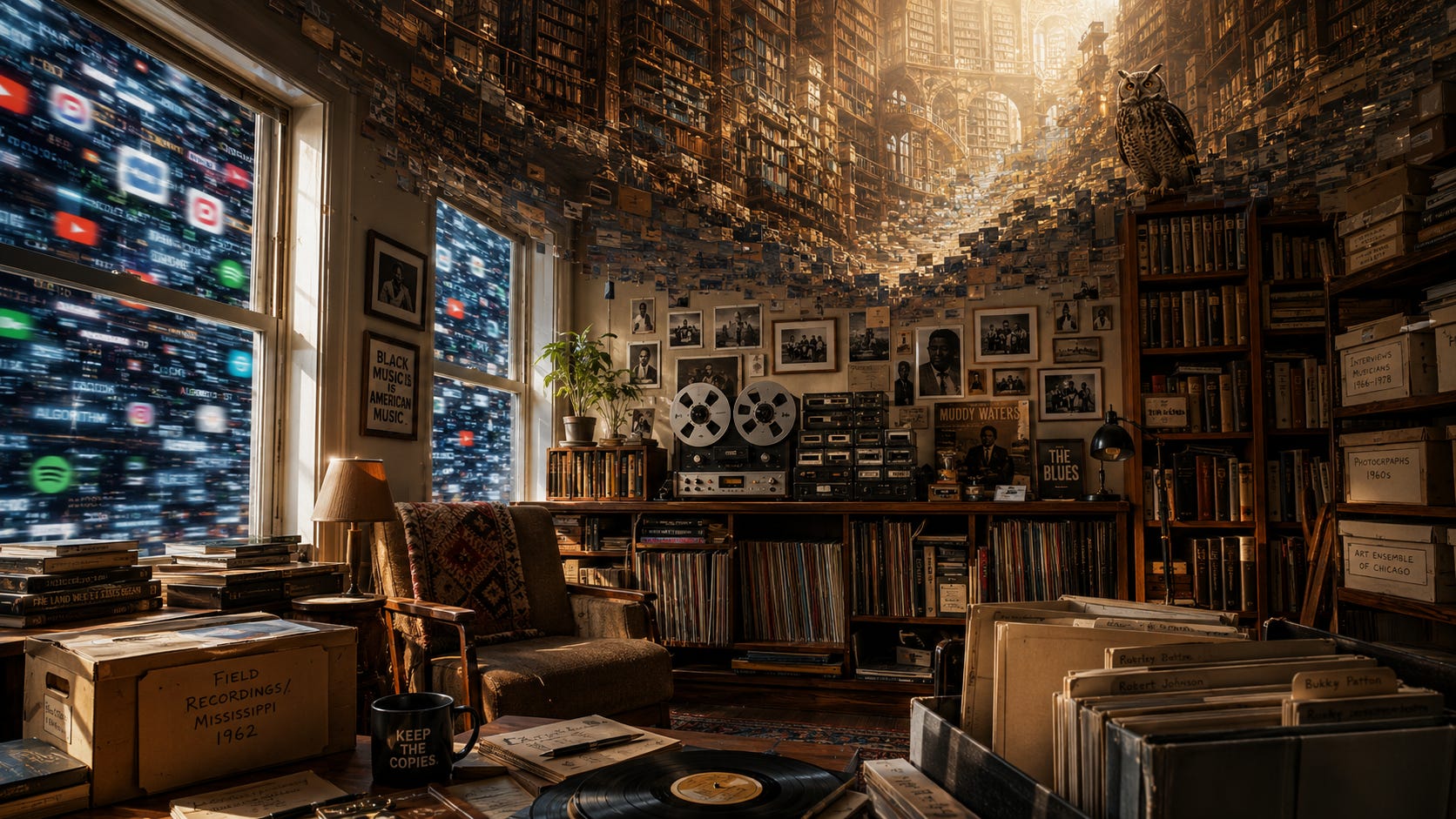
by Floyd Webb
“You’ve taken my blues and gone. You sing ‘em on Broadway And you sing ‘em in Hollywood Bowl, And you mixed ‘em up with symphonies
And you fixed ‘em, So they don’t sound like me.”
— Langston Hughes
The Morning
This morning I wanted John Lee Hooker and got a stranger wearing his face. YouTube served it through the playlist — my usual arrangement — and by the time I understood what I was hearing, the kettle was screaming and my iron skillet was smoking. The counterfeit didn’t just occupy the man’s seat. It took my morning with it.
Understand the arrangement it broke. Playlist rolling, Hooker keeping me company through the chores, the shower, the eggs. I didn’t pick the songs; that was the pleasure of it. Some mornings “Boom Boom,” some mornings “It Serves Me Right to Suffer” — a small, reliable randomness, like cutting a deck of cards you already love. This morning the deck came up wrong.
The strange thing is, it didn’t even sound like him. Nobody who knows John Lee Hooker would be fooled for eight bars — this was some downtown rock-concert production wearing his name. But it was wearing everything else too: his photograph, his song titles, the year 1962, dressed up like a new release of an old album. No credits. No information. Not one word admitting what it was.
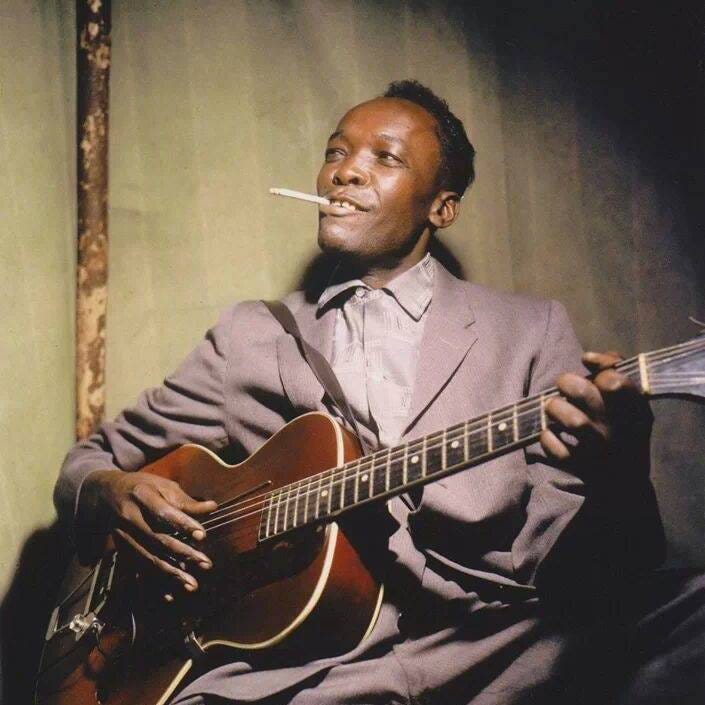
And that’s when I understood the counterfeit doesn’t have to be good. It only has to be first. It isn’t trying to fool me. It’s trying to fool the machine that decides what I see — and the listener ten years from now who never heard the man, who’ll find “Boom Boom (1962)” with his face on it and take the date as a promise.
The counterfeit doesn’t have to be better than the original. It only has to arrive first.
Two Exhibits, Two Different Crimes
Later that same morning the feed offered me a second act: “Big Mama Thornton & Jimi Hendrix — Blues Power Session — Live Analog Recording.” A concert that never happened, in a room that never existed, painted by a machine. The track list gives it away — “Midnight Smoke & Electric Bones,” “Velvet Ash & Howlin’ Wires,” “Neon Mercy & Gravel Tears” — titles no bluesman ever wrote. Somewhere in the description sits the word “Inspired,” doing quiet legal work.
That one is a lie, but a legible lie. It announces itself as fantasy even while stamping “Analog” on the poster. Call it the fantasy fake.
The Hooker upload is something else. Call it the archive fake. Real name. Real photograph. The real track list — “Dimples,” “Crawlin’ King Snake,” “Tupelo Blues” — the real year. Every marker a future listener would use to verify provenance is authentic. Only the sound is counterfeit, and nothing on the page confesses it. The fantasy fake invents a past that never was. The archive fake overwrites the past that was — it moves into the man’s house and answers his mail.
The archive fake doesn’t erase history. It moves into history’s house.
And none of this is new under the sun. Langston Hughes named the crime in 1940, in “Note on Commercial Theatre” — watching his blues carried off to Broadway and the Hollywood Bowl, dressed in orchestras, worked over until they no longer sounded like the people they came from.
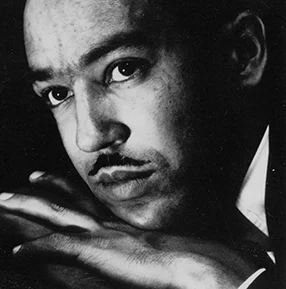
What Broadway did with arrangers, the farm channels now do with a prompt. The machinery changed. The taking didn’t.
I Have Watched This Before
The idea that somebody chooses what history keeps first hit me doing research for the BBC at the Museum of Broadcast Communications in Chicago. In those files I found local television interviews with Malcolm X, on a program called City Desk. Chicago television had sat the man down and let him talk. And there was Kup’s Show — Irv Kupcinet’s annual sit-downs with Elijah Muhammad, head of the Nation of Islam, year after year, on local TV.
Years later I went back, researching for another European news outlet. I could find none of it. Not the Malcolm X interviews. Not the Kupcinet conversations with Muhammad. Only recently did I learn the truth, which is worse than simple loss for what it teaches: the Malcolm X interviews exist — they were simply not visible online. And Kup’s Show has gone missing entirely. The good news is the City Desk interview reappeared on YouTube.
Sit with those two fates a moment. One archive vanished. The other survives but cannot be found. To the person searching, they are identical. “Exists but not visible” is just erasure with better manners — and it is exactly the mechanism the algorithm now performs at scale.
Burial did not need AI. AI just removed the labor cost.
Burial did not need artificial intelligence. It only needed indifference.
The web taught me the lesson a second time. Between 1999 and 2004 the internet was a Wild West — you never knew who was coming or going. Renegade sites, self-published, unaffiliated, answerable to nobody. The most amazing things would just pop up. There was one site I remember doing a history of Black comics, cover after cover filling the screen — and it came and went by the month, blinking in and out as the small service providers that hosted it were swallowed by larger ones. Blogs were something entirely new to us then, and I started paying attention — especially when I couldn’t find them any longer. Burnout. A home server going down. A hosting bill unpaid. Black histories assembled by people no institution had hired to assemble them; dissertations published online because the web, briefly, let scholarship skip the gatekeepers entirely. Things I found in the late 1990s started going missing by 2003. So I began saving what I judged valuable — SiteSucker, Rick Cranisky’s downloading app first released in 2001, and other free tools, copying entire directories into my own machine. I have that archive still. The renegade sites are what needed saving precisely because they were renegade: nobody’s job was to keep them, so nobody did.
So when the counterfeit Hooker arrived in my morning feed, I did not experience it as something new. I recognized it as the third act of a pattern I have been watching for forty years: first the archive chosen by hand — curators deciding whose interviews were worth keeping visible; then the archive decaying by neglect — link rot, dead directories, nobody assigned to care; and now the archive buried by volume — the flood ranking itself above the record. Three mechanisms, one result. And each time, the only thing that reliably survived was the copy somebody kept themselves.
First the archive is chosen. Then it decays. Finally it is buried beneath abundance.
Burial Is the New Erasure
The recordings still exist. Nothing was deleted. That’s what makes this hard to name — there’s no fire, no smashed shellac, no purge order. The archive stays intact while the path to it disappears, and most people only ever walk the path.
The mechanism is simple: recommendation systems rank on freshness, volume, and engagement — three things the dead cannot supply and content farms supply endlessly. John Lee Hooker’s estate uploads nothing new. The farms upload constantly. At that volume the original isn’t destroyed, it’s buried — and burial does the work of erasure without anyone having to commit it.
Let me be careful here, because care is the argument…
The flood doesn’t have to hate John Lee Hooker. It only has to be indifferent.
Timbuktu
When the extremists came for Timbuktu’s libraries, what saved the manuscripts wasn’t the institution. It was the households…
Concentration was the vulnerability. The household was the archive.
The Blues Already Proved It
This music has run this experiment before…
The vault failed twice—once by fire, once by silence.
LOCKSS
Archivists have a doctrine for it: LOCKSS — Lots Of Copies Keep Stuff Safe. The acronym even does double work: it sounds like locks, securing something, while meaning the opposite of locking away. Safety through dispersal, not through the vault.
Safety comes through dispersal, not centralization.
The practice, plainly:
Own files, not licenses.
A playlist is rented access — the platform can rearrange it, relabel it, or let a counterfeit move in next door. A drive in your home, physical media on your shelf, cannot be updated out from under you.
Keep the chain of hands.
An archive without context is just files. The home archive wants provenance attached: this is the 1962 recording, this is the label, this is who played on it, this is why it matters. That’s the one thing the flood cannot counterfeit — not the sound, but the chain of hands.
Trust the network as a copy, never as the primary.
The network is where you find things. The home is where things survive.
…
The catalogue is the real work…
Before there can be a rescue, there has to be a list.
…
The institution keeps not arriving. The households never left.
The institution keeps not arriving. The households never left.
Ten years from now, somebody is going to want to hear some blues in the morning…
Lots of copies keep stuff safe. Start counting yours.
One last image, and it’s a building.
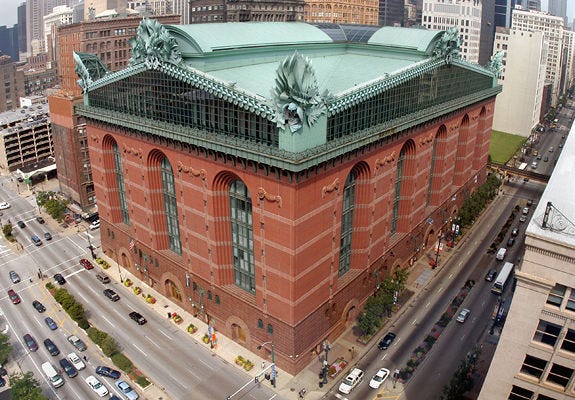
The Harold Washington Library holds none of the broadcast museum’s materials — that archive has its own space now. I keep it here for its face. When I first saw those enormous owls perched on the corners of the roof, I laughed, because the design articulated something true about the man it was named for: verbose, over the top, and always with humor. I always thought Harold would like the owls. A library that announces itself — a building with edges you can see from the street, and watchers posted at every corner of the record. The feed watches me for its own reasons. The owls are watching my back.
But the owls are only on one building. The list is everywhere.
Author’s Note
I was born in the Mississippi Delta, on Highway 61 between Jonestown and Clarksdale, where the blues is less a genre than part of the landscape. Long before I understood its history, its voices were already part of the world I inherited. That journey eventually led me to Chicago, where I have spent a lifetime working as a filmmaker, photographer, writer, curator, and producer documenting Black history, music, and culture.
I am the founder of Blacknuss Network and publisher of BFMMag.com. My work has included producing films, curating international film programs, preserving overlooked histories, and building archives that connect people to the stories that shaped them. The Remain Human essays grow out of that same lifelong pursuit: exploring how memory, culture, and community survive in times of technological change.
If this essay resonates with you, I hope you’ll share it, explore the listening companion, and—most importantly—keep your own copies.
A Listening Companion
This essay began with a morning spent listening to John Lee Hooker. If you’d like to follow the thread, I’ve assembled a playlist of many of the artists and recordings that shaped this piece. Think of it as an invitation, not an archive. The music still deserves to be sought out in its original recordings, reissues, and physical collections whenever possible.
Further Reading
Haidara, Abdel Kader, with Joshua Hammer. The Bad-Ass Librarians of Timbuktu: And Their Race to Save the World’s Most Precious Manuscripts. New York: Simon & Schuster, 2016.
Hughes, Langston. The Collected Poems of Langston Hughes. Edited by Arnold Rampersad and David Roessel. New York: Alfred A. Knopf, 1994.
Oliver, Paul. The Story of the Blues. Boston: Northeastern University Press, 1997.
Rosenthal, Jonathan. “The Day the Music Burned.” The New York Times Magazine, June 11, 2019.
Smith, Harry, ed. Anthology of American Folk Music. Washington, DC: Smithsonian Folkways Recordings, 1997. Originally released 1952.
Wald, Elijah. Escaping the Delta: Robert Johnson and the Invention of the Blues. New York: Amistad, 2004.
Wilmer, Val. As Serious as Your Life: Black Music and the Free Jazz Revolution, 1957–1977. London: Serpent’s Tail, 1992.
Rosenthal, David S. H., Thomas Lipkis, Thomas S. Robertson, and Seth Morabito. “LOCKSS: A Permanent Web Publishing and Access System.” D-Lib Magazine 11, no. 6 (2005).
Blues Archives & Collections
Rather than just museums, I’d point readers toward archives that are actively preserving recordings, photographs, oral histories, and documents.
Delta Blues Museum (Clarksdale, Mississippi) — The oldest state-supported blues museum, with extensive collections, educational resources, artist archives, and one of the country’s important collections of 78 rpm recordings.
The Blues Foundation & Blues Hall of Fame (Memphis, Tennessee) — Home of the Blues Hall of Fame and an important center for preserving blues history, scholarship, and recordings.
Smithsonian Folkways Recordings — The nation’s most important nonprofit record label devoted to preserving traditional music from around the world, including foundational blues recordings.
Association for Cultural Equity (Alan Lomax Archive) — Alan Lomax’s field recordings, photographs, interviews, and research documenting American vernacular music.
Archives of Traditional Music, Indiana University Bloomington — One of the world’s largest sound archives, including significant collections of blues field recordings.
University of Mississippi Blues Archive — A major research collection of books, recordings, photographs, manuscripts, oral histories, and ephemera devoted to the blues.
Barrelhouse Blues Archives — A remarkable independent online archive of Chicago blues photographs, posters, memorabilia, and performance history assembled by collectors and musicians. It demonstrates exactly the kind of personal stewardship this essay celebrates.