
The Whispering Gallery
Listening for Africa in the Architecture of the Obama Presidential Center

by Floyd Webb
“Imagination is a field of struggle, not an ephemeral afterthought that we have the luxury to dismiss or romanticize.”
—Ruha Benjamin, Imagination: A Manifesto
Every act of criticism begins with an archive. We all bring one.
Museums have never been spectacles to me. They’ve always been conversations.
When I was a little boy of 6, my teenage cousin Joe and I would arrive at Chicago’s museums on Saturday mornings just as the doors opened. We had the run of the place before the crowds arrived, wandering wherever curiosity pulled us. We loved the Egyptian galleries, but my favorite stop was always the Whispering Gallery at the Museum of Science and Industry.
Two people could stand on opposite sides of the room facing away from one another. One would lean toward the curved wall and whisper. Somehow the building carried those words across the space until they arrived, impossibly clear, in the other person’s ear.
I never forgot that.
Long before I understood architecture, I understood that buildings could carry voices.
I’ve been listening for whispers ever since.
Which is probably why I let the spectacle surrounding the opening of the Obama Presidential Center pass me by.
The public conversation had already become predictable. Depending on who was speaking, the museum tower was either a triumph or a disaster. Critics compared it to a bunker, a prison, an obelisk. Others defended it with equal certainty. Everybody seemed to know what the building meant before they had spent much time with it.
I wanted the building after everyone else had finished telling me what it was.
Attention is slower than opinion. That’s why it so often arrives somewhere else.
I wanted the building after everyone else had finished telling me what it was.
So I went on a Tuesday evening.
The attraction wasn’t the museum itself. It was a screening of Hamilton on the plaza. As a filmmaker and curator, I know how buildings learn to carry cinema—and gather people around it. How would this new civic campus use the screen? Could a space designed around democracy become a place where neighbors gathered simply to watch a story together?
That Tuesday evening, the answer was unfinished—and unmistakable.
Three hundred or more had come. Families with children. Old and young. Mixed across the plaza like an oasis opening in the middle of rupture, in the middle of a moment when democracy itself felt fractured and uncertain.
The screen was too small for a crowd that large. From the back it nearly disappeared into the scale of the plaza. The audio struggled across stone, softening dialogue into reverberation. These weren’t failures of vision. They were signs of a building still learning its own scale, still figuring out how to gather people without commodifying the gathering.
If anything, they reassured me.
This wasn’t a sealed monument or a spectacle sold to tourists.
It was a place in formation. And people were already claiming it.
I wandered away before the movie began.
That, too, is an old habit.
Across the lagoon, the Museum of Science and Industry stood exactly where it had stood throughout my childhood. No museum shaped my imagination more. It wasn’t simply the exhibits. It was the feeling that curiosity itself had been given a home.
I followed the path around the Obama Center, moving slowly enough to let the building introduce itself.
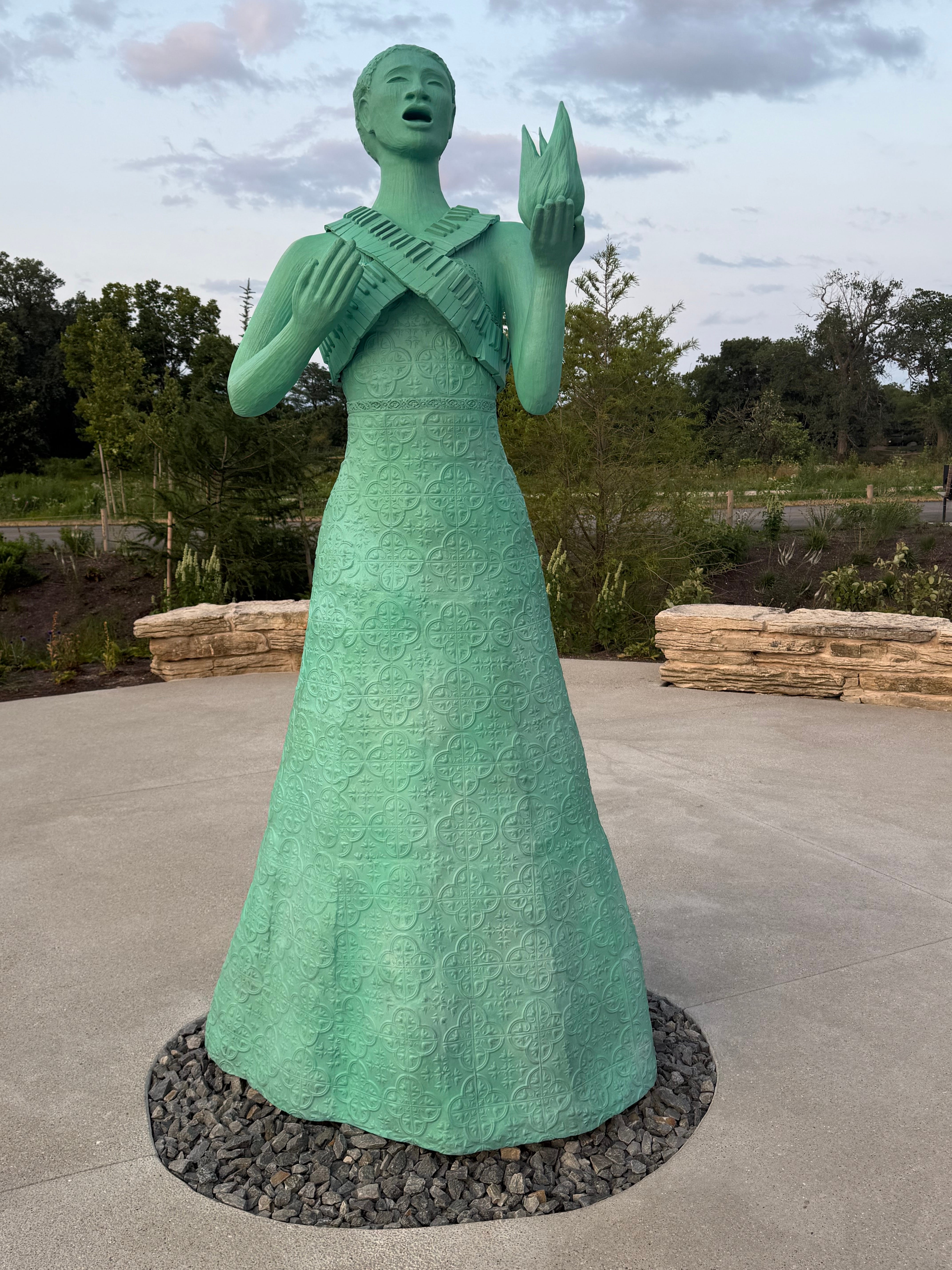
It sits between South Shore Drive and the lagoon with a confidence that many critics have mistaken for arrogance. Photographs flatten what walking reveals: granite alive with light, carved surfaces demanding to be circled rather than glanced at. The building asks to be encountered over time.
Then I found Alison Saar’s Torch Song.
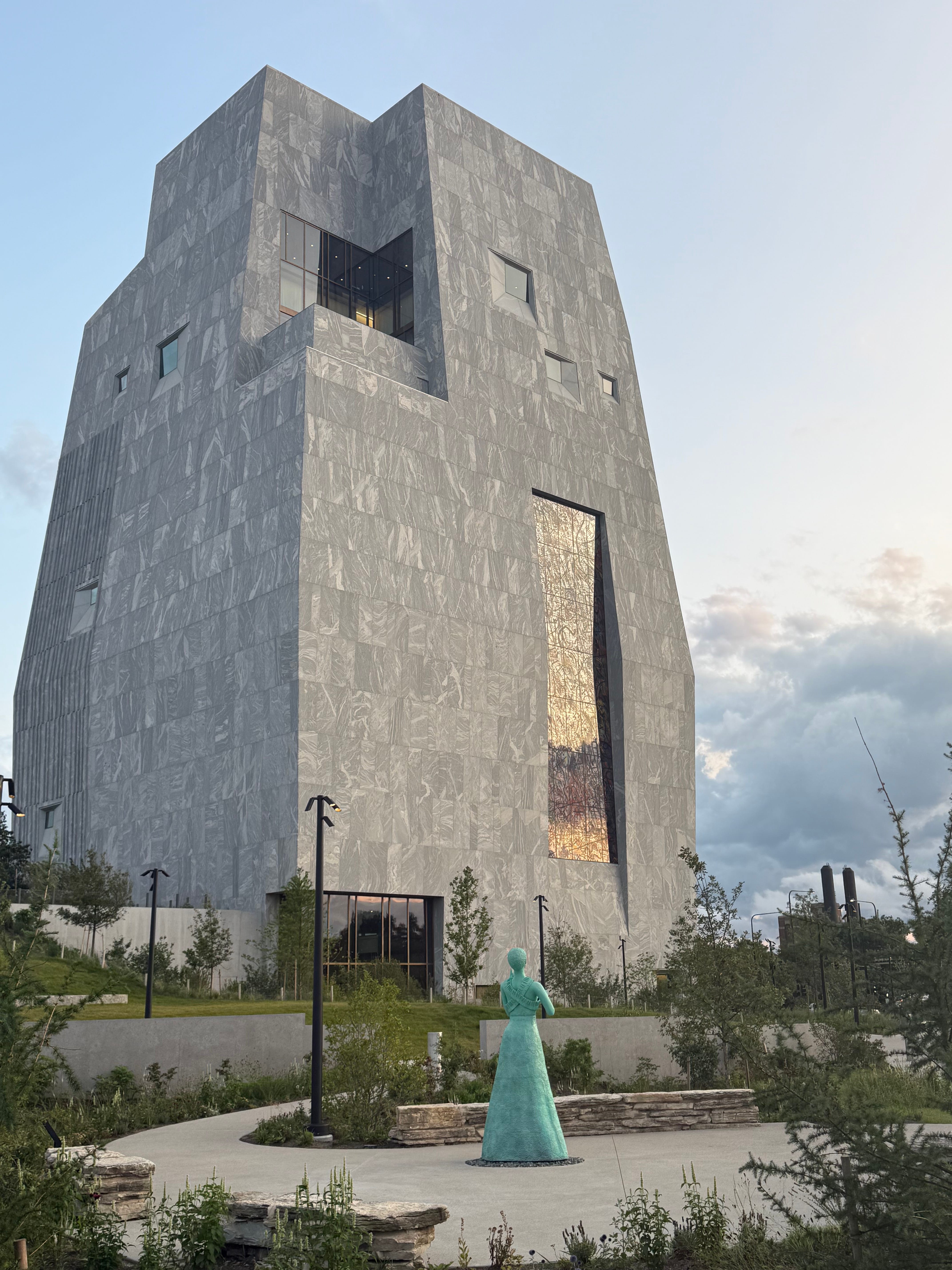
She stands in the Women’s Garden, not greeting visitors but facing the museum itself. Cast in bronze with the blue-green patina of the Statue of Liberty, she raises a flame above her head. Draped across her torso is a bandolier of piano keys, carrying the memory of Black music into the landscape.
The Obama Foundation describes the sculpture as honoring the voices of Black women—from Marian Anderson to Koko Taylor to Nina Simone—whose artistry helped carry generations toward justice.
Standing there, I heard something else.
“This little light of mine . . . I’m gonna let it shine.”
The sculpture stopped being an object.
It became a torch bearer.
Behind her stood the museum.
Suddenly I wasn’t looking at a prison or a bunker.
I was looking at a fortress of culture.
Suddenly I wasn’t looking at a prison or a bunker. I was looking at a fortress of culture.
My archive kicked in.
Alison Saar’s larger body of work immediately called her mother to mind. Years ago, I had stood before Five Guys Named Moe—that magnificent stacked totem inspired by Louis Jordan’s 1943 jump blues classic. The sculpture presents five carved African American male heads facing different directions, each representing a distinct archetype: Mo-Hair, the investigator; Mo-Gul, money; Mo-Town, creativity and art; Mo-Jo, magic; Mo-Fo, violence.
Standing before Torch Song, I recognized Mo-Hair—not simply as a character in Saar’s sculpture, but as a way of seeing. The one who looks closely. Who follows threads through time before arriving at conclusions.
From there my thoughts traveled to the monumental architecture of the Sahel.
Not because the Obama Center imitates African architecture.
Because it participates in a way of thinking about monumentality that American criticism rarely begins with.
I began writing this essay before Bettye Saar’s death. By the time I returned to finish it, I was seeing Alison Saar’s Torch Song differently.
Bettye Saar, how I loved that woman.
Phenomenal artist. Master craftswoman. Always facing forward—not as provocation but as navigation. She knew things about materials, about what a bottle could say, what a mirror could refuse, what time does to metal and cloth. Encounter her work and you’re smiling before you understand why. Dumbstruck after.
She left us the evidence that the future is handmade. That politics lives in the particular. That a Black woman’s imagination, once uncontained, remakes the world.
She left us the evidence that the future is handmade.
Standing before her daughter’s sculpture, I realized something the Whispering Gallery had taught me decades earlier.
Buildings carry voices.
Not only the voices of architects.
The voices of artists.
Landscapes.
Histories.
Songs.
Memories.
That realization carried me farther into the Sahel.
For centuries, Timbuktu was one of the world’s great centers of learning. Its libraries preserved hundreds of thousands of manuscripts on astronomy, mathematics, medicine, law, poetry, philosophy, and faith—evidence that Africa’s intellectual history had always been richer than the colonial imagination allowed.
When extremists occupied the city in 2012, they understood something about those manuscripts.
They understood their power.
Librarians and ordinary families understood it too.
Quietly, patiently, they smuggled the manuscripts out in trunks, wooden chests, and rice sacks, carrying an entire civilization’s memory beyond the reach of fire.
Buildings carry voices.
Sometimes people must carry the buildings’ voices.
Standing before the Obama Presidential Center, I found myself wondering whether this, too, was part of that longer tradition—not merely preserving artifacts, but constructing another house for memory
The loudest voices surrounding the Obama Center had been architectural critics. Their vocabulary was familiar: Brutalism, bunker, prison, monument, obelisk. None of those descriptions is entirely wrong. But nearly all of them emerge from the same dominant architectural tradition—a vocabulary inherited largely from Europe and modern America.
My archive whispered differently: Bettye. Alison. Louis Jordan. The Sahel.
Only later did I learn that the architects themselves had spoken about being inspired by an ancient carved stone in Aksum, Ethiopia. I smiled when I read that—not because it proved my interpretation, but because it reminded me that sometimes intuition arrives before research completes itself.
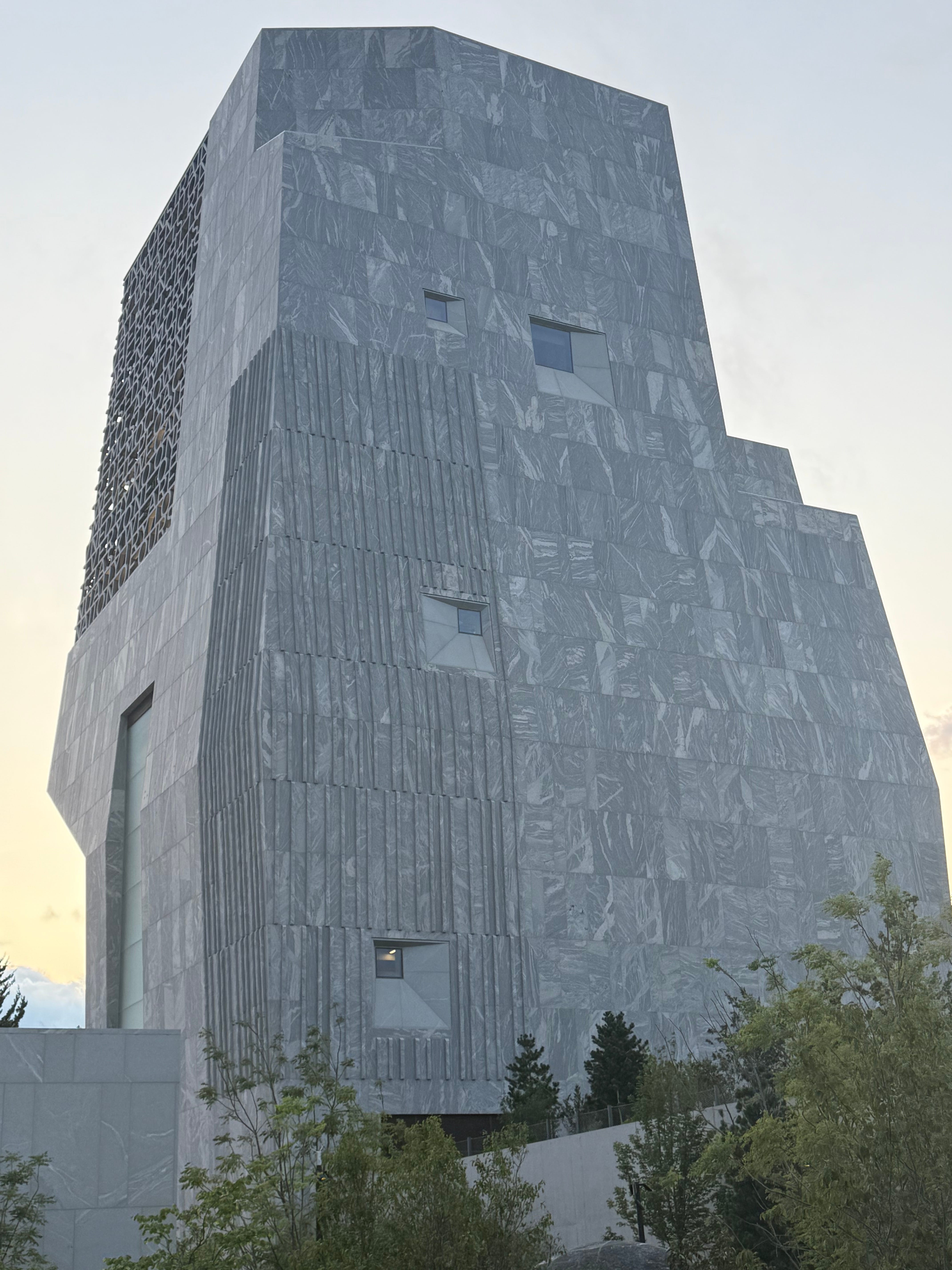
Looking closely at the building, I stopped seeing a blank wall. The granite is alive with veins that flow like geological time compressed into architecture. The carved surfaces demand attention. Obama’s words are not attached to the building. They inhabit it. From a distance, the inscriptions dissolve into texture. Step closer and they become the building’s skin—language as architecture, architecture as language.
The critics kept asking why there was so little glass.


Standing beneath those carved words, I found myself asking a different question: What if transparency wasn’t the point at all? What if the building had substituted language for glass—making its openness a matter of what you were invited to read rather than what you could see through?
The building wasn’t asking you to look past it to something inside.
It was asking you to read what it had to say.
The building wasn’t asking you to look past it to something inside. It was asking you to read what it had to say.
By then I realized I didn’t need to get inside the museum.
Not yet.
The campus had already begun the conversation.
Only later did I learn that more than thirty artists had been commissioned across the campus, most of their work freely accessible rather than hidden behind a ticket. That decision seems entirely consistent with the Obama Center’s refusal to seal culture behind walls or paywalls. This is not simply a museum. It is an attempt to build civic life—a place for basketball, gardening, concerts, conversations, films, and art.
Perhaps that is why my first encounter with it happened outside.
Every act of criticism begins with an archive.
We all bring one.
Mine happened to include Saturday mornings with my cousin Joe, the Museum of Science and Industry, Bettye and Alison Saar, Louis Jordan, the investigator’s way of seeing, African architecture, photography, jazz, and a lifetime of wandering museums until something began to speak.
The Whispering Gallery taught me that buildings can carry voices across a room.
The Obama Presidential Center asked whether architecture could carry voices across generations.
I stopped long enough to hear the conversation.
On the Architecture: The Designers’ Intent
The Obama Presidential Center in Chicago features a signature 225-foot, faceted granite museum tower designed by Tod Williams Billie Tsien Architects. The building’s striking, tapering form was directly inspired by an artifact the architects found in Aksum, Ethiopia, and its verticality reflects a deliberate conversation with the monumental traditions of African architecture.
“In a dusty box on the floor of a souvenir store in Aksum in the Tigray section of Ethiopia,” Billie Tsien noted of the tower’s early development, “it fits in the palm of your hand... it was mysterious and felt as if it carried a message.”
That intuition—that a small carved stone from Ethiopia could speak to the scale and intention of a civic building in Chicago—is the same intuition that moved through the essay. The architects and the critic, working independently, heard the same whisper.
Monumental Earth and Stone Architecture
The Obelisks of Aksum (Ethiopia): The primary physical inspiration for the museum tower came from carved stone artifacts found in Aksum. The ancient stelae of Aksum are monolithic stone obelisks defined by geometric precision, minimal fenestration, and precise structural tapering—the exact vocabulary the Obama Center employs.
**The Great Mosque of Djenné (Mali):** This masterpiece of Sudano-Sahelian architecture features massive, windowless mud-brick walls that slope inward as they rise. Like the Obama Center, it commands its landscape through verticality, uses the building itself as a civic statement, and functions as a community gathering place.
Great Zimbabwe (Zimbabwe): The monumental granite-block construction of Great Zimbabwe utilizes curved, massive stone walls without mortar. The Obama Center’s faceted, heavy New Hampshire granite exterior mirrors this imposing, timeless stone masonry.
Modern and Contemporary African Structures
The National Museum of African American History and Culture (Washington, D.C.):** Designed by British-Ghanaian architect David Adjaye, this building is a direct conceptual cousin to the Obama Center. Its three-tiered form is an abstraction modeled directly after the historic carved wooden columns of Nigerian Yoruba shrines, translating sacred African architectural language into contemporary civic space.
Bessang Train Station (Douala, Cameroon):** This building pairs a massive concrete structural footprint and prominent clock tower with a wide, welcoming community concourse. It blends heavy geometric forms with civic integration in a manner similar to the Obama Center’s approach.
Integrated Earth and Landscape Design
The Rock-Hewn Churches of Lalibela (Ethiopia): While the Obama Center’s museum tower rises from Jackson Park, its low-slung forum and library buildings are integrated directly into the landscape, featuring green roofs that visitors can walk on. This “landscape-as-building” philosophy mirrors Lalibela, where monolithic stone structures are carved directly down into the earth, blurring the boundary between building and topography.
The architects found what they were seeking. The building carries the conversation forward. And the city—300 people gathered on a Tuesday evening, families bringing their children to watch a story together in the middle of democratic rupture—the city understood what the building was saying before the critics finished their descriptions.
About the Author
Floyd Webb is a Chicago filmmaker, photographer, writer, and curator whose work explores the intersections of Black history, visual culture, architecture, technology, and memory. founder of the Blacklight International Film Festival, and an associate producer for the groundbreaking Julie Dash film, Daughters of the Dust, he has spent more than four decades documenting the people, places, and ideas that shape the African diaspora. His essays combine memoir, criticism, and cultural history, asking how images—and the stories we tell about them—influence the way we see the world. He writes the Remain Human series on Substack from Chicago.
Further Reading
Imagination, Cultural Memory, and the Future
Benjamin, Ruha. Imagination: A Manifesto. New York: W. W. Norton & Company, 2024.
A philosophical and political meditation on imagination as a contested public resource rather than a private indulgence. Benjamin’s argument provides the conceptual frame for thinking about whose visions are permitted to shape shared institutions and futures.
hooks, bell. Art on My Mind: Visual Politics. New York: New Press, 1995.
A collection of essays examining art, representation, spectatorship, and the importance of developing critical languages rooted in Black experience rather than inherited dominant standards.
Lorde, Audre. “Poetry Is Not a Luxury.” In Sister Outsider: Essays and Speeches, 36–39. Berkeley, CA: Crossing Press, 1984.
Lorde argues that imagination and creative expression are essential instruments through which unnamed experience becomes thought, language, and transformative action.
Saar, Betye. Betye Saar: Black Girl’s Window. Edited by Christophe Cherix and Esther Adler. New York: Museum of Modern Art, 2019.
A study of Saar’s prints, assemblages, symbolism, and visual vocabulary, demonstrating how memory, found materials, spirituality, and political history converge in her practice.
African Architecture and Monumentality
Adenowo, Olajumoke. Neo Heritage: Defining Contemporary African Architecture. Milan: Rizzoli, 2023.
Adenowo proposes a framework for contemporary architecture grounded in African heritage principles rather than the superficial repetition of traditional forms. Her work considers symbolism, light, community, sustainability, and ancestral spatial knowledge as resources for contemporary design.
Gardi, René. Indigenous African Architecture. Translated by Sigrid MacRae. New York: Van Nostrand Reinhold, 1974.
A photographic and architectural survey of West African dwellings and civic structures, emphasizing the relationship among local materials, climate, community organization, construction practice, and expressive form.
Herz, Manuel, Ingrid Schröder, Hans Focketyn, and Julia Jamrozik, eds. African Modernism: The Architecture of Independence: Ghana, Senegal, Côte d’Ivoire, Kenya, Zambia. Photographs by Iwan Baan and Alexia Webster. 2nd ed. Zürich: Park Books, 2023.
A broad survey of the architecture created during and after African independence, showing how newly sovereign nations used monumental civic buildings, universities, cultural centers, and government complexes to materialize political identity and national aspiration.
Stierli, Martino, Ikem Stanley Okoye, and Mallory Cohen, eds. Architects of Liberation: Modernism in Western Africa. New York: Museum of Modern Art, 2026.
Examines modern architecture across Senegal, Côte d’Ivoire, Ghana, Togo, Benin, Nigeria, and Cameroon, focusing on how architects adopted, revised, and transformed modernism to serve the cultural and political ambitions of newly independent nations.
Van Beek, Suzanne Preston Blier. The Anatomy of Architecture: Ontology and Metaphor in Batammaliba Architectural Expression. Chicago: University of Chicago Press, 1987.
A close study of architecture as a social, spiritual, and bodily system, examining how built forms carry knowledge, identity, ritual, and cosmology.
Sahelian Form, Earth, and Surface
Denyer, Susan. African Traditional Architecture: An Historical and Geographical Perspective. New York: Africana Publishing Company, 1978.
A foundational survey of African architectural traditions organized through geography, material, climate, social structure, and historical development.
Rael, Ronald. Earth Architecture. New York: Princeton Architectural Press, 2009.
A global study of earthen construction that places adobe, rammed earth, and related techniques within contemporary architectural and environmental conversations.
Van der Laan, James Morris. Butabu: Adobe Architecture of West Africa. Photographs by James Morris. New York: Princeton Architectural Press, 2004.
A photographic survey of monumental earthen architecture across the Sahel, documenting the sculptural beauty, scale, ingenuity, and regional variety of adobe buildings in Mali, Niger, Nigeria, Togo, Benin, Ghana, and Burkina Faso.
This essay was written by the author and structurally edited with AI assistance, for fact checking and verification, and additional research.
Such a beautiful piece to read and contemplate on a rainy Saturday morning. Thank you Floyd.
Thank you for this beautiful education in seeing and listening. Your words have helped me.