
UNDERGROUND FIELD DISPATCH No. 2: The Kit Kat Heist
On the Difference Between Contains Chocolate and Is Chocolate

by Floyd Webb
This dispatch is satire. The cocoa industry’s labor problem is not. — fw
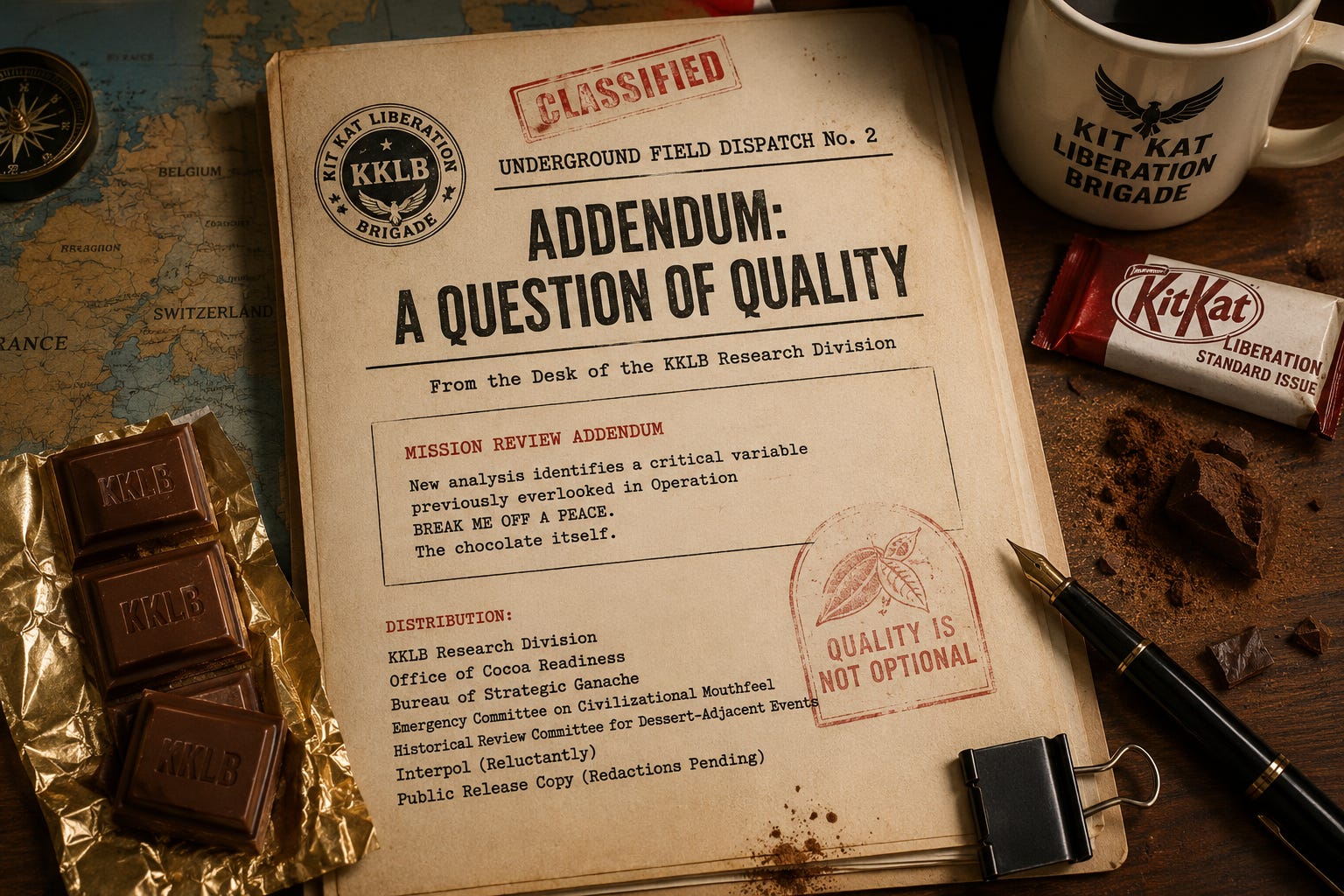
Addendum: A Question of Quality
Before proceeding, the Kit Kat Liberation Brigade (KKLB) Research Division recommends that readers familiarize themselves with the findings contained in Underground Field Dispatch No. 1: Break Me Off a Peace. While the Brigade continues to classify the original operation as operationally ambitious, subsequent review has identified several critical deficiencies in procurement standards, confectionery doctrine, and the regrettable assumption that all chocolate is created equal.
Readers wishing to review the original case file may do so here:
UNDERGROUND FIELD DISPATCH No. 1 — Break Me Off a Peace
https://open.substack.com/pub/floydwebb/p/break-me-off-a-peace?r=c40a&utm_campaign=post&utm_medium=web
The following document constitutes the official addendum to that report. It incorporates the findings of the KKLB Research Division, the recommendations of the Post-Deployment Chocolate Assessment Committee, and the uncomfortable conclusions reached after an exhaustive review of postwar European dessert history.
Certain findings remain contested.
Others have become increasingly difficult to ignore.
DISTRIBUTION
Kit Kat Liberation Brigade Research Division
Office of Cocoa Readiness
Bureau of Strategic Ganache
Emergency Committee on Civilizational Mouthfeel
Historical Review Committee for Dessert-Adjacent Events
Interpol (Reluctantly)
Public Release Copy (Redactions Pending)
A QUESTION OF QUALITY
Following a six-week internal review, three external audits, two ethics waivers, and one unfortunate incident involving a fondue fountain, the Brigade has concluded that the failure of the original twelve-ton chocolate deployment cannot be attributed solely to logistics, ideology, weather, or human stubbornness.
The chocolate was inadequate.
This finding was not reached lightly.
The original shipment consisted largely of mass-market milk chocolate: heavily processed, aggressively sweetened, alkalized for shelf stability, and manufactured to survive conditions no genuine cacao bean ever volunteered for.
“We deployed a snack when history required a sacrament.”
The distinction is now considered operationally significant.
ERRATUM 4.3 — ON THE SCIENTIFIC BASIS OF OPERATION
BREAK ME OFF A PEACE
Subsequent review has determined that the Brigade’s original operational assumptions were, in fact, grounded in legitimate scientific literature.
Multiple peer-reviewed studies demonstrate that high-cacao dark chocolate is associated with improved cardiovascular health, enhanced cognitive performance, increased cerebral blood flow, reduced inflammation, and measurable improvements in mood. Researchers have further identified flavanols, theobromine, magnesium, and other naturally occurring compounds within cacao as contributing factors in these effects.
The Research Division therefore wishes to emphasize that the Brigade did not fabricate the science.
The Brigade merely failed to read all of it.
Specifically, investigators have determined that the cited research referred almost exclusively to high-percentage dark chocolate—often approaching 100% cacao—consumed in carefully measured quantities under controlled laboratory conditions.
The Brigade, by contrast, procured approximately twelve tons of heavily processed, mass-market milk chocolate during a seasonal promotional event.
This distinction is now considered operationally significant.
Review of the original planning documents suggests the Procurement Committee concluded its literature review shortly after encountering the phrase “improves mood.”
No evidence has been found that anyone continued to the section discussing flavanols.
Nor, regrettably, cacao percentage.
An internal audit has further concluded that the Brigade committed what policy analysts now describe as a Category III Confectionery Equivalency Error—mistakenly assuming that contains chocolate and is chocolate were operationally interchangeable concepts.
They were not.
“The Brigade did not fabricate the science. The Brigade merely failed to read all of it.”
The Research Division now believes the Brigade inadvertently optimized for Halloween rather than international peace.
The Brigade’s Research Division spent the recalibration period examining what initially appeared to be an unrelated historical anomaly: the remarkable period of relative peace across Western Europe following 1945 occurring alongside the continent’s increasingly obsessive commitment to high-cacao Belgian, Swiss, and French chocolate.
Correlation is not causation.
Neither, the report notes, is it something to dismiss merely because it begins sounding expensive.
Marshall Plan funding and premium couverture arrived within statistical shouting distance of one another. The Brigade has elected not to investigate the coincidence further for fear of accidentally proving something.
The revised hypothesis is straightforward.
Properly conched, minimally processed dark chocolate preserves theobromine, flavanols, and what researchers repeatedly describe as “the full moral architecture of the cacao bean.”
Mass-market chocolate preserves quarterly earnings.
The implications are difficult to overstate.
Where ordinary milk chocolate produces a brief sugar rush followed by disappointment, properly made dark chocolate appears capable of creating what one researcher called “a temporary suspension of unnecessary certainty.”
The Brigade now considers this civilization’s most underfunded natural resource.
Earlier reports compared chocolate to diplomacy.
Those reports have now been corrected.
The Brigade believes diplomacy may simply be what happens after sufficiently good chocolate.
“Europe didn’t get lucky. Europe got better cacao.”
Several members of the Historical Review Committee have proposed that the Treaty of Rome be reclassified as a dessert-adjacent event.
The recommendation remains under review.
An internal memorandum further observes that historians continue insisting postwar reconstruction was driven by institutions.
The Brigade respectfully notes that institutions rarely contain hazelnut praline.
Previous editions of this report also understated Belgium’s strategic importance.
The Brigade regrets the oversight.
Belgium appears to have devoted itself almost entirely to producing chocolate, brewing exceptional beer, and quietly preventing another continental catastrophe.
This should have attracted greater academic attention.
Swiss officials neither confirmed nor denied maintaining strategic chocolate reserves.
Their refusal has been interpreted as encouraging.
Nestlé declined to comment.
Several Belgian chocolatiers likewise declined comment, though investigators observed what has been officially recorded as “an expression consistent with professional confidence.”
LESSONS LEARNED
Accordingly, all future Brigade procurement protocols have been amended.
Mission success will no longer be measured by tonnage.
It will instead be evaluated according to cacao percentage, country of origin, ethical sourcing, mouthfeel, and the demonstrated ability of the chocolate to cause powerful people to pause before saying something irreversible.
The Bureau of Strategic Ganache has been formally established.
The Office of Cocoa Readiness will oversee implementation.
Funding for the Emergency Committee on Civilizational Mouthfeel remains under congressional review.
Repeated requests to establish an International Working Group on Truffles and De-escalation have thus far received no official response.
This silence is being monitored.
The Post-Deployment Chocolate Assessment Committee has further recommended the following operational guidelines:
Not all chocolate is strategically equivalent.
Procurement officers should never substitute promotional pricing for peer review.
Scientific abstracts should be read to completion.
If the words “contains real cacao” appear in larger type than the cacao percentage itself, the mission should be reconsidered.
Peace, like chocolate, cannot be improved by adding corn syrup.
“The Brigade inadvertently optimized for Halloween rather than international peace.”
SUBJECT STATUS: UNCONTAINED
Last observed standing motionless in the premium chocolate aisle, comparing single-origin Ecuadorian bars with the concentration normally reserved for nuclear inspectors.
Subject reportedly muttered,
“Ninety-two percent…”
before returning one bar to the shelf for containing “notes of citrus.”
Public should not intervene.
If approached, calmly offer sea salt.
Appendix G remains classified pending the outcome of Operation Bitter Harvest.
A NOTE, WITHOUT THE BIT
Much of the world’s cocoa still comes from West Africa — Côte d’Ivoire and Ghana account for the large majority of global supply — where child labor and forced labor remain documented, persistent realities on cacao farms, despite two decades of industry pledges to end it. The chocolate companies named for comic effect above, and most of their competitors, have repeatedly missed their own self-imposed deadlines to eliminate the worst of it.
Readers looking to act on this can look into certification and advocacy organizations working on the issue — Fair Trade USA, Fairtrade International, the Rainforest Alliance, and the International Cocoa Initiative all publish sourcing standards and ongoing research, though even certified supply chains remain imperfect and worth scrutinizing rather than treating as a final answer.
The Brigade’s bureaucratic absurdity is invented. The conditions on the farms supplying the chocolate aisle are not.
A WORD FROM THE AUTHOR
In the interest of full disclosure, and in the spirit of the Brigade’s own commitment to rigorous self-reporting: the author did not arrive at this dispatch as a neutral party. He has a 100% cacao habit that predates the research, survives every health-conscious New Year’s resolution, and shows no sign of remission. Pralus Le 100% Madagascar is the current drug of choice — no sugar, no apology, all the bitterness left fully intact, the way the Procurement Committee should have been buying it all along. It is not for everyone. It is, by most accounts, barely a snack. It is closer to an act of faith.
So take the Brigade’s findings with the appropriate grain of salt — or, more appropriately, sea salt, served alongside whatever’s left of the bar.
Floyd Webb is a filmmaker, photographer, curator, and writer whose work explores the intersections of Black culture, cinema, music, technology, and social movements. Born in Mississippi and raised between the Mississippi Delta and Chicago, he has spent more than five decades documenting artists, activists, and communities across the African diaspora.
FURTHER READING
Coe, Sophie D., and Michael D. Coe. The True History of Chocolate. London: Thames & Hudson, 2013.
Higgs, Catherine. Chocolate Islands: Cocoa, Slavery, and Colonial Africa. Athens: Ohio University Press, 2012.
Off, Carol. Bitter Chocolate: Investigating the Dark Side of the World’s Most Seductive Sweet. New York: New Press, 2008.
NORC at the University of Chicago. Assessing Progress in Reducing Child Labor in Cocoa Production in Cocoa Growing Areas of Côte d’Ivoire and Ghana. Chicago: NORC, 2020. https://www.norc.org/content/dam/norc-org/pdfs/NORC%202020%20Cocoa%20Report_English.pdf.
U.S. Department of Labor, Bureau of International Labor Affairs. Findings on the Worst Forms of Child Labor. Washington, DC: U.S. Department of Labor, annual.
One note: the NORC report above is the most recent comprehensive study commissioned by the U.S. Department of Labor, but its survey data is from the 2018–19 harvest season — it’s the standard citation in this space, but it isn’t current-year data, and I’d flag that to readers rather than present it as fresh. Worth a quick check of the Department of Labor’s annual Findings report for whatever year’s edition is most recently published before you finalize, since that one does update yearly.