
Who Owns the Struggle?
On people doing the work

by Floyd Webb
I recently read a short essay by former Seattle Black Panther captain Aaron Dixon recently wrote something that has stayed with me.
His essay arrived in the middle of a rivalry unfolding in Chicago over who owns the legacy of the Black Panther Party — a dispute attracting significant attention and generating considerable heat. I have no intention of adding my voice to that argument. But Dixon’s words illuminate what gets lost when the argument consumes everything else.
What stayed with me was not the details of the dispute. It was the sadness beneath the words. His essay read like the reflection of an elder who has spent decades watching the same cycle repeat itself. Trauma becomes anger. Anger becomes resentment. Resentment becomes ego. Ego becomes performance. Performance replaces service. Then the work suffers.
That cycle is not unique to any organization. It appears in politics, churches, activist circles, nonprofits, cultural institutions, and families. The names and personalities change. The pattern does not.
I’ve written before that history cannot be recreated through imitation — that the Panthers answered the demands of their time, and our job is to answer the demands of ours.
The question is not who gets to inherit the Panthers.
The question is who is doing the work.
Meanwhile, the conditions facing many Black communities continue to worsen. Civil rights protections erode. Voting rights are gutted. Wealth inequality expands. The infrastructure that sustains community life grows more fragile with each passing year.
This is not a moment that requires more nostalgia.
It requires builders.
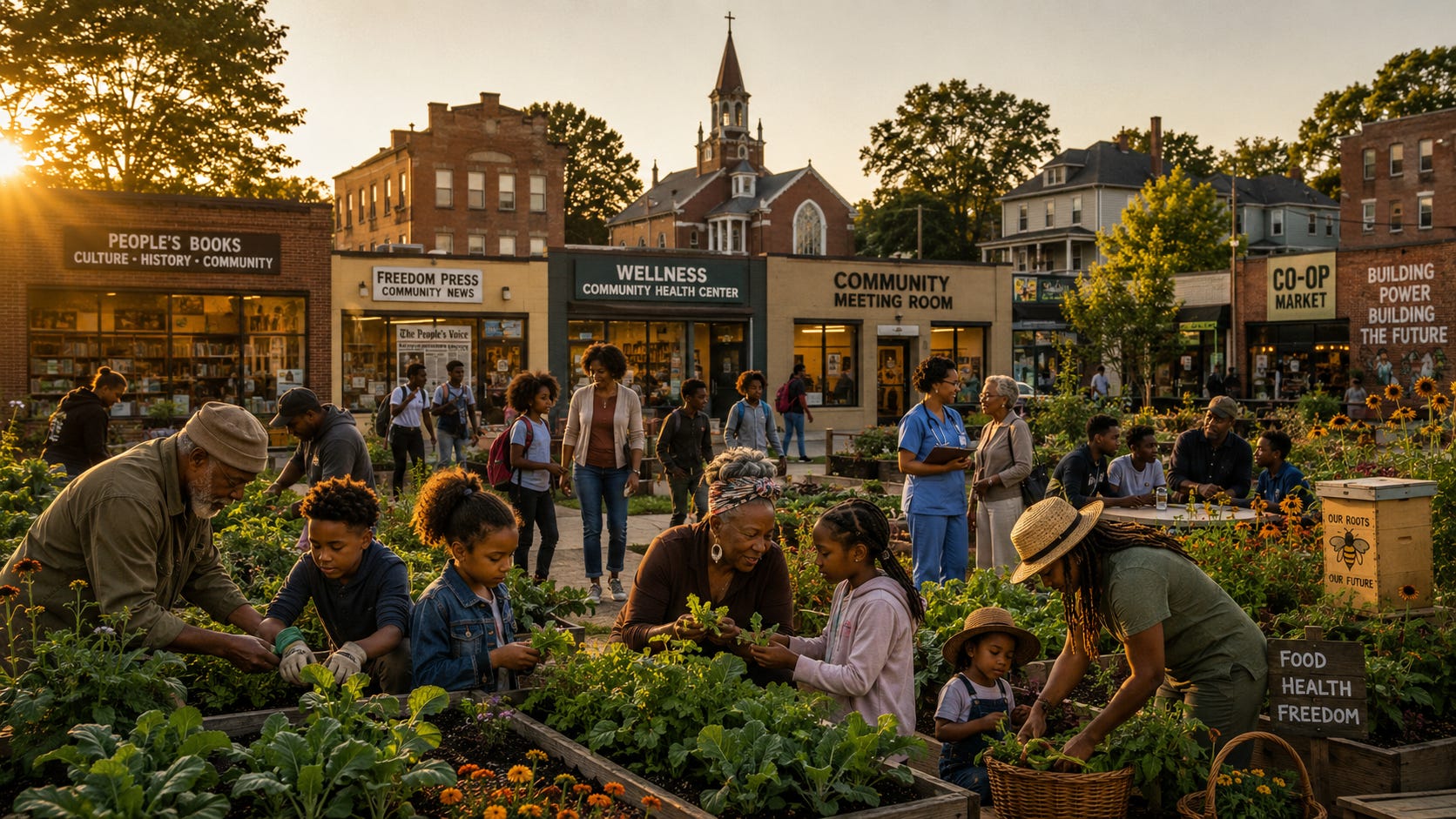
The most important people in our communities are often the least visible. They are not fighting over history; they are creating the future. They mentor young people, organize neighborhoods, establish food programs, build community gardens, preserve cultural memory, reduce violence, create businesses, protect public resources, and strengthen the social fabric one relationship at a time.
Building from the Ground
One such person is my young brother Leo Louis II of Omaha, Nebraska.
Leo has spent decades engaged in community transformation. Long before recognition arrived, he was involved in youth gang intervention, helping young people navigate environments where too many paths led toward incarceration, violence, or despair. He committed himself to building relationships and institutions capable of producing lasting change.
As president of the Malcolm X Memorial Foundation — work recognized with honors including Civic Nebraska’s Adam Morfeld Founder’s Award — he helped guide efforts connecting historical memory to contemporary community needs. The Shabazz Community Garden demonstrated a principle too often overlooked: communities grow stronger when people invest in their own capacity to feed, educate, and sustain themselves.
Many people outside Omaha became familiar with Leo through the documentary My Omaha — a film exploring the city’s racial divisions, social tensions, and competing visions for its future. What makes Leo compelling is not that he presents himself as a heroic figure, but that he remains committed to the hard work of bringing people together while staying rooted in principle.
Today he serves as an educator within the College of Public Health at the University of Nebraska Medical Center, helping prepare future civic leaders to understand the relationship between public health, democracy, and community engagement.
His most enduring act may be this: he helped secure Malcolm X’s induction into the Nebraska Hall of Fame, ensuring that future generations would encounter Malcolm not merely as a contested historical figure but as part of Nebraska’s own living story. That is the kind of work that outlasts the person who does it.
Leo’s story is one of institution-building within a relatively stable community context — patient, cumulative, decades long. Nicole Mitchell’s story is something else: what it looks like to build something with your hands on actual soil, and then be forced to defend it against the logic of extraction.
Building on Contested Ground
Mitchell is one of the most celebrated musicians in contemporary creative music — flutist, composer, Guggenheim fellow, fifteen consecutive years atop Downbeat Magazine’s Critics Poll as Top Flutist of the Year. She has been commissioned by the French Ministry of Culture and the Chicago Symphony. She teaches at the University of Virginia.
Home, for Nicole Mitchell, is Vance County, North Carolina. She did not just choose it. In 2025, she and her family incorporated Heartland Oasis Farms. Chickens. Microgreens. Bees. Her daughter and son-in-law as co-visionaries. Grandchildren growing up on the land.
Then Natelli Holdings arrived. The same developer had retreated from affluent Apex, NC when that community organized. It found smoother ground in a majority-Black, lower-income county.
On April 20, 2026, more than 140 residents packed a commissioners meeting to oppose a data center rezoning. The board chair had scheduled a special called meeting beginning at 4 p.m., before the regular session, where no public comment would be permitted. The vote lasted minutes. The board approved 6-1. A community that had done everything right walked out with nothing.
A hyperscale data center can consume between 300,000 and one million gallons of water per day. During North Carolina summers, that number can reach 2.7 million gallons. Henderson and Vance County combined use approximately four million gallons per day. The farm Mitchell’s family is building depends on the same aquifer. The bees need the same ecosystem.
Mitchell was mid-tour in Europe when the vote happened — six cities in nine days, performing on a new flute while her primary instrument sat in repairs. A flutist of her caliber has a relationship with her instrument that is physiological; every performance on an unfamiliar flute is a negotiation with muscle memory built across decades. Between soundchecks she was on the phone about Vance County. “I’m trying to figure out what I’m coming home to,” she told me.
That same discipline — the patient, embodied practice of tending an instrument across decades — is what she brings to the farm. Both require showing up when the conditions are imperfect. Both are acts of cultivation that only pay out over time.
She came home and organized. On June 9th, Defend Henderson: A Data Center Awareness Event — live music, documentary screening, testimony, a legal roadmap, food sourced locally. Fifty people came. A new network of connections and ideas took shape in that room. The April 20th loss had become the foundation for something the developer had not anticipated: a community that had not conceded.
This is how communities are built. A family. A farm. Fifty people in a room.
What Endures
When I think about the future of Black political organizing, I find myself less interested in who claims a legacy and more interested in who is producing results. Are children safer? Are educational opportunities expanding? Are families healthier? Are neighborhoods stronger? Are people gaining greater control over the conditions that shape their lives?
Those questions matter more than any argument about historical ownership.
The Black Panther Party’s greatest achievement was never its aesthetic — never the leather jackets, the berets, the photographs, or the mythology that later generations would attach to it. The Panthers became significant because they built institutions. Breakfast programs. Health clinics. Political education. Tenant organizing. They were visible and loud, yes — but the visibility served the infrastructure, not the other way around. That is what too many who claim the legacy have reversed.
Communities are transformed not by symbolism but by infrastructure.
The people carrying forward that tradition may never call themselves Panthers. They may never quote Huey Newton, wear a beret, or raise a fist in front of a camera. Many will never attract national attention. They will simply continue doing the steady, often invisible work of making life better for the people around them.
The real heirs to any tradition are not the people who speak most loudly about it. They are the people willing to shoulder its responsibilities.
When the debates have faded and the personalities have been forgotten, what will remain are the lives changed, the institutions built, and the communities made stronger. A garden in Omaha. A farm in Vance County. A room of fifty people who came together and did not leave defeated.
That is the legacy that endures — and the work that still demands to be done.
The struggle is not owned by those who inherit a name. It belongs to those who accept a responsibility.
Floyd Webb is a filmmaker, photographer, and writer based in Chicago. Over the course of fifty years working in film, journalism, publishing, and cultural organizing, he has learned that lasting change rarely comes from personalities alone. It comes from the institutions people build, the communities they sustain, and the knowledge they pass forward.
He is the founder of BlacknussNetwork.com, Blacknuss.tv, and BFMmag.com, platforms dedicated to documenting Black culture, history, cinema, and community life.
Further Reading
Black Against Empire. Black Against Empire: The History and Politics of the Black Panther Party. Berkeley: University of California Press, 2013.
Revolutionary Suicide. Revolutionary Suicide. New York: Harcourt Brace Jovanovich, 1973.
A Taste of Power. A Taste of Power: A Black Woman’s Story. New York: Pantheon Books, 1992.
Waiting ’Til the Midnight Hour. Waiting ’Til the Midnight Hour: A Narrative History of Black Power in America. New York: Henry Holt, 2006.
I’ve Got the Light of Freedom. I’ve Got the Light of Freedom: The Organizing Tradition and the Mississippi Freedom Struggle. Berkeley: University of California Press, 1995.
Collective Courage. Collective Courage: A History of African American Cooperative Economic Thought and Practice. University Park: Pennsylvania State University Press, 2014.
Emergent Strategy. Emergent Strategy: Shaping Change, Changing Worlds. Chico, CA: AK Press, 2017.
Freedom Dreams. Freedom Dreams: The Black Radical Imagination. Boston: Beacon Press, 2002.
The Revolution Will Not Be Funded. The Revolution Will Not Be Funded: Beyond the Non-Profit Industrial Complex. Cambridge, MA: South End Press, 2007.
Pedagogy of the Oppressed. Pedagogy of the Oppressed. New York: Continuum, 1970.
Films
The Black Power Mixtape 1967–1975. Directed by Göran Olsson. Sweden, 2011.
Eyes on the Prize. Created by Henry Hampton. United States, 1987–1990.
My Omaha. Directed by Nick Beaulieu. United States, 2020.
🗣️“Are children safer? Are educational opportunities expanding? Are families healthier? Are neighborhoods stronger? Are people gaining greater control over the conditions that shape their lives?”
🙌🏽
Amen, Floyd.