
Youth Are Essential Infrastructure
What Chicago Proved and We Refused to Build

by Floyd Webb
Researchers at the University of Chicago Crime Lab found that participation in targeted summer employment programs reduced violent-crime arrests among vulnerable youth by roughly 43 percent over a sixteen-month period. A city capable of producing those results is not a city that has failed its young people. It is a city that has already demonstrated that meaningful harm reduction is possible — and a country that has repeatedly refused to scale what works.
This is the version of Chicago that national media coverage rarely lingers on.
Programs combining mentoring, trauma-informed therapy, cognitive behavioral interventions, and intensive outreach have also demonstrated measurable reductions in retaliatory violence, arrests, and school disciplinary incidents. Organizations such as READI Chicago and Cure Violence affiliates have intervened directly in cycles of retaliation before conflicts escalated further into shootings.
These outcomes do not suggest that Chicago has solved youth violence. They establish something more important: violence responds to social investment more reliably than American political culture is comfortable admitting.
That matters because much of the national discussion surrounding youth violence proceeds from the assumption that either nothing works or only punishment works. Chicago’s own evidence points toward a different conclusion. Violence behaves less like an isolated criminal phenomenon than a structural one, shaped by the strength or weakness of the systems surrounding young people.
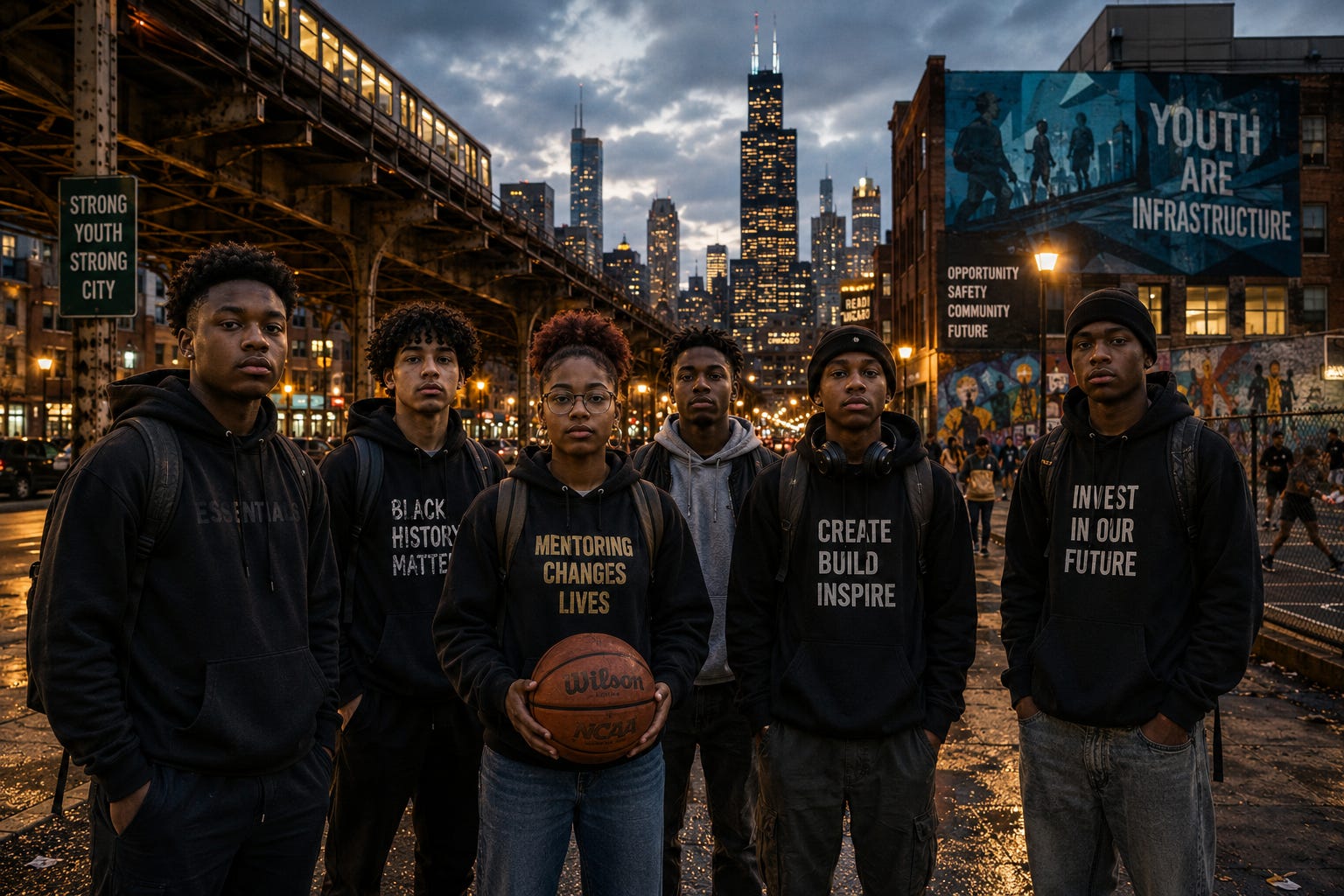
Youth are essential infrastructure.
Not symbolically.
Not rhetorically.
Literally.
A bridge does not merely “help” a city function. It absorbs pressure that, left unmanaged, would disrupt everything connected to it. Youth development systems perform a similar role. They channel adolescent energy, create continuity between generations, absorb social stress before it escalates into violence, and stabilize communities long before policing becomes necessary.
When those systems weaken, disorder spreads outward.
Chicago’s current struggles did not emerge accidentally. They were produced through decades of racialized disinvestment, school closures, housing segregation, deindustrialization, and what urban planners have called planned abandonment concentrated in Black neighborhoods across the city. The 2013 closure of more than fifty public schools, largely in neighborhoods already experiencing deep economic fragmentation, did not simply remove educational spaces. It weakened civic anchors that also functioned as sources of safety, recreation, mentorship, neighborhood continuity, and social attachment.
The erosion of those structures left entire sections of the city navigating intensified fragmentation with fewer institutions capable of absorbing it.
This context is almost entirely absent from the way youth gatherings and violence are commonly discussed in public life.
Instead, media outlets and police agencies increasingly rely on the phrase “teen trends” to describe a wide range of phenomena: flash gatherings, downtown takeovers, fights, coordinated robberies, retaliatory meetups, viral challenges, and crowd formations organized rapidly through social media.
The phrase sounds harmless, even playful. That is part of its political usefulness.
“Teen trends” functions as a containment strategy. It transforms structural breakdown into adolescent spectacle, making systemic fragmentation appear temporary, irrational, and youth-generated rather than rooted in decades of policy decisions. The phrase compresses housing insecurity, economic exclusion, trauma exposure, weakened public institutions, and collapsing neighborhood support systems into the language of trend cycles and youthful impulsiveness.
Once framed this way, the public conversation shifts easily toward punishment while avoiding the deeper conditions producing the disorder itself.
What earlier generations did not face was an information ecosystem built to reward escalation with visibility.
Chicago experienced youth violence long before smartphones existed. What social media changes is the speed, visibility, and scale through which conflict can organize itself publicly. A confrontation that once remained local can now circulate almost instantly through reposts, livestreams, stitched videos, group chats, and recommendation systems designed to reward emotional intensity and engagement. Visibility itself becomes social currency. Gatherings increasingly function not simply as physical events, but as performances for distributed audiences far beyond the participants physically present.
This does not create violence or fragmentation from nothing. It accelerates and amplifies conditions already present on the ground.
And despite all of this, Chicago has still demonstrated that harm can be reduced when stabilizing institutions are funded consistently enough to function.
The problem is not the absence of evidence.
The problem is that the United States continues to fund youth stabilization as though it were an optional social service rather than essential civic infrastructure.
No city debates whether bridges require maintenance.
It funds them or accepts collapse.
The unresolved question is whether the country is prepared to apply that same clarity to the young people whose stability — or disintegration — will determine what kind of city, and ultimately what kind of society, we are actually building.
Floyd Webb is a Chicago-based filmmaker, writer, curator, and founder of the Blacknuss Network. A longtime cultural organizer working at the intersection of cinema, media, technology, and Black social history, Webb founded the Blacklight Film Festival in Chicago in 1982 and has spent decades documenting and exhibiting Black independent and diasporic cinema internationally. His essays and film work explore race, urban life, memory, political culture, and the social consequences of technological and economic transformation
Further Reading
1. Wilson, William Julius. The Truly Disadvantaged: The Inner City, the Underclass, and Public Policy. Chicago: University of Chicago Press, 1987.
A foundational study of concentrated poverty, deindustrialization, and structural inequality in American cities. Wilson’s analysis helps explain how economic abandonment reshaped urban neighborhoods long before contemporary debates about youth violence and “teen trends.”
2. Sharkey, Patrick. Uneasy Peace: The Great Crime Decline, the Renewal of City Life, and the Next War on Violence. New York: W. W. Norton, 2018.
Sharkey argues that reductions in violence in major American cities were tied not only to policing, but to the growth of community organizations, neighborhood institutions, and local violence-prevention systems.
3. Klinenberg, Eric. Palaces for the People: How Social Infrastructure Can Help Fight Inequality, Polarization, and the Decline of Civic Life. New York: Crown, 2018.
Essential for understanding the essay’s central argument that youth systems — schools, parks, libraries, recreation centers, and mentoring spaces — function as forms of social infrastructure critical to civic stability.
4. Hirsch, Arnold R. Making the Second Ghetto: Race and Housing in Chicago, 1940–1960. Chicago: University of Chicago Press, 1983.
A classic history of segregation, housing policy, and racialized urban planning in Chicago. Hirsch documents how policy decisions produced many of the structural conditions that continue shaping the city today.
5. Kotlowitz, Alex. There Are No Children Here: The Story of Two Boys Growing Up in the Other America. New York: Doubleday, 1991.
A landmark portrait of youth, violence, and survival in Chicago public housing communities during the late twentieth century. The book remains essential for understanding the human consequences of structural abandonment.
6. Noble, Safiya Umoja. Algorithms of Oppression: How Search Engines Reinforce Racism. New York: New York University Press, 2018.
Noble’s work provides a framework for understanding how digital systems and algorithmic amplification shape visibility, attention, and social narratives in ways that intensify existing inequalities.
7. University of Chicago Crime Lab. “Summer Jobs Programs and Violence Reduction Research.” Chicago: University of Chicago Crime Lab. Accessed May 7, 2026. University of Chicago Crime Lab
Research documenting measurable reductions in violent-crime arrests among vulnerable youth participating in targeted employment and intervention programs in Chicago. This work provides key empirical grounding for the essay’s argument that violence reduction responds to sustained social investment.